Donna T. Andrew - Böcker
Visar alla böcker från författaren Donna T. Andrew. Handla med fri frakt och snabb leverans.
5 produkter
5 produkter
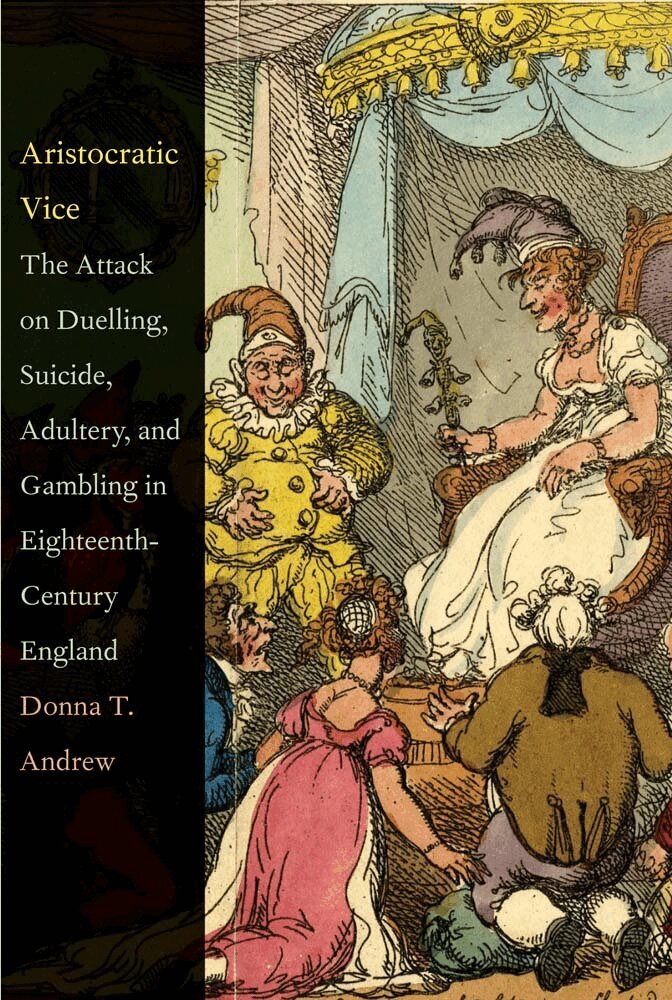
Aristocratic Vice
The Attack on Duelling, Suicide, Adultery, and Gambling in Eighteenth-Century England
Inbunden, Engelska, 2013
913 kr
Skickas inom 5-8 vardagar
Aristocratic Vice examines the outrage against—and attempts to end—the four vices associated with the aristocracy in eighteenth-century England: duelling, suicide, adultery, and gambling. Each of the four, it was commonly believed, owed its origin to pride. Many felt the law did not go far enough to punish those perpetrators who were members of the elite. In this exciting new book, Andrew explores each vice’s treatment by the press at the time and shows how a century of public attacks on aristocratic vices promoted a sense of “class superiority” among the soon-to-emerge British middle class.“Donna Andrew continues to illuminate the mental landscapes of eighteenth-century Britain. . . . No historian of the period has made greater or more effective use of the newspaper press as a source for cultural history than she. This book is evidently the product of a great deal of work and is likely to stimulate further work.”—Joanna Innes, University of Oxford
1 063 kr
Skickas inom 3-6 vardagar
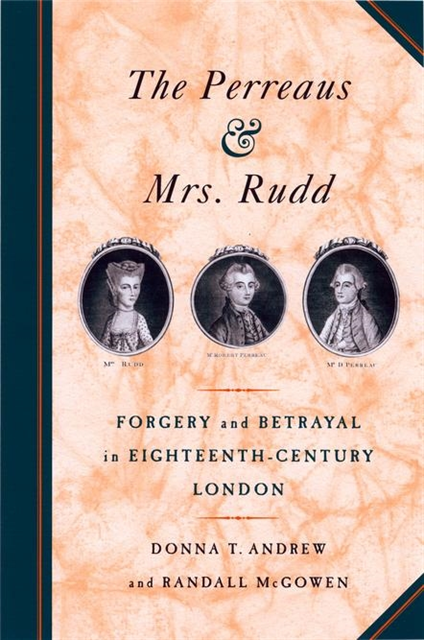
The Perreaus and Mrs. Rudd tells the remarkable story of a complex forgery uncovered in London in 1775. Like the trials of Martin Guerre and O.J. Simpson, the Perreau-Rudd case - filled with scandal, deceit, and mystery - preoccupied a public hungry for sensationalism. Peopled with such familiar figures as John Wilkes, King George III, Lord Mansfield, and James Boswell, this story reveals the deep anxieties of this period of English capitalism. The case acts as a prism that reveals the hopes, fears, and prejudices of that society. Above all, this episode presents a parable of the 1770s, when London was the center of European finance and national politics, of fashionable life and tell-all journalism, of empire achieved and empire lost. The crime, a hanging offense, came to light with the arrest of identical twin brothers, Robert and Daniel Perreau, after the former was detained trying to negotiate a forged bond. At their arraignment they both accused Daniel's mistress, Margaret Caroline Rudd, of being responsible for the crime.The brothers' trials coincided with the first reports of bloodshed in the American colonies at Lexington and Concord and successfully competed for space in the newspapers. From March until the following January, people could talk of little other than the fate of the Perreaus and the impending trial of Mrs. Rudd. The participants told wildly different tales and offered strikingly different portraits of themselves. The press was filled with letters from concerned or angry correspondents. The public, deeply divided over who was guilty, was troubled by evidence that suggested not only that fair might be foul, but that it might not be possible to decide which was which. While the decade of the 1770s has most frequently been studied in relation to imperial concerns and their impact upon the political institutions of the day, this book draws a different portrait of the period, making a cause celebre its point of entry. Exhaustively researched and brilliantly presented, it offers both a vivid panorama of London and a gauge for tracking the shifting social currents of the period.
353 kr
Skickas inom 7-10 vardagar
In this study of voluntary charities in eighteenth-century London, Donna Andrew reconsiders the adequacy of humanitarianism as an explanation for the wave of charitable theorizing and experimentation that characterized this period. Focusing on London, the most visible area of both destitution and social experimentation, this book examines the political as well as benevolent motives behind the great expansion of public institutions--nondenominational organizations seeking not only to relieve hardship, but to benefit the nation directly--funded and run by voluntary associations of citizens. The needs of police, the maintaining of civil order and the refining of society, were thought by many ordinary citizens to be central to the expansion of England's role in the world and to the upholding of the country's peace at home. Drawing on previously unexplored and unsynthesized materials, this work reveals the interaction between charitable theorizing and practical efforts to improve the condition of the poor. The author argues that it is impossible to comprehend eighteenth-century charity without taking into account its perceived social utility, which altered as circumstances mandated.For example, the charities of the 1740s and 1750s, founded to aid in the strengthening of England's international supremacy, lost their public support as current opinions of England's most urgent needs changed. Creating and responding to new visions of what well-directed charities might accomplish, late-century philanthropists tried using charitable institutions to reknit what they believed was a badly damaged social fabric. Originally published in 1989. The Princeton Legacy Library uses the latest print-on-demand technology to again make available previously out-of-print books from the distinguished backlist of Princeton University Press. These editions preserve the original texts of these important books while presenting them in durable paperback and hardcover editions. The goal of the Princeton Legacy Library is to vastly increase access to the rich scholarly heritage found in the thousands of books published by Princeton University Press since its founding in 1905.
1 608 kr
Skickas inom 3-6 vardagar
In this study of voluntary charities in eighteenth-century London, Donna Andrew reconsiders the adequacy of humanitarianism as an explanation for the wave of charitable theorizing and experimentation that characterized this period. Focusing on London, the most visible area of both destitution and social experimentation, this book examines the political as well as benevolent motives behind the great expansion of public institutions--nondenominational organizations seeking not only to relieve hardship, but to benefit the nation directly--funded and run by voluntary associations of citizens. The needs of police, the maintaining of civil order and the refining of society, were thought by many ordinary citizens to be central to the expansion of England's role in the world and to the upholding of the country's peace at home. Drawing on previously unexplored and unsynthesized materials, this work reveals the interaction between charitable theorizing and practical efforts to improve the condition of the poor. The author argues that it is impossible to comprehend eighteenth-century charity without taking into account its perceived social utility, which altered as circumstances mandated.For example, the charities of the 1740s and 1750s, founded to aid in the strengthening of England's international supremacy, lost their public support as current opinions of England's most urgent needs changed. Creating and responding to new visions of what well-directed charities might accomplish, late-century philanthropists tried using charitable institutions to reknit what they believed was a badly damaged social fabric. Originally published in 1989. The Princeton Legacy Library uses the latest print-on-demand technology to again make available previously out-of-print books from the distinguished backlist of Princeton University Press. These editions preserve the original texts of these important books while presenting them in durable paperback and hardcover editions. The goal of the Princeton Legacy Library is to vastly increase access to the rich scholarly heritage found in the thousands of books published by Princeton University Press since its founding in 1905.
757 kr
Skickas inom 7-10 vardagar
A collection of advertisements placed by the flourishing London debating societies of the late eighteenth century in the most popular London newspapers.London in the first decades of the eighteenth century was already rich in a variety of public entertainments. In addition to the theatres and shows, to the coffee houses and inns, there was a series of forums in which people came together to listen to and participate in conversation. By the 1770s, these private or semi-private clubs or societies increased in size and number in the metropolis, as gripping political and religious issues seized the interests and imaginations of Londoners.In 1780 these now enlarged clubs were transformed into large-scale, commercial events, whose managers used the publicity that the burgeoning press sold to advertise their topics of debate, to rouse and create a paying public for such debates, and to combine an expanding interest in public speaking with the respectable pursuit of profit.