Douglas E Nash – författare
Visar alla böcker från författaren Douglas E Nash. Handla med fri frakt och snabb leverans.
5 produkter
5 produkter
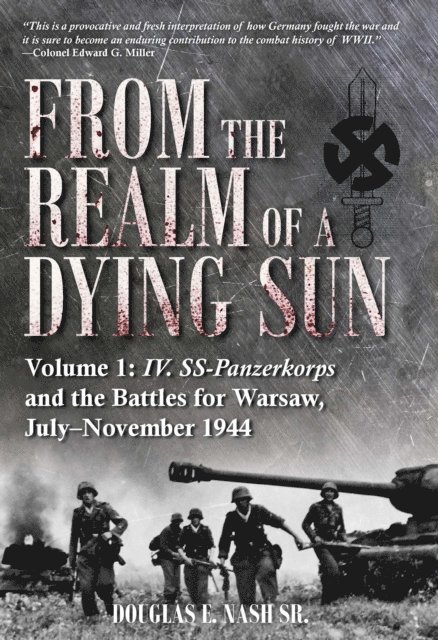
From the Realm of a Dying Sun
IV. SS-Panzerkorps and the Battles for Warsaw, July–November 1944 (Volume I)
Inbunden, Engelska, 2020
318 kr
Tillfälligt slut
During World War Two, the armed or Waffen-SS branch of the Third Reich’s dreaded security service expanded from two divisions in 1940 to 38 divisions by the end of the war, eventually growing to a force of over 900,000 men until Germany’s defeat in May 1945. Not satisfied with allowing his nascent force to be commanded in combat by army headquarters of the Wehrmacht, Heinrich Himmler, chief of the SS, began to create his own SS corps and army headquarters beginning with the SS-Panzerkorps in July 1942. As the number of Waffen-SS divisions increased, so did the number of corps headquarters, with 18 corps and two armies being planned or activated by the war’s end. While the histories of the first three SS corps are well known, the IV SS-Panzerkorps – which never fought in the west or in Berlin but participated in many of the key battles fought on the Eastern Front during the last year of the war – has been overlooked. Activated during the initial stages of the defence of Warsaw in late July 1944, the corps, consisting of both the 3. and 5. SS-Panzer Divisions (Totenkopf and Wiking, respectively) was born in battle and spent the last ten months of the war in combat, figuring prominently in the battles of Warsaw, the attempted Relief of Budapest, Operation Spring Awakening, the defence of Vienna, and the withdrawal into Austria where it finally surrendered to American forces in May 1945. Herbert Otto Gille’s IV SS-Panzerkorps was renowned for its tenacity, high morale and, above all, its lethality, whether conducting a hard-hitting counterattack or a stubborn defense in situations where its divisions were hopelessly outnumbered. Often embroiled in heated disputes with its immediate Wehrmacht higher headquarters over his seemingly cavalier conduct of operations, Gille’s corps remained to the bitter end one of the Third Reich’s most reliable and formidable field formations.
From the Realm of a Dying Sun. Volume 2
Volume II: The IV. SS-Panzerkorps in the Budapest Relief Efforts, December 1944-February 1945
Inbunden, Engelska, 2020
318 kr
Skickas
On Christmas Eve 1944, the men of the IV SS-Panzerkorps were preparing to celebrate the occasion as best they could. Taking advantage of the pause in the fighting around Warsaw, they looked forward to partaking in that most German of holidays, including the finest Christmas dinner their field kitchens could still prepare in this fifth year of the war. They had earned it too; after five months of unrelenting combat and the loss of many of their friends, troops from the corps headquarters, headquarters troops, and its two divisions - the 3rd SS Panzer Division “Totenkopf” and the 5th SS Panzer Division “Wiking” - were eagerly anticipating what the holiday would bring, including presents from home and perhaps sharing a bottle of schnapps or wine with their comrades. This was not to be, for that very evening, the corps commander, SS-Obergruppenführer Herbert Otto Gille, received a telephone call notifying him that the 35,000 men of his corps would begin boarding express trains the following day that would take them from the relative quiet of the Vistula Front to the front lines in Hungary, hundreds of kilometers away. Their mission: Relieve Budapest! Thus would begin the final round in the saga of the IV SS-Panzerkorps. In Hungary, it would play a key role in the three attempts to raise the siege of that fateful city. Threatened as much by their high command as by the forces of the Soviet Union, Gille and his troops overcame seemingly insurmountable obstacles in their attempts to rescue the city’s garrison, only to have their final attack called off at the last minute. At that moment, they were only a few kilometers away from the objective towards which they had striven for nearly a month. After the relief attempt’s failure sealed the fate of hundreds of thousands of Hungarians and Germans, the only course of action remaining was to dig in and protect the Hungarian oilfields as long as possible.
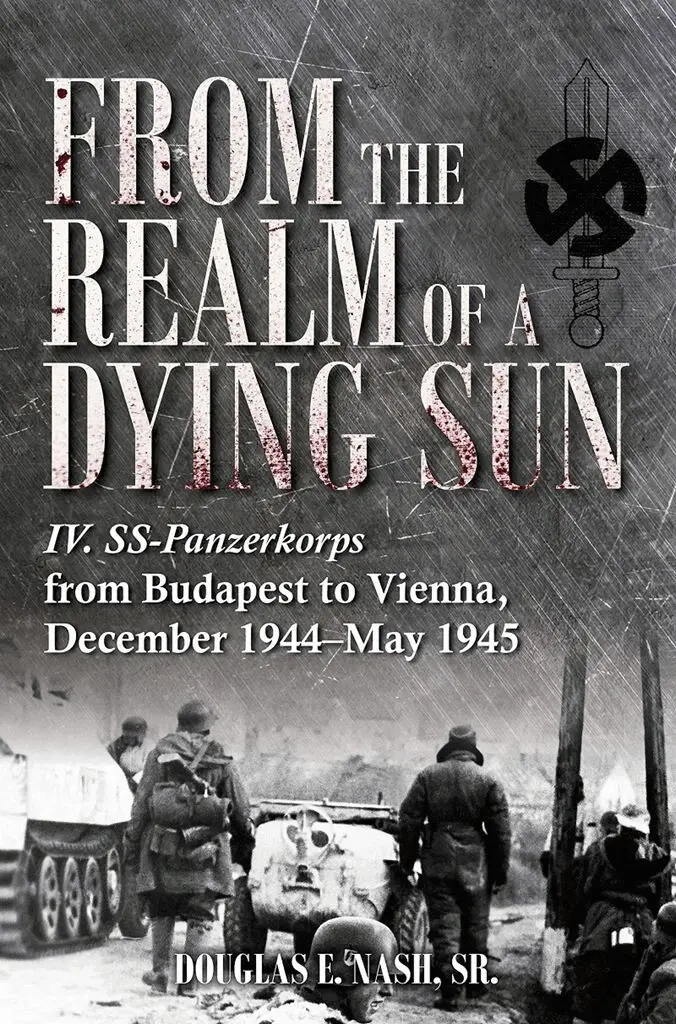
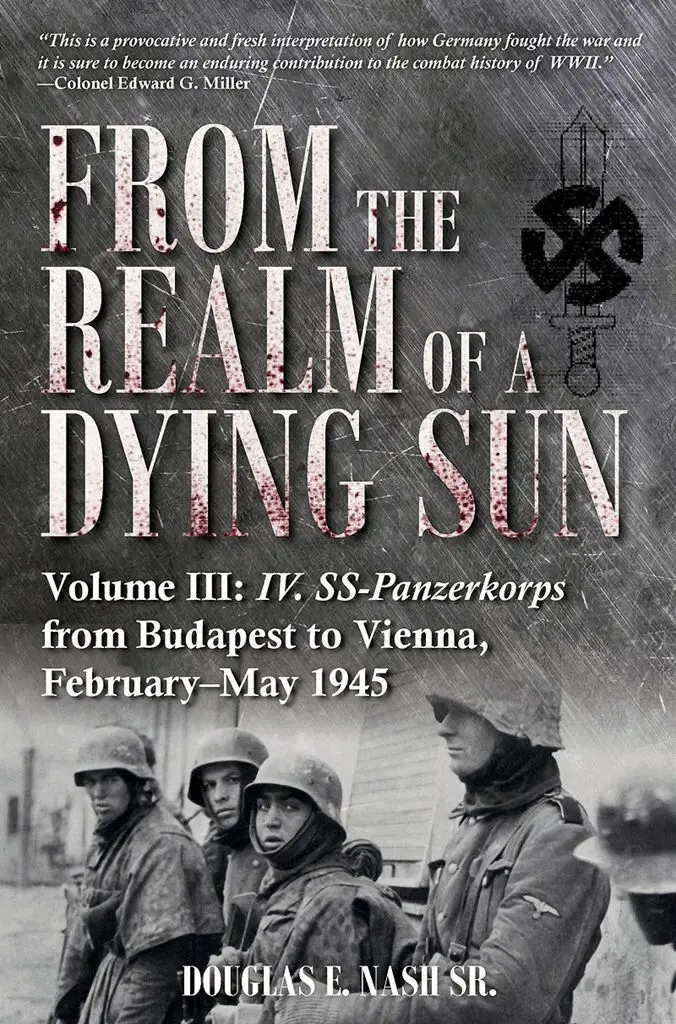
From the Realm of a Dying Sun. Volume 3
IV. SS-Panzerkorps from Budapest to Vienna, February-May 1945
Inbunden, Engelska, 2021
318 kr
Skickas
In the closing months of World War II, with Budapest’s fall on 12 February 1945 and the breakout attempt by the IX SS-Gebirgskorps having failed, the only thing the IV. SS-Panzerkorps could do was fall back to a more defensible line and fortify the key city of Stuhlweissenburg. Exhausted after three relief attempts in January 1945 and outnumbered by the ever-increasing power of Marshal Tolbukhin’s Third Ukrainian Front, SS-Obergruppenführer Gille’s veterans dug in for a lengthy period of defensive warfare. However, Adolf Hitler had not forgotten about the Hungarian theatre of operations nor the country’s rich oilfields and was sending help. To the detriment of the defence of Berlin, SS-Oberstgruppenführer Sepp Dietrich’s legendary 6. Panzerarmee was on its way, not to retake Budapest, but to encircle and destroy Tolbukhin’s forces and completely reverse the situation in south-eastern Europe in Hitler’s favour. This overly ambitious offensive, known as Frühlingserwachen (Spring Awakening), was soon bogged down in the face of resolute Soviet defences aided by the springtime thaw. Heralded as Nazi Germany’s last great offensive of World War II, it resulted in great losses to Hitler’s last armoured reserve in exchange for only minor gains. Though it played a supporting role during the battle, the IV. SS-Panzerkorps was soon caught up in its aftermath, after the Red Army launched its Vienna Operation that nearly swept the armies of Heeresgruppe Süd from the battlefield. Withdrawing into Austria, Gille’s battered corps attempted to bar the route into Germany, while the Red Army bore down on Vienna. Forced to endure relentless Soviet attacks as well as the caustic leadership of the 6. Armee commander, General Hermann Balck, the men of the IV. SS-Panzerkorps fought their way through Austria to reach the safety of the demarcation line where it finally surrendered to U.S. forces on 9 May 1945 after nearly a year of relentless campaigning.
Victory Was Beyond Their Grasp
With the 272nd Volks-Grenadier Division from the Huertgen Forest to the Heart of the Reich
Häftad, Engelska, 2021
214 kr
Skickas
As the Allies were approaching the German frontier at the beginning of September 1944, the German Armed Forces responded with a variety of initiatives designed to regain the strategic initiative. While the "Wonder Weapons" such as the V-1 flying bomb, the V-2 missile and the Messerschmitt Me-262 jet fighter are widely recognized as being the most prominent of these initiatives upon which Germany pinned so much hope, the Volks-Grenadier Divisions (VGDs) are practically unknown. Often confused with the Volkssturm, the Home Guard militia, VGDs have suffered the undeserved reputation as second-rate formations, filled with young boys and old men suited to serve only as cannon fodder. This groundbreaking book, now reappearing as a new edition, shows that VGDs were actually conceived as a new, elite corps loyal to the National Socialist Party composed of men from all branches of Hitler's Wehrmacht and equipped with the finest ground combat weapons available.Whether fighting from defensive positions or spearheading offensives such as the Battle of the Bulge, VGDs initially gave a good account of themselves in battle. Using previously unpublished unit records, Allied intelligence and interrogation reports and above all interviews with survivors, the author has crafted an in-depth look at a late-war German infantry company, including many photographs from the veterans themselves. In this book we follow along with the men of the 272nd VGD's Fusilier Company from their first battles in the Huertgen Forest to their final defeat in the Harz Mountains. Along the way we learn the enormous potential of VGDs . . . and feel their soldiers' heartbreak at their failure.Among Douglas Nash's previous works is Hell's Gate: The Battle for the Cherkassy Pocket, January-February 1944, a work unsurpassed for insight into the other side of the hill in WWII.
From the Realm of a Dying Sun
Volume I - IV. SS-Panzerkorps and the Battles for Warsaw, July–November 1944
Häftad, Engelska, 2024
240 kr
Skickas
A detailed account of Herbert Otto Gille’s IV SS-Panzerkorps that participated in many of the key battles fought on the Eastern Front during the last year of WWII.During World War Two, the armed or Waffen-SS branch of the Third Reich’s dreaded security service expanded from two divisions in 1940 to 38 divisions by the end of the war, eventually growing to a force of over 900,000 men until Germany’s defeat in May 1945\. Not satisfied with allowing his nascent force to be commanded in combat by army headquarters of the Wehrmacht, Heinrich Himmler, chief of the SS, began to create his own SS corps and army headquarters beginning with the SS-Panzerkorps in July 1942\. As the number of Waffen-SS divisions increased, so did the number of corps headquarters, with 18 corps and two armies being planned or activated by the war’s end.The histories of the first three SS corps are well known – the actions of I, II, and III (Germanic) SS-Panzerkorps and their subordinate divisions, including the Leibstandarte SS Adolf Hitler, Das Reich, Hitlerjugend, Hohenstaufen, Frundsberg and Nordland divisions, have been thoroughly documented and publicized. Overlooked in this pantheon is another SS corps that never fought in the west or in Berlin but one that participated in many of the key battles fought on the Eastern Front during the last year of the war – the IV SS-Panzerkorps. Activated during the initial stages of the defense of Warsaw in late July 1944, the corps, consisting of both the 3\. and 5\. SS-Panzer Divisions (Totenkopf and Wiking, respectively) was born in battle and spent the last ten months of the war in combat, figuring prominently in the battles of Warsaw, the attempted Relief of Budapest, Operation Spring Awakening, the defense of Vienna, and the withdrawal into Austria where it finally surrendered to U.S. forces in May 1945.Herbert Otto Gille’s IV SS-Panzerkorps was renowned for its tenacity, high morale and, above all, its lethality, whether conducting a hard-hitting counterattack or a stubborn defense in situations where its divisions were hopelessly outnumbered. Often embroiled in heated disputes with its immediate Wehrmacht higher headquarters over his seemingly cavalier conduct of operations, Gille’s corps remained to the bitter end one of the Third Reich’s most reliable and formidable field formations.