Douglas Frye – författare
Visar alla böcker från författaren Douglas Frye. Handla med fri frakt och snabb leverans.
5 produkter
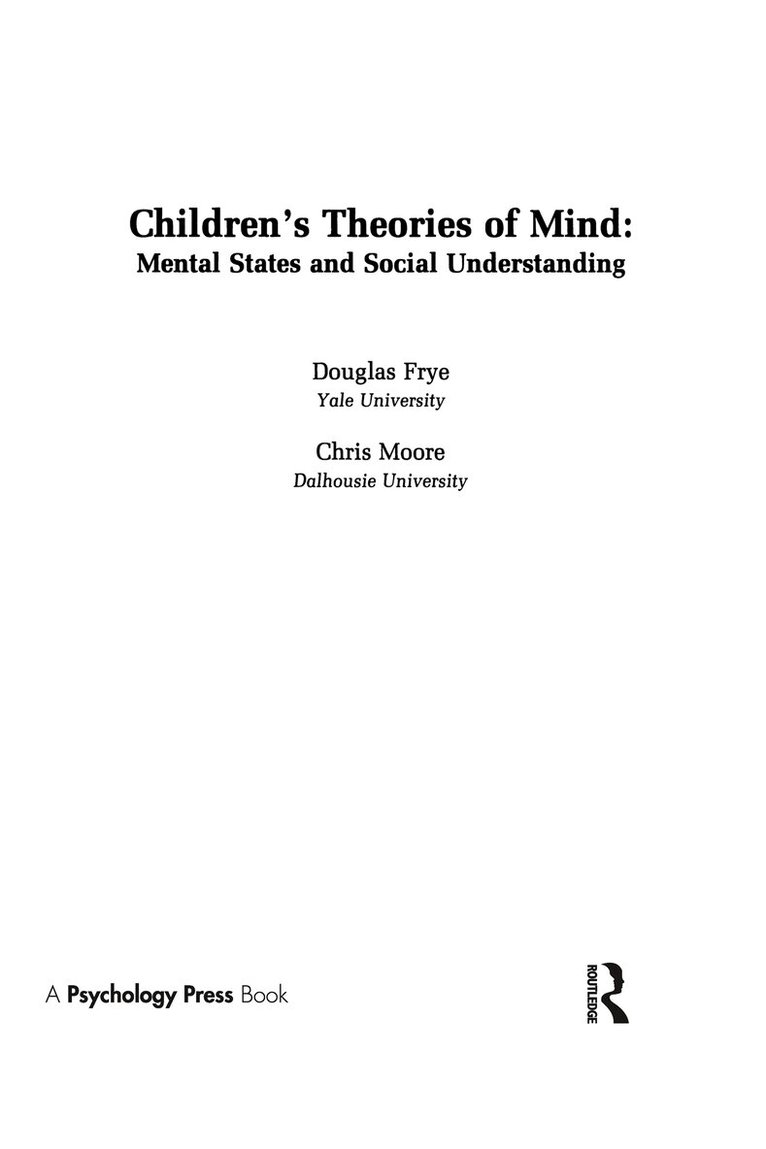
Children's Theories of Mind
Mental States and Social Understanding
Inbunden, 1991
2441 kr
Lägg i varukorg
This book is a result of a study group that met to discuss the child's theory of mind. A topic whose effects span cognitive, language, and social development, it may bring a unifying influence to developmental psychology. New studies in this area acknowledge children's conceptions of intention and …
Children's Theories of Mind
Mental States and Social Understanding
Häftad, 1991
763 kr
Lägg i varukorg
This book is a result of a study group that met to discuss the child's theory of mind. A topic whose effects span cognitive, language, and social development, it may bring a unifying influence to developmental psychology. New studies in this area acknowledge children's conceptions of intention and …
Children's Theories of Mind
Mental States and Social Understanding
E-bok, 2014
692 kr
Lägg i varukorg
This book is a result of a study group that met to discuss the child''s theory of mind. A topic whose effects span cognitive, language, and social development, it may bring a unifying influence to developmental psychology. New studies in this area acknowledge children''s conceptions of intention …
Children's Theories of Mind
Mental States and Social Understanding
E-bok, 2014
707 kr
Lägg i varukorg
This book is a result of a study group that met to discuss the child''s theory of mind. A topic whose effects span cognitive, language, and social development, it may bring a unifying influence to developmental psychology. New studies in this area acknowledge children''s conceptions of intention …
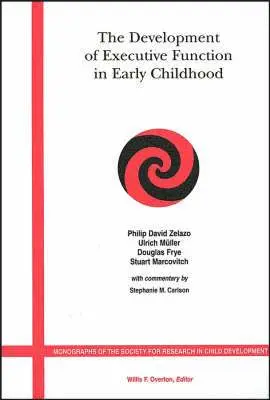
Development of Executive Function in Early Childhood
Av Philip David Zelazo, Ulrich Muller m. fl.
Häftad, 2000
552 kr
Lägg i varukorg
This monograph concerns the psychological processes underlying the development of executive function, or the conscious control of thought and action. It has long been clear that these processes change considerably in early childhood, transforming a relatively stimulus-driven toddler into a child …