Douglas Lemke - Böcker
Visar alla böcker från författaren Douglas Lemke. Handla med fri frakt och snabb leverans.
5 produkter
5 produkter
1 456 kr
Skickas inom 3-6 vardagar
When states die, there are massive consequences for neighboring states and sometimes for the entire international system. Somalia's death in 1991 created a safe haven for criminal non-state actors and has unsettled the Horn of Africa for decades. When the Iraqi state was dismantled in 2003, a similar set of consequences plagued the Middle East and the international system more broadly.In How States Die, Douglas Lemke provides a rigorous analysis of this phenomenon by reconceptualizing the definitions of the state and state death. A state exists, according to Lemke, whenever a set of state-like political entities exercise control over a populated territory. This includes both sovereign states and "territorial contenders," which lack formal diplomatic recognition. Conceiving statehood in this way vastly increases the population of states that have experienced state death, which casts new light on the entire phenomenon. This increased range not only expands the list of ways states can die; it also provides insights into whether diplomatic recognition is associated with longer life and shows that state strength is not related to state death. Similarly, in contrast to the conventional wisdom, victories in conflict do not coincide with longer state survival. State death is one of the central questions within international relations, and Lemke's reformulation of what a state is will transform our understanding of how and why these deaths happen.
497 kr
Skickas inom 3-6 vardagar
When states die, there are massive consequences for neighboring states and sometimes for the entire international system. Somalia's death in 1991 created a safe haven for criminal non-state actors and has unsettled the Horn of Africa for decades. When the Iraqi state was dismantled in 2003, a similar set of consequences plagued the Middle East and the international system more broadly.In How States Die, Douglas Lemke provides a rigorous analysis of this phenomenon by reconceptualizing the definitions of the state and state death. A state exists, according to Lemke, whenever a set of state-like political entities exercise control over a populated territory. This includes both sovereign states and "territorial contenders," which lack formal diplomatic recognition. Conceiving statehood in this way vastly increases the population of states that have experienced state death, which casts new light on the entire phenomenon. This increased range not only expands the list of ways states can die; it also provides insights into whether diplomatic recognition is associated with longer life and shows that state strength is not related to state death. Similarly, in contrast to the conventional wisdom, victories in conflict do not coincide with longer state survival. State death is one of the central questions within international relations, and Lemke's reformulation of what a state is will transform our understanding of how and why these deaths happen.
445 kr
Skickas inom 7-10 vardagar
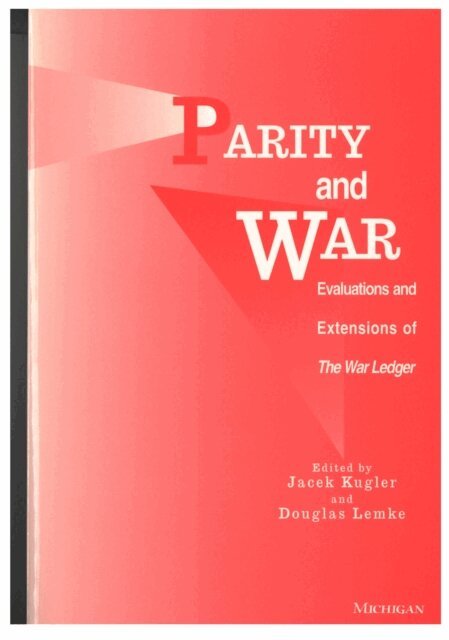
Parity and War is an impressive explanation of why peace predominates in the international arena and why, on occasion, wars do start. Useful for college students and scholars alike, the work scrutinzes and tests ideas about power preponderance, first discussed over a decade ago in the widely acclaimed book The War Ledger. An alternative to traditional realism, power preponderence contends that peace is preserved when a preponderant nation supports the status quo. The theory convincingly accounts for war initiation, recovery, and peace by analyzing military arms buildups, alliances, territorial threats, economic cycles, and nuclear environment deterrence and proliferation. The contributors to this volume examine and analyze cases as diverse as the peaceful collapse of the Soviet Union, the presence of interstate war in South America in the last century and the absence thereof--despite domestic war--in this century, the economic and political consequences of the American Civil War, and the observation of long-term patterns of conflict and peace in international relations. Moreover, contributors to Parity and War utilize game theory, expected utility, and differential calculus techniques to model major war and to formalize the originally intuitive propositions of power preponderance. Their timely research shows that, in this era of nuclear weapons dominated by a single super power, effective regime guidance by the United States can insure peace for the next century. Contributors include Arina Arbetman, Bruce Bueno de Mesquita, Vesna Danilovic, Daniel S. Geller, Kenk W. Houweling, Kelly M. Kadera, Woosang Kim, Jacek Kugler, Douglas Lemke, Ross A. Miller, James D. Morrow, A. F. K. Organski, Jan G. Siccama, Randoph M. Siverson, Ronald Tammen, William R. Thompson, John A. Vasquez, Frank Whelon Wayman, Suzanne Werner, and Frank C. Zagare.
428 kr
Skickas inom 7-10 vardagar
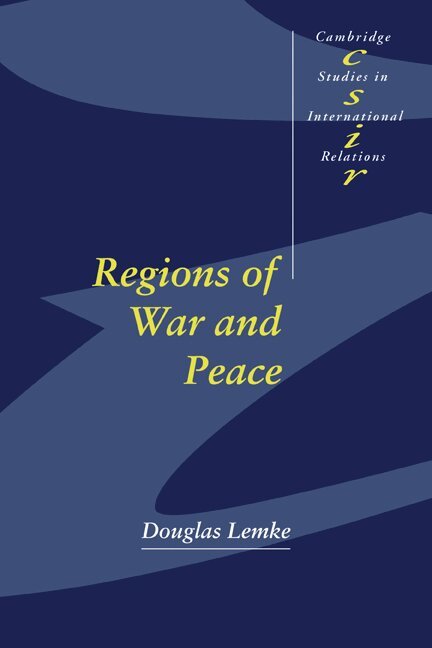
In this contribution to the literature on the causes of war, Douglas Lemke asks whether the same factors affect minor powers as affect major ones. He investigates whether power parity and dissatisfaction with the status quo have an impact within Africa, the Far East, the Middle East and South America. Lemke argues that there are similarities across these regions and levels of power, and that parity and dissatisfaction are correlates of war around the world. The extent to which they increase the risk of war varies across regions, however, and the book looks at the possible sources of this cross-regional variation, concluding that differential progress toward development is the likely cause. This book will interest students and scholars of international relations and peace studies, as well as comparative politics and area studies.
Del 80 - Cambridge Studies in International Relations
Regions of War and Peace
Inbunden, Engelska, 2002
1 192 kr
Skickas inom 7-10 vardagar
In this contribution to the literature on the causes of war, Douglas Lemke asks whether the same factors affect minor powers as affect major ones. He investigates whether power parity and dissatisfaction with the status quo have an impact within Africa, the Far East, the Middle East and South America. Lemke argues that there are similarities across these regions and levels of power, and that parity and dissatisfaction are correlates of war around the world. The extent to which they increase the risk of war varies across regions, however, and the book looks at the possible sources of this cross-regional variation, concluding that differential progress toward development is the likely cause. This book will interest students and scholars of international relations and peace studies, as well as comparative politics and area studies.