Douglas O. Linder – författare
Visar alla böcker från författaren Douglas O. Linder. Handla med fri frakt och snabb leverans.
6 produkter
6 produkter
Inbunden, Engelska, 2010
274 kr
Skickas inom 3-6 vardagar
Despite the handsome incomes they often command, lawyers are far from the happiest of professionals. Seven in ten attorneys in one poll said they would choose other careers if they had to do it over again and, in another poll, fewer than half said they would encourage young people to become lawyers. Indeed, no poll has ever put the law in the top tier of satisfying professions. The economic uncertainty of recent years has only made law students and lawyers think harder than ever before about what they can hope to get out of careers in law.This book not only sheds light on why so many lawyers find so little to like about their jobs, but also explores what they can do about the problem. Drawing on recent psychological research on happiness, Nancy Levit and Douglas Linder highlight various factors that contribute to professional stress and frustration--from pressure to increase the number of billable hours to discontents that occur when the job's demands fail to mesh with a lawyer's personal values or aspirations. They offer an array of coping tools, both large and small, that will help attorneys find more balance in their lives; they also suggest ways that law firms can be more flexible to accommodate their employees' needs, thus boosting morale and, in the process, producing higher-quality work. The authors also show how law students can better define their goals to ensure a satisfying career.Having interviewed more than two hundred lawyers across the country, Levit and Linder enliven their account with engrossing--and sometimes surprising--career stories from both happy and unhappy lawyers. From these stories they develop sensible solutions for lawyers and the legal profession as a whole. Attorneys and law students with doubts or questions about their career choices will find a wealth of reassurance and good advice in this book.
Inbunden, Engelska, 2014
302 kr
Skickas inom 3-6 vardagar
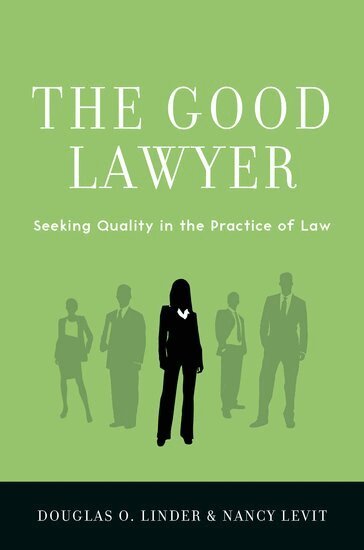
Every lawyer wants to be a good lawyer. They want to do right by their clients, contribute to the professional community, become good colleagues, interact effectively with people of all persuasions, and choose the right cases. All of these skills and behaviors are important, but they spring from hard-to-identify foundational qualities necessary for good lawyering. After focusing for three years on getting high grades and sharpening analytical skills, far too many lawyers leave law school without a real sense of what it takes to be a good lawyer.In The Good Lawyer, a follow up to their book The Happy Lawyer, law professors Douglas O. Linder and Nancy Levit combine evidence from the latest social science research with numerous engaging accounts of able attorneys at work to explain just what makes a good lawyer. They organize the book around the qualities they see as crucial: courage, empathy, integrity, realism, a strong sense of justice, clarity of purpose, and an ability to transcend emotionalism. But as the authors point out, each one must be apportioned in the right measure, and achieving the right balance is difficult. Lawyers need to know when to empathize and also when to detach; courage without an appreciation of consequences becomes recklessness. And what do you do in tricky situations, where the urge to deceive is high? How can you maintain focus through a mind-taxing (or mind-numbing) project? Every lawyer faces these problems at some point -- they're inherent in the nature of the work-but if properly recognized and approached, they can be overcome. It's not easy being good -- quality is less something one grasps and hangs onto than a goal that requires constant striving and attention -- but this engaging guide will serve as a handbook for any lawyer trying not only to figure out how to respond to difficult situations, but how to become a better -- meaning both more competent and more virtuous -- lawyer.
E-bok
PDF, Engelska, 2014246 kr
Läs direkt efter köp
Every lawyer wants to be a good lawyer. They want to do right by their clients, contribute to the professional community, become good colleagues, interact effectively with people of all persuasions, and choose the right cases. All of these skills and behaviors are important, but they spring from hard-to-identify foundational qualities necessary for good lawyering. After focusing for three years on getting high grades and sharpening analytical skills, far too many lawyers leave law school without a real sense of what it takes to be a good lawyer.In The Good Lawyer, Douglas O. Linder and Nancy Levit combine evidence from the latest social science research with numerous engaging accounts of top-notch attorneys at work to explain just what makes a good lawyer. They outline and analyze several crucial qualities: courage, empathy, integrity, diligence, realism, a strong sense of justice, clarity of purpose, and an ability to transcend emotionalism. Many qualities require apportionment in the right measure, and achieving the right balance is difficult. Lawyers need to know when to empathize and also when to detach; courage without an appreciation of consequences becomes recklessness; working too hard leads to exhaustion and mistakes. And what do you do in tricky situations, where the urge to deceive is high? How can you maintain focus through a mind-taxing (or mind-numbing) project? Every lawyer faces these problems at some point, but if properly recognized and approached, they can be overcome. It''s not easy being good, but this engaging guide will serve as a handbook for any lawyer trying not only to figure out how to become a better--and, almost always, more fulfilled--lawyer.
E-bok
Engelska, 2014237 kr
Läs direkt efter köp
Every lawyer wants to be a good lawyer. They want to do right by their clients, contribute to the professional community, become good colleagues, interact effectively with people of all persuasions, and choose the right cases. All of these skills and behaviors are important, but they spring from hard-to-identify foundational qualities necessary for good lawyering. After focusing for three years on getting high grades and sharpening analytical skills, far too many lawyers leave law school without a real sense of what it takes to be a good lawyer.In The Good Lawyer, Douglas O. Linder and Nancy Levit combine evidence from the latest social science research with numerous engaging accounts of top-notch attorneys at work to explain just what makes a good lawyer. They outline and analyze several crucial qualities: courage, empathy, integrity, diligence, realism, a strong sense of justice, clarity of purpose, and an ability to transcend emotionalism. Many qualities require apportionment in the right measure, and achieving the right balance is difficult. Lawyers need to know when to empathize and also when to detach; courage without an appreciation of consequences becomes recklessness; working too hard leads to exhaustion and mistakes. And what do you do in tricky situations, where the urge to deceive is high? How can you maintain focus through a mind-taxing (or mind-numbing) project? Every lawyer faces these problems at some point, but if properly recognized and approached, they can be overcome. It''s not easy being good, but this engaging guide will serve as a handbook for any lawyer trying not only to figure out how to become a better--and, almost always, more fulfilled--lawyer.
E-bok
PDF, Engelska, 2010190 kr
Läs direkt efter köp
You get good grades in college, pay a small fortune to put yourself through law school, study hard to pass the bar exam, and finally land a high-paying job in a prestigious firm. You''re happy, right? Not really. Oh, it beats laying asphalt, but after all your hard work, you expected more from your job. What gives?The Happy Lawyer examines the causes of dissatisfaction among lawyers, and then charts possible paths to happier and more fulfilling careers in law. Eschewing a one-size-fits-all approach, it shows how maximizing our chances for achieving happiness depends on understanding our own personality types, values, strengths, and interests.Covering everything from brain chemistry and the science of happiness to the workings of the modern law firm, Nancy Levit and Doug Linder provide invaluable insights for both aspiring and working lawyers. For law students, they offer surprising suggestions for selecting a law school that maximizes your long-term happiness prospects. For those about to embark on a legal career, they tell you what happiness research says about which potential jobs hold the most promise. For working lawyers, they offer a handy toolbox--a set of easily understandable steps--that can boost career happiness. Finally, for firm managers, they offer a range of approaches for remaking a firm into a more satisfying workplace.Read this book and you will know whether you are more likely to be a happy lawyer at age 30 or age 60, why you can tell a lot about a firm from looking at its walls and windows, whether a 10 percent raise or a new office with a view does more for your happiness, and whether the happiness prospects are better in large or small firms. No book can guarantee a happier career, but for lawyers of all ages and stripes, The Happy Lawyer may give you your best shot.
E-bok
Engelska, 2010142 kr
Läs direkt efter köp
You get good grades in college, pay a small fortune to put yourself through law school, study hard to pass the bar exam, and finally land a high-paying job in a prestigious firm. You''re happy, right? Not really. Oh, it beats laying asphalt, but after all your hard work, you expected more from your job. What gives?The Happy Lawyer examines the causes of dissatisfaction among lawyers, and then charts possible paths to happier and more fulfilling careers in law. Eschewing a one-size-fits-all approach, it shows how maximizing our chances for achieving happiness depends on understanding our own personality types, values, strengths, and interests.Covering everything from brain chemistry and the science of happiness to the workings of the modern law firm, Nancy Levit and Doug Linder provide invaluable insights for both aspiring and working lawyers. For law students, they offer surprising suggestions for selecting a law school that maximizes your long-term happiness prospects. For those about to embark on a legal career, they tell you what happiness research says about which potential jobs hold the most promise. For working lawyers, they offer a handy toolbox--a set of easily understandable steps--that can boost career happiness. Finally, for firm managers, they offer a range of approaches for remaking a firm into a more satisfying workplace.Read this book and you will know whether you are more likely to be a happy lawyer at age 30 or age 60, why you can tell a lot about a firm from looking at its walls and windows, whether a 10 percent raise or a new office with a view does more for your happiness, and whether the happiness prospects are better in large or small firms. No book can guarantee a happier career, but for lawyers of all ages and stripes, The Happy Lawyer may give you your best shot.