Dov M. Gabbay – författare
Visar alla böcker från författaren Dov M. Gabbay. Handla med fri frakt och snabb leverans.
203 produkter
Greek, Indian and Arabic Logic
Inbunden, 2004
2398 kr
Lägg i varukorg
Greek, Indian and Arabic Logic marks the initial appearance of the multi-volume Handbook of the History of Logic. Additional volumes will be published when ready, rather than in strict chronological order. Soon to appear are The Rise of Modern Logic: From Leibniz to Frege. Also in preparation are …
Handbook of Logic in Computer Science: Volume 1. Background: Mathematical Structures
Av S. Abramsky, Dov M. Gabbay m. fl.
Inbunden, 1992
7014 kr
Lägg i varukorg
The Handbook of Logic in Computer Science is a multi-volume work covering all major areas of application of logic to theoretical computer science. The Handbook comprises six volumes. Each volume contains five or six chapters, giving an in-depth overview of one of the major topics in the field. It …
Practical Logic of Cognitive Systems
The Reach of Abduction: Insight and Trial
E-bok, 2005
2217 kr
Lägg i varukorg
The present work is a continuation of the authors'' acclaimed multi-volume APractical Logic of Cognitive Systems. After having investigated the notion ofrelevance in their previous volume, Gabbay and Woods now turn to abduction. Inthis highly original approach, abduction is construed as …
Logic and the Modalities in the Twentieth Century
E-bok, 2006
2852 kr
Lägg i varukorg
Logic and the Modalities in the Twentieth Century is an indispensable research tool for anyone interested in the development of logic, including researchers, graduate and senior undergraduate students in logic, history of logic, mathematics, history of mathematics, computer science and artificial …
Greek, Indian and Arabic Logic
E-bok, 2004
2363 kr
Lägg i varukorg
Greek, Indian and Arabic Logic marks the initial appearance of the multi-volume Handbook of the History of Logic. Additional volumes will be published when ready, rather than in strict chronological order. Soon to appear are The Rise of Modern Logic: From Leibniz to Frege. Also in preparation are …
Rise of Modern Logic: from Leibniz to Frege
E-bok, 2004
2852 kr
Lägg i varukorg
With the publication of the present volume, the Handbook of the History of Logic turns its attention to the rise of modern logic. The period covered is 1685-1900, with this volume carving out the territory from Leibniz to Frege. What is striking about this period is the earliness and persistence of …
Handbook of the Logic of Argument and Inference
The Turn Towards the Practical
Av John Woods, Dov M. Gabbay m. fl.
E-bok, 2002
1794 kr
Lägg i varukorg
The Handbook of the Logic of Argument and Inference is an authoritative reference work in a single volume, designed for the attention of senior undergraduates, graduate students and researchers in all the leading research areas concerned with the logic of practical argument and inference.After an …
Handbook of Temporal Reasoning in Artificial Intelligence
Av Lluis Vila, Dov M. Gabbay m. fl.
E-bok, 2005
2685 kr
Lägg i varukorg
This collection represents the primary reference work for researchers and students in the area of Temporal Reasoning in Artificial Intelligence. Temporal reasoning has a vital role to play in many areas, particularly Artificial Intelligence. Yet, until now, there has been no single volume …
Many-Dimensional Modal Logics: Theory and Applications
Av Dov M. Gabbay, M. Zakharyaschev m. fl.
E-bok, 2003
2232 kr
Lägg i varukorg
Modal logics, originally conceived in philosophy, have recently found many applications in computer science, artificial intelligence, the foundations of mathematics, linguistics and other disciplines. Celebrated for their good computational behaviour, modal logics are used as effective formalisms …
Many Valued and Nonmonotonic Turn in Logic
E-bok, 2007
2852 kr
Lägg i varukorg
The present volume of the Handbook of the History of Logic brings together two of the most important developments in 20th century non-classical logic. These are many-valuedness and non-monotonicity. On the one approach, in deference to vagueness, temporal or quantum indeterminacy or …
Handbook of Quantum Logic and Quantum Structures
Quantum Structures
Av Daniel Lehmann, Dov M. Gabbay m. fl.
E-bok, 2011
2689 kr
Lägg i varukorg
Since its inception in the famous 1936 paper by Birkhoff and von Neumann entitled "The logic of quantum mechanics quantum logic, i.e. the logical investigation of quantum mechanics, has undergone an enormous development. Various schools of thought and approaches have emerged and there are a variety …
British Logic in the Nineteenth Century
E-bok, 2008
2631 kr
Lägg i varukorg
The present volume of the Handbook of the History of Logic is designed to establish 19th century Britain as a substantial force in logic, developing new ideas, some of which would be overtaken by, and other that would anticipate, the century''s later capitulation to the mathematization of logic. …
Mediaeval and Renaissance Logic
E-bok, 2008
2631 kr
Lägg i varukorg
Starting at the very beginning with Aristotle''s founding contributions, logic has been graced by several periods in which the subject has flourished, attaining standards of rigour and conceptual sophistication underpinning a large and deserved reputation as a leading expression of human …
Logic from Russell to Church
E-bok, 2009
2771 kr
Lägg i varukorg
This volume is number five in the 11-volume Handbook of the History of Logic. It covers the first 50 years of the development of mathematical logic in the 20th century, and concentrates on the achievements of the great names of the period--Russell, Post, Gödel, Tarski, Church, and the like. This …
Computational Logic
Av John Woods, Jorg H. Siekmann m. fl.
E-bok, 2014
3025 kr
Lägg i varukorg
Handbook of the History of Logic brings to the development of logic the best in modern techniques of historical and interpretative scholarship. Computational logic was born in the twentieth century and evolved in close symbiosis with the advent of the first electronic computers and the growing …
Quantification in Nonclassical Logic
Av Valentin Shehtman, Dimitrij Skvortsov m. fl.
E-bok, 2009
2282 kr
Lägg i varukorg
Quantification and modalities have always been topics of great interest for logicians. These two themes emerged from philosophy andlanguage in ancient times; they were studied by traditional informalmethods until the 20th century. In the last century the tools becamehighly mathematical, and both …
Handbook of Quantum Logic and Quantum Structures
Quantum Logic
Av Daniel Lehmann, Dov M. Gabbay m. fl.
E-bok, 2009
2282 kr
Lägg i varukorg
Quantum mechanics is said to be the most successful physical theory ever. It is, in fact, unique in its success when applied to concrete physical problems. On the other hand, however, it raises profound conceptual problems that are equally unprecedented. Quantum logic, the topic of this volume, can …
Inductive Logic
E-bok, 2011
2771 kr
Lägg i varukorg
Inductive Logic is number ten in the 11-volume Handbook of the History of Logic. While there are many examples were a science split from philosophy and became autonomous (such as physics with Newton and biology with Darwin), and while there are, perhaps, topics that are of exclusively philosophical …
Logic: A History of its Central Concepts
Av John Woods, Francis Jeffry Pelletier m. fl.
E-bok, 2012
2640 kr
Lägg i varukorg
The Handbook of the History of Logic is a multi-volume research instrument that brings to the development of logic the best in modern techniques of historical and interpretative scholarship. It is the first work in English in which the history of logic is presented so extensively. The volumes are …
Handbook of Logic in Computer Science: Volume 5. Algebraic and Logical Structures
Av T. S. E. Maibaum, Dov M. Gabbay m. fl.
E-bok, 2001
6123 kr
Lägg i varukorg
This handbook volume covers fundamental topics of semantics in logic and computation. The chapters (some monographic in length), were written following years of co-ordination and follow a thematic point of view. The volume brings the reader up to front line research, and is indispensable to any …
Handbook of Logic in Artificial Intelligence and Logic Programming: Volume 5: Logic Programming
Av J. A. Robinson, C. J. Hogger m. fl.
E-bok, 1998
4970 kr
Lägg i varukorg
The Handbook of Logic in Artificial Intelligence and Logic Programming is a multi-volume work covering all major areas of the application of logic to artificial intelligence and logic programming. The authors are chosen on an international basis and are leaders in the fields covered. Volume 5 is …
Fibring Logics
Inbunden, 1998
2444 kr
Lägg i varukorg
Modern applications of logic, in mathematics, theoretical computer science, and linguistics, require combined systems involving many different logics working together. In this book the author offers a basic methodology for combining-or fibring-systems. This means that many existing complex systems …
Interpolation and Definability
Modal and Intuitionistic Logics
Av Dov M. Gabbay, Larisa Maksimova
Inbunden, 2005
3773 kr
Lägg i varukorg
This book is a specialized monograph on interpolation and definability, a notion central in pure logic and with significant meaning and applicability in all areas where logic is applied, especially computer science, artificial intelligence, logic programming, philosophy of science and natural …
Handbook of Logic in Artificial Intelligence and Logic Programming: Volume 1: Logic Foundations
Av Dov M. Gabbay, C. J. Hogger m. fl.
Inbunden, 1993
7531 kr
Lägg i varukorg
Logic is now widely recognized to be one of the foundational disciplines of computing and has found applications in virtually all aspects of the subject, from software engineering and hardware to programming languages and artificial intelligence. This Handbook has been created in response to the …
Handbook of Logic in Artificial Intelligence and Logic Programming: Volume 2: Deduction Methodologies
Av Dov M. Gabbay, C. J. Hogger m. fl.
Inbunden, 1994
7531 kr
Lägg i varukorg
Logic is now widely recognized to be one of the foundational disciplines of computing and has found applications in virtually all aspects of the subject, from software engineering and hardware to programming languages and artificial intelligence. There is a growing need for an in-depth survey of …
Handbook of Logic in Artificial Intelligence and Logic Programming: Volume 3: Nonmonotonic Reasoning and Uncertain Reasoning
Av Dov M. Gabbay, C. J. Hogger m. fl.
Inbunden, 1994
8290 kr
Lägg i varukorg
Logic is now widely recognized to be one of the foundational disciplines of computing and has found applications in virtually all aspects of the subject, from software engineering and hardware to programming languages and artificial intelligence. There is a growing need for an in-depth survey of …
Handbook of Logic in Computer Science: Volume 2. Background: Computational Structures
Av Thomas S. E. Maibaum, S. Abramsky m. fl.
Inbunden, 1992
8290 kr
Lägg i varukorg
The Handbook of Logic in Computer Science is a multi-volume work covering all major areas of application of logic to theoretical computer science. The Handbook comprises six volumes. Each volume contains five or six chapters giving an in-depth overview of one of the major topics in the field. It is …
Handbook of Logic in Computer Science: Volume 3. Semantic Structures
Inbunden, 1995
7531 kr
Lägg i varukorg
This handbook volume covers fundamental topics of semantics in logic and computation. The chapters (some monographic in length), were written following years of coordination and follow a thematic point of view. The volume brings the reader up to front line research, and is indispensable to any …
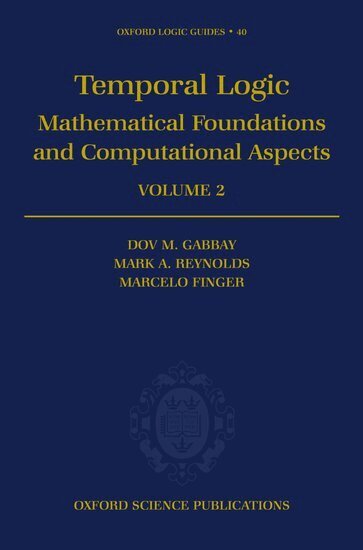
Temporal Logic: Volume 2
Av Dov M Gabbay, M. Finger m. fl.
Inbunden, 2000
4460 kr
Lägg i varukorg
This is the second volume of this respected work in temporal logic. Whereas volume 1 dealt primarily with basic concepts and methods, volume 2 discusses the more applicable aspects of temporal logics. The first four chapters continue the more theoretical presentations in volume 1, covering …
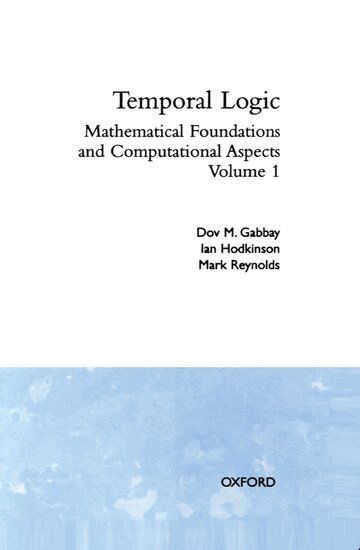
Temporal Logic: Volume 1
Av Dov M. Gabbay, Ian Hodkinson m. fl.
Inbunden, 1994
5149 kr
Lägg i varukorg
This long awaited book gives a thorough account of the mathematical foundations of Temporal Logic, one of the most important areas of logic in computer science.The book, which consists of fifteen chapters, moves on from giving a solid introduction in semantical and axiomatic approaches to temporal …