D.T. Clarkson – författare
Visar alla böcker från författaren D.T. Clarkson. Handla med fri frakt och snabb leverans.
3 produkter
3 produkter
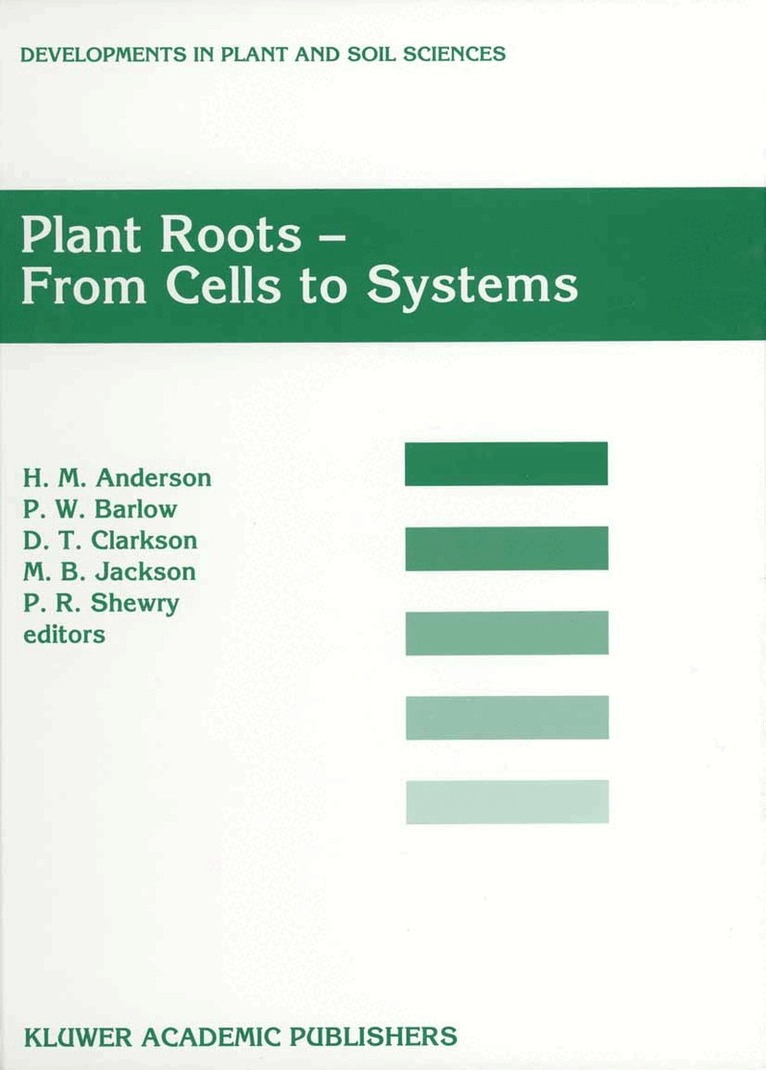
Plant Roots - From Cells to Systems
Proceedings of the 14th Long Ashton International Symposium Plant Roots — From Cells to Systems, held in Bristol, U.K., 13–15 September 1995
Inbunden, Engelska, 1997
1 062 kr
Skickas inom 10-15 vardagar
Proceedings of the 14th Long Ashton International Symposium: Plant Roots - From Cells to Systems held in Bristol, UK, 13-15 September 1995
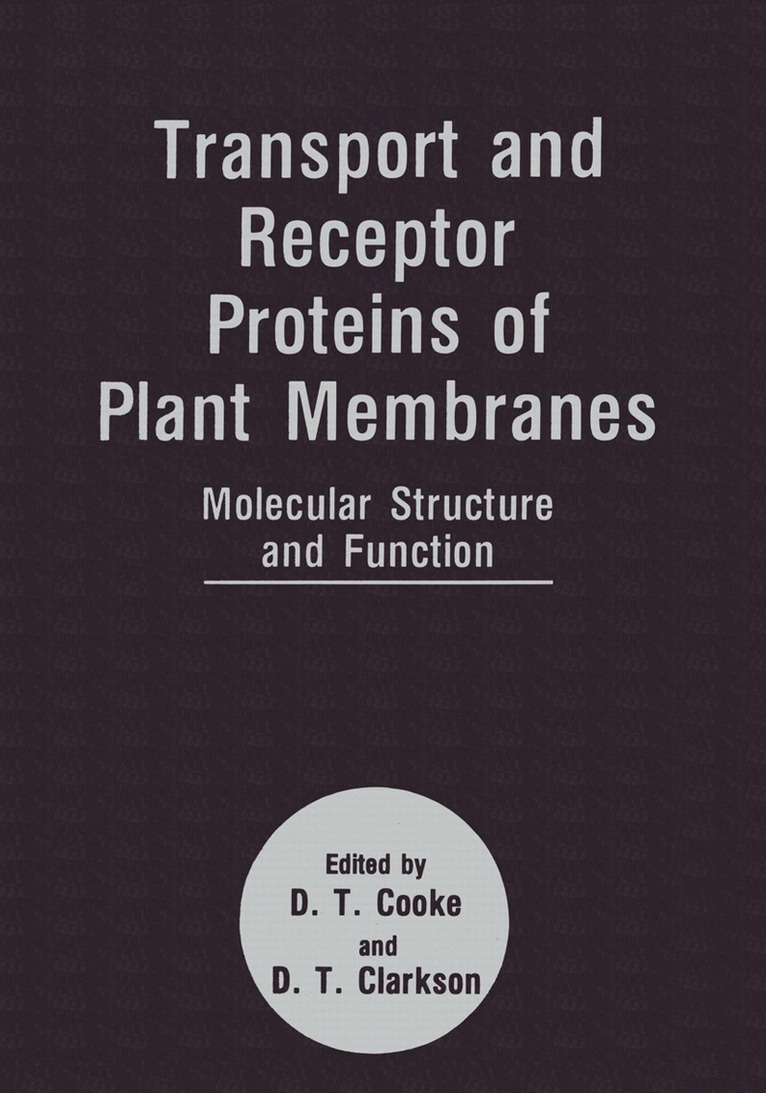
Transport and Receptor Proteins of Plant Membranes
Molecular Structure and Function
Häftad, Engelska, 2012
534 kr
Skickas inom 10-15 vardagar
This book presents the contributions of the main speakers to the 12th Long Ashton InternationalSymposium, heldat theUniversityofBristolfrom 17thto20thSeptember 1991. Manyofthe 160delegates who attended presented posters, the abstractsofwhich have been published separately and reflected thevigour, excitementand originalityofthepresentations. The identity and molecular structure of solute of membrane proteins are of interest in of themselves but may be seen as only a step towards broader questions about the regulation their activity and their integration into the lifeofcells and organisms. This symposium was held at a time when exciting progress was being made on the molecular biology of some transporters, ion channels and hormone receptors. The contributions reflect this progress in different degrees. Some problems are less tractable than others and the mixture of success stories and hopeful aspirations was a deliberate choice by the organisers. At the symposium those who were still confronted with great difficulties were listened to sympathetically and with constructive interest. Itis hoped that their papers will be read in the same way.During the symposium we discussed the natureofmany transport proteinsand receptors, as well as the existence ofadditional regulatory proteins such as protein kinases, G-proteins and calmodulin. Wecould say that upto twentyproteins wereconsidered inany detail. While this may sound like a considerable achievement, the scaleofourignorance can be illustrated byconsideringthatonatypicalsilver-stained, two-dimensionalpolyacrylamidegelofpurified plant plasma membrane polypeptides, between 150 and 200 spots are routinely shown; radiolabelled membranes frequently giveeven more, indicating how much membraneprotein there is, the function of which we have no conceptual framework.
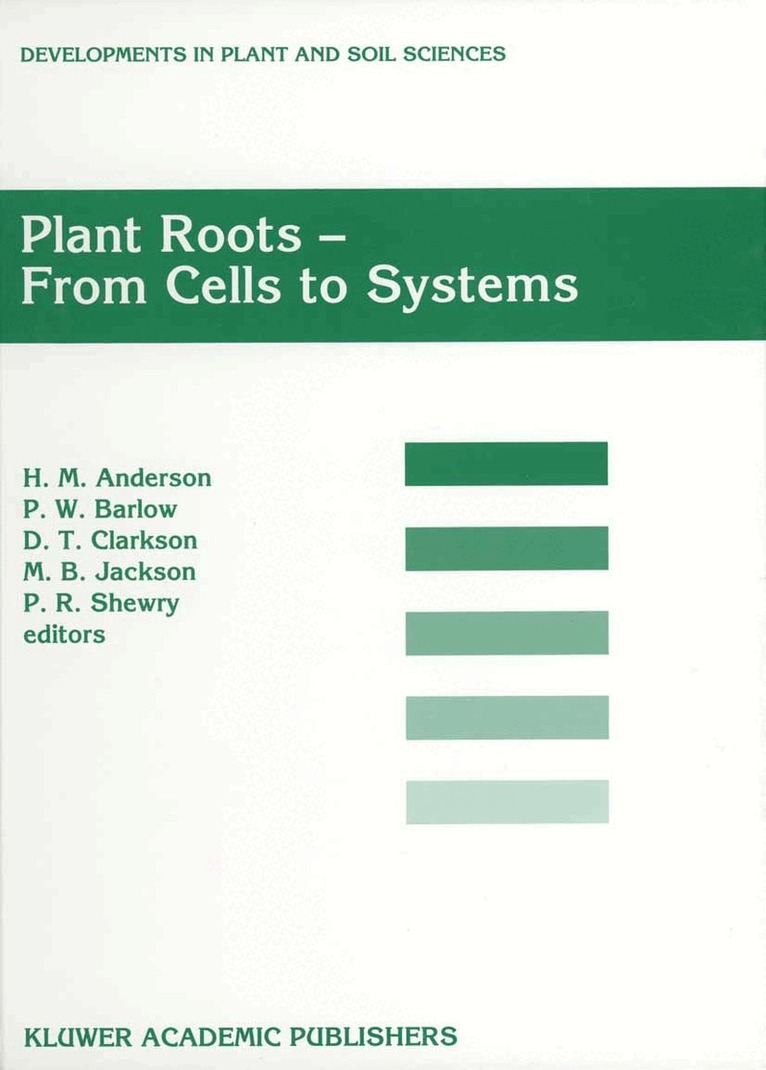
Plant Roots - From Cells to Systems
Proceedings of the 14th Long Ashton International Symposium Plant Roots — From Cells to Systems, held in Bristol, U.K., 13–15 September 1995
Häftad, Engelska, 2012
1 062 kr
Skickas inom 10-15 vardagar
tests the suitability of using mannitol as an osmoticum during experiments. Pressure probe and SiCSA techniques The expanding maize root tip Use of the cell pressure probe (Htisken et aI. , 1978) and single-cell sampling and analysis (SiCSA; Tomos Individual cells expand to many times their ongl- et aI. , 1994) provide an approach to study plant water nal length as they progress from the meristem to the and solute relations at the resolution of the individual mature zone of root tips. The expansion first accel- cell. In the case of water relations, the pressure probe erates and then decelerates, stopping at the proximal provides the only technique that measures cell tur- end of the expansion zone (Pritchard, 1994). This is gor pressure, and hence turgor adjustment processes, accomplished at constant ceJl turgor (P) and with a loss directly. In some cases, such as the motor cells of pul- of osmotic (7l'j) pressure in the order of 15% (wheat: vini or in the stomatal complex, turgor varies between Tomos et aI. , 1989; maize: Pritchard et aI. , 1993; adjacent cells - making analysis at single cell resolu- Pritchard and Tomos, 1993).The constant turgor indi- tion essential for understanding mechanisms (Irving et cates that changes in cell-wall mechanical properties, aI. , 1994). Correlating turgor pressure measurements rather than driving force, are responsible for the imme- with cell expansion rate permits unique measurement diate control of expansion-rate in roots (Pritchard et aI.