E. Bach - Böcker
Visar alla böcker från författaren E. Bach. Handla med fri frakt och snabb leverans.
5 produkter
5 produkter
2 101 kr
Skickas inom 10-15 vardagar
This is the first Supplementary volume to Kluwer's highly acclaimed Encyclopaedia of Mathematics. This additional volume contains nearly 600 new entries written by experts and covers developments and topics not included in the already published 10-volume set. These entries have been arranged alphabetically throughout. A detailed index is included in the book. This Supplementary volume enhances the existing 10-volume set. Together, these eleven volumes represent the most authoritative, comprehensive up-to-date Encyclopaedia of Mathematics available.
Del 32 - Studies in Linguistics and Philosophy
Categorial Grammars and Natural Language Structures
Inbunden, Engelska, 1988
2 101 kr
Skickas inom 10-15 vardagar
For the most part, the papers collected in this volume stern from presentations given at a conference held in Tucson over the weekend of May 31 through June 2, 1985. We wish to record our gratitude to the participants in that conference, as well as to the National Science Foundation (Grant No. BNS-8418916) and the University of Arizona SBS Research Institute for their financial support. The advice we received from Susan Steele on organizational matters proved invaluable and had many felicitous consequences for the success of the con- ference. We also would like to thank the staff of the Departments of Linguistics of the University of Arizona and the University of Massachusetts at Amherst for their help, as weIl as a number of individuals, including Lin Hall, Kathy Todd, and Jiazhen Hu, Sandra Fulmer, Maria Sandoval, Natsuko Tsujimura, Stuart Davis, Mark Lewis, Robin Schafer, Shi Zhang, Olivia Oehrle-Steele, and Paul Saka. Finally, we would like to express our gratitude to Martin Scrivener, our editor, for his patience and his encouragement.Vll INTRODUCTION The term 'categorial grammar' was introduced by Bar-Rillel (1964, page 99) as a handy way of grouping together some of his own earlier work (1953) and the work of the Polish logicians and philosophers Lesniewski (1929) and Ajdukiewicz (1935), in contrast to approaches to linguistic analysis based on phrase structure grammars.
Del 32 - Studies in Linguistics and Philosophy
Categorial Grammars and Natural Language Structures
Häftad, Engelska, 1988
2 101 kr
Skickas inom 10-15 vardagar
For the most part, the papers collected in this volume stern from presentations given at a conference held in Tucson over the weekend of May 31 through June 2, 1985. We wish to record our gratitude to the participants in that conference, as well as to the National Science Foundation (Grant No. BNS-8418916) and the University of Arizona SBS Research Institute for their financial support. The advice we received from Susan Steele on organizational matters proved invaluable and had many felicitous consequences for the success of the con- ference. We also would like to thank the staff of the Departments of Linguistics of the University of Arizona and the University of Massachusetts at Amherst for their help, as weIl as a number of individuals, including Lin Hall, Kathy Todd, and Jiazhen Hu, Sandra Fulmer, Maria Sandoval, Natsuko Tsujimura, Stuart Davis, Mark Lewis, Robin Schafer, Shi Zhang, Olivia Oehrle-Steele, and Paul Saka. Finally, we would like to express our gratitude to Martin Scrivener, our editor, for his patience and his encouragement.Vll INTRODUCTION The term 'categorial grammar' was introduced by Bar-Rillel (1964, page 99) as a handy way of grouping together some of his own earlier work (1953) and the work of the Polish logicians and philosophers Lesniewski (1929) and Ajdukiewicz (1935), in contrast to approaches to linguistic analysis based on phrase structure grammars.
Del 33 - Studies in Linguistics and Philosophy
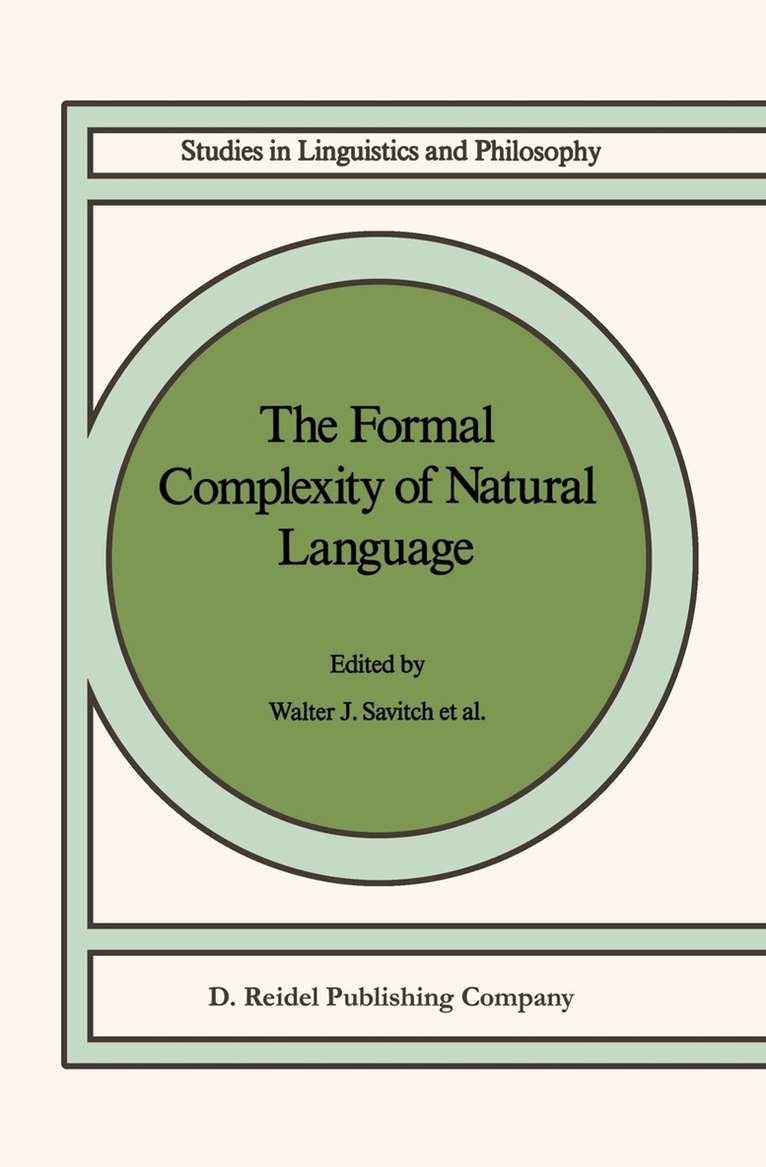
Formal Complexity of Natural Language
Inbunden, Engelska, 1987
1 625 kr
Skickas inom 10-15 vardagar
Ever since Chomsky laid the framework for a mathematically formal theory of syntax, two classes of formal models have held wide appeal. The finite state model offered simplicity. At the opposite extreme numerous very powerful models, most notable transformational grammar, offered generality. As soon as this mathematical framework was laid, devastating arguments were given by Chomsky and others indicating that the finite state model was woefully inadequate for the syntax of natural language. In response, the completely general transformational grammar model was advanced as a suitable vehicle for capturing the description of natural language syntax. While transformational grammar seems likely to be adequate to the task, many researchers have advanced the argument that it is "too adequate. " A now classic result of Peters and Ritchie shows that the model of transformational grammar given in Chomsky's Aspects [IJ is powerful indeed. So powerful as to allow it to describe any recursively enumerable set. In other words it can describe the syntax of any language that is describable by any algorithmic process whatsoever. This situation led many researchers to reasses the claim that natural languages are included in the class of transformational grammar languages. The conclu sion that many reached is that the claim is void of content, since, in their view, it says little more than that natural language syntax is doable algo rithmically and, in the framework of modern linguistics, psychology or neuroscience, that is axiomatic.
1 625 kr
Skickas inom 10-15 vardagar
Ever since Chomsky laid the framework for a mathematically formal theory of syntax, two classes of formal models have held wide appeal. The finite state model offered simplicity. At the opposite extreme numerous very powerful models, most notable transformational grammar, offered generality. As soon as this mathematical framework was laid, devastating arguments were given by Chomsky and others indicating that the finite state model was woefully inadequate for the syntax of natural language. In response, the completely general transformational grammar model was advanced as a suitable vehicle for capturing the description of natural language syntax. While transformational grammar seems likely to be adequate to the task, many researchers have advanced the argument that it is "too adequate. " A now classic result of Peters and Ritchie shows that the model of transformational grammar given in Chomsky's Aspects [IJ is powerful indeed. So powerful as to allow it to describe any recursively enumerable set. In other words it can describe the syntax of any language that is describable by any algorithmic process whatsoever. This situation led many researchers to reasses the claim that natural languages are included in the class of transformational grammar languages. The conclu sion that many reached is that the claim is void of content, since, in their view, it says little more than that natural language syntax is doable algo rithmically and, in the framework of modern linguistics, psychology or neuroscience, that is axiomatic.