M. Ablowitz – författare
Visar alla böcker från författaren M. Ablowitz. Handla med fri frakt och snabb leverans.
2 produkter
2 produkter
2 120 kr
Skickas inom 10-15 vardagar
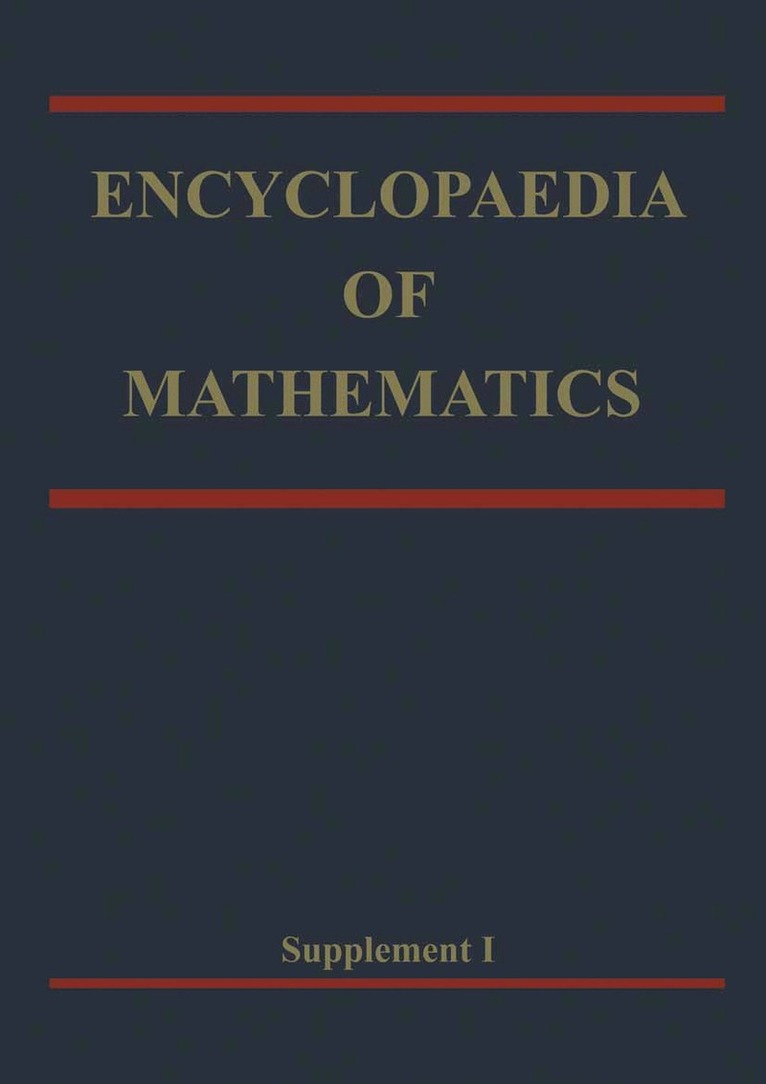
This is the first Supplementary volume to Kluwer's highly acclaimed Encyclopaedia of Mathematics. This additional volume contains nearly 600 new entries written by experts and covers developments and topics not included in the already published 10-volume set. These entries have been arranged alphabetically throughout. A detailed index is included in the book. This Supplementary volume enhances the existing 10-volume set. Together, these eleven volumes represent the most authoritative, comprehensive up-to-date Encyclopaedia of Mathematics available.
1 822 kr
Skickas inom 5-8 vardagar
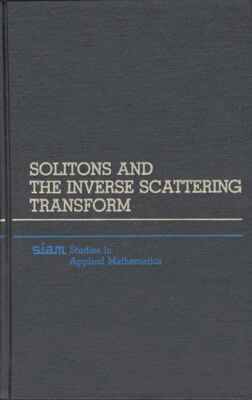
A study, by two of the major contributors to the theory, of the inverse scattering transform and its application to problems of nonlinear dispersive waves that arise in fluid dynamics, plasma physics, nonlinear optics, particle physics, crystal lattice theory, nonlinear circuit theory and other areas.A soliton is a localized pulse-like nonlinear wave that possesses remarkable stability properties. Typically, problems that admit soliton solutions are in the form of evolution equations that describe how some variable or set of variables evolve in time from a given state. The equations may take a variety of forms, for example, PDEs, differential difference equations, partial difference equations, and integrodifferential equations, as well as coupled ODEs of finite order. What is surprising is that, although these problems are nonlinear, the general solution that evolves from almost arbitrary initial data may be obtained without approximation. For such exactly solvable problems, the inverse scattering transform provides the general solution of their initial value problems. It is equally surprising that some of these exactly solvable problems arise naturally as models of physical phenomena.Simply put, the inverse scattering transform is a nonlinear analog of the Fourier transform used for linear problems. Its value lies in the fact that it allows certain nonlinear problems to be treated by what are essentially linear methods.Chapters 1 and 2 of the book describe in detail the theory of the inverse scattering transform. Chapter 3 discusses alternate methods for these exactly solvable problems and the interconnections among them. Physical applications are described in Chapter 4, where, for example, similarities between deep water waves and nonlinear optics become evident. Because of the fundamental role of linear theory, there is an extensive appendix that addresses the linear problems and their solutions.