E. J. Dionne - Böcker
Visar alla böcker från författaren E. J. Dionne. Handla med fri frakt och snabb leverans.
9 produkter
9 produkter
251 kr
Skickas inom 7-10 vardagar
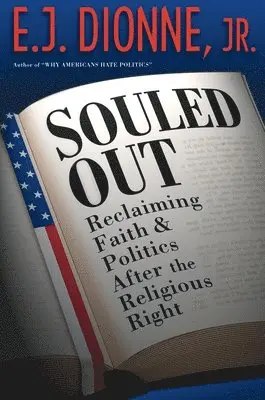
The religious and political winds are changing. Tens of millions of religious Americans are reclaiming faith from those who would abuse it for narrow, partisan, and ideological purposes. And more and more secular Americans are discovering common ground with believers on the great issues of social justice, peace, and the environment. In Souled Out, award-winning journalist and commentator E. J. Dionne explains why the era of the Religious Right--and the crude exploitation of faith for political advantage--is over. Based on years of research and writing, Souled Out shows that the end of the Religious Right doesn't signal the decline of evangelical Christianity but rather its disentanglement from a political machine that sold it out to a narrow electoral agenda of such causes as opposition to gay marriage and abortion. With insightful portraits of leading contemporary religious figures from Rick Warren and Richard Cizik to John Paul II and Benedict XVI, Dionne shows that our great religions have always preached a broad message of hope for more just human arrangements and refused to be mere props for the powers that be.Dionne also argues that the new atheist writers should be seen as a gift to believers, a demand that they live up to their proclaimed values and embrace scientific and philosophical inquiry in a spirit of "intellectual solidarity." Written in the tradition of Reinhold and H. Richard Niebuhr, Souled Out will help change how we think and talk about religion and politics in the post-Bush era.
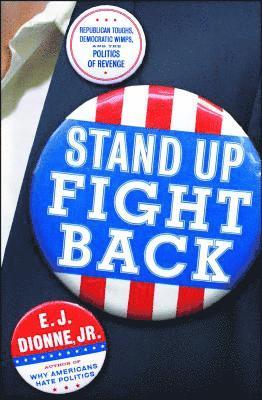
Stand Up Fight Back
Republican Toughs, Democratic Wimps, and the New Politics of Revenge
Häftad, Engelska, 2018
169 kr
Skickas inom 5-8 vardagar
324 kr
Skickas inom 3-6 vardagar
One of our shrewdest political observers traces thirty years of volatile political history and finds that on point after point, liberals and conservatives are framing issues as a series of "false choices," making it impossible for politicians to solve problems, and alienating voters in the process.
264 kr
Skickas inom 10-15 vardagar
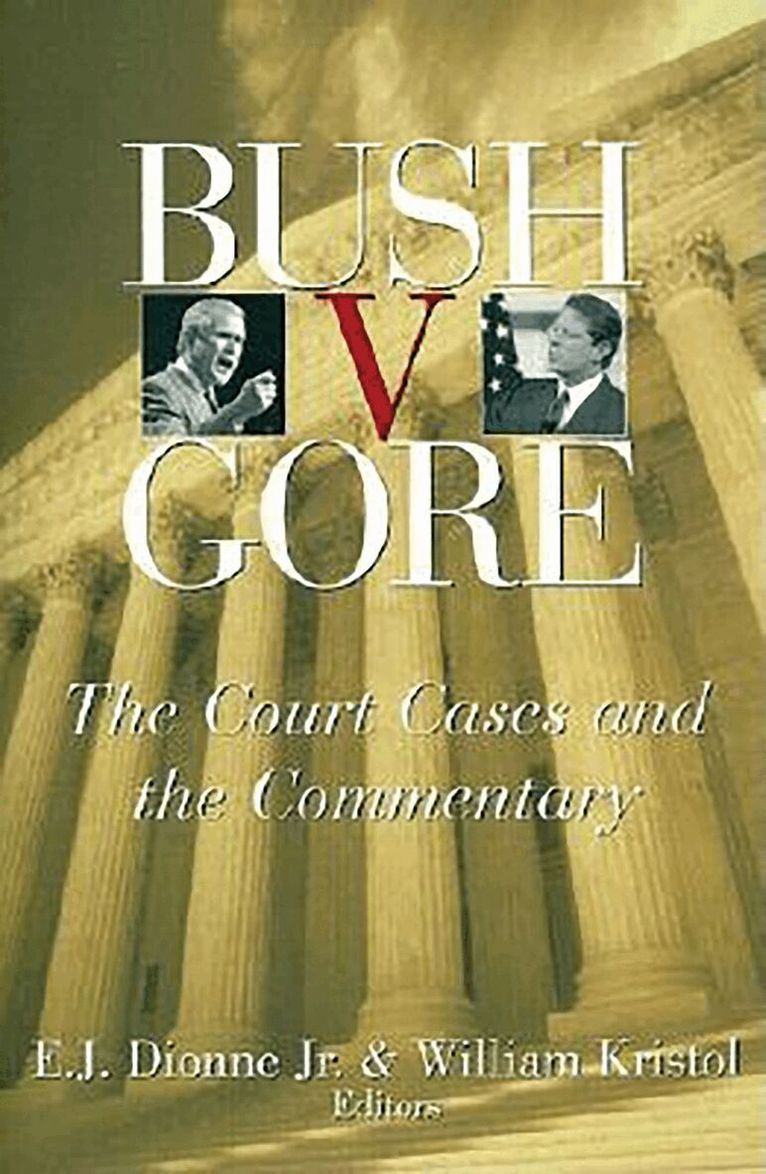
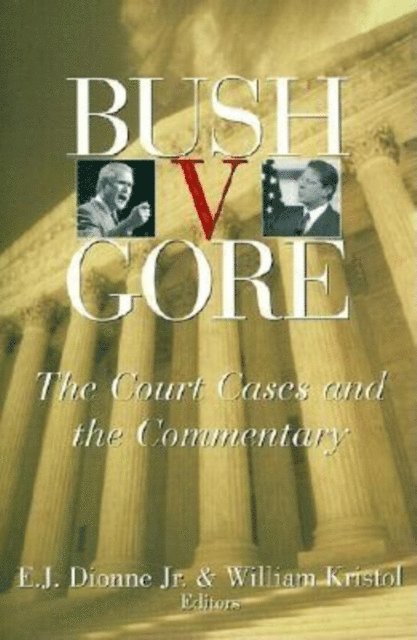
On December 12, 2000, a controversial decision by the Supreme Court of the United States effectively ended the disputed presidential contest between George W. Bush and Albert Gore Jr. with a 5-4 ruling that revealed the court to be as bitterly divided as the electorate. Four days earlier, the Florida Supreme Court had abruptly changed the dynamics of the election by reversing a lower court and ordering hand recounts of ""undervotes"" statewide. The U.S. Supreme Court quickly stepped in to halt the recounts and agreed to hear Bush v. Gore. After brief oral arguments and a short period of deliberation, the high court reversed the state court decision. The justices in both cases were bitterly divided, and passionate language emerged in both the majority rulings and the dissents. The drama and divisiveness of this extraordinary saga come to life in the rulings, opinions, and dissents from these two cases: U.S. Supreme Court case 00-949 (Bush v. Gore) and Florida Supreme Court case 00-2431 (Gore v. Harris). The first section of this volume gathers the complete text of both rulings, along with selections from oral arguments in the U.S. Supreme Court case. The second section of the book gathers the most significant opinion pieces from journalists and scholars on both sides of the political fence. Selected and organized by political analysts E.J. Dionne and William Kristol, these articles illuminate the perspectives of both sides about the various twists and turns in the post-election campaign, and the landmark judicial intervention. A companion website will provide links to documents from additional legal proceedings and other related documents and writings. The legal and historical significance of the 2000 election will be studied and debated for years to come. This volume combines the most important source documents with the most intelligent opinion and analysis about the conflict and its controversial resolution.
287 kr
Skickas inom 10-15 vardagar
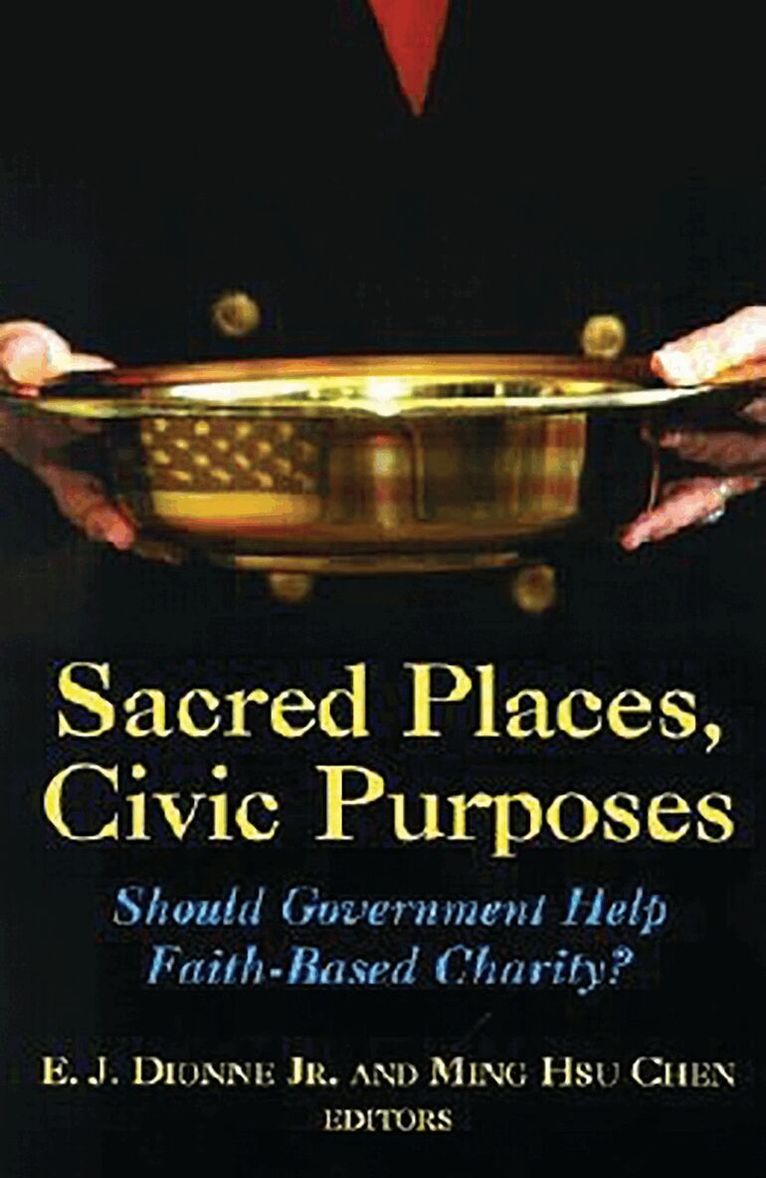
Long before there was a welfare state, there were efforts by religious congregations to alleviate poverty. Those efforts have continued since the establishment of government programs to help the poor, and congregations have often worked with government agencies to provide food, clothing and care, to set up after-school activities, provide teen pregnancy counseling, and develop programs to prevent crime. Until now, much of this church-state cooperation has gone on with limited opposition or notice. But the Bush Administration's new proposal to broaden support for ""faith-based"" social programs has heated up an already simmering debate. What are congregations' proper roles in lifting up the poor? What should their relationship with government be? Sacred Places, Civic Purposes explores the question with a lively discussion that crisscrosses every line of partisanship and ideology. The result of a series of conferences funded by the Pew Charitable Trusts and sponsored by the Brookings Institution, this book focuses not simply on abstract questions of the promise and potential dangers of church-state cooperation, but also on concrete issues where religious organizations are leading problem solvers. The authors experts in their respective fields and from various walks of life - examine the promises and perils of faith-based organizations in preventing teen pregnancy, reducing crime and substance abuse, fostering community development, bolstering child care, and assisting parents and children on education issues. They offer conclusions about what congregations are currently doing, how government could help, and how government could usefully get out of the way. Contributors include William T. Dickens (National Community Development Policy Analysis Network and the Brookings Institution), John DiIulio (White House Office of Faith-Based and Community Initiatives and University of Pennsylvania), Floyd Flake (Allen AME Church and Manhattan Institute), Bill Galston (Unversity of Maryland), David Hornbeck (former superintendent, Philadelphia Public Schools), George Kelling (Rutgers University), Joyce Ladner (Brookings Institution), Joan Lombardi (Children's Project), Pietro Nivola (Brookings Institution), Eugene Rivers (Azusa Christian Community Center), Isabel V. Sawhill (National Campaign to Prevent Teen Pregnancy and the Brookings Institution), Lisbeth Schorr (Harvard Project for Effective Interventions), Peter Steinfels (New York Times), Jim Wallis (Sojourners), and Christopher Winship (Harvard University).
287 kr
Skickas inom 10-15 vardagar
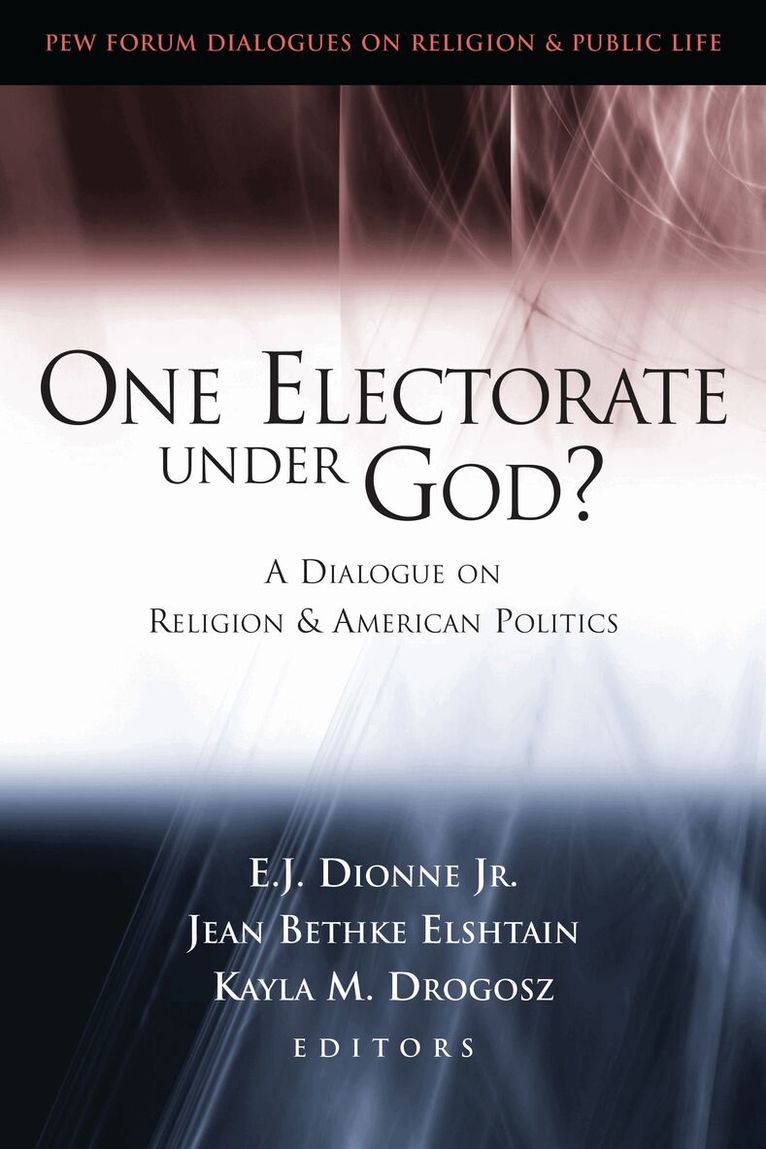
The United States has been described as a nation with the soul of a church. Religion is discussed more explicitly and more urgently in American politics than in the public debates of any other wealthy democracy. It is certain to play an important role in the elections of 2004. Yet debates over religion and politics are often narrow and highly partisan, although the questions at hand demand a broader and more civil discussion. One Electorate under God? widens the dialogue by bringing together in one volume some of the most influential voices in American intellectual and political life. This book draws on a public debate between former New York governor Mario Cuomo and Indiana congressman Mark Souder, who discuss how their respective faith convictions have been both shaped by and reflected in their careers as public servants. This discussion, in turn, prompted commentary by a diverse group of scholars, politicians, journalists, and religious leaders who are engaged simultaneously in the religious and policy realms. Each contributor offers insights on how political leaders and religious convictions shape our politics. One Electorate under God arises from the idea that public deliberation is more honestand more democraticwhen officials are open and reflective about the interactions between their religious convictions and their commitments in the secular realm. This volumethe first of its kindseeks to promote a greater understanding of American thinking about faith and public office in a pluralistic society. Contributors include Joanna Adams, Azizah Al-Hibri, Doug Bandow, Michael Barone, Gary Bauer, Robert Bellah, David Brooks, Harvey Cox, Michael Cromartie, John DiIulio Jr., Terry Eastland, Robert Edgar, Jean Bethke Elshtain, Richard Wightman Fox, William Galston, Robert George, Andrew Greeley, John Green, Anna Greenberg, Susannah Heschel, Representative Amo Houghton (R-New York), Michael Kazin, Martha Minow, Stephen Monsma, Mark Noll, Rabbi David Novak, Ramesh Ponnuru, Representative David E. Price (D-North Carolina), Jeffrey Rosen, Cheryl Sanders, Ron Sider, Jim Skillen, Matthew Spalding, Jeffrey Stout, John Sweeney, Roberto Suro, Margaret O'Brien Steinfels, Jim Towey, Doug Tanner, Mark Warren, Alan Wolfe, and Andrew Young.
301 kr
Skickas inom 10-15 vardagar
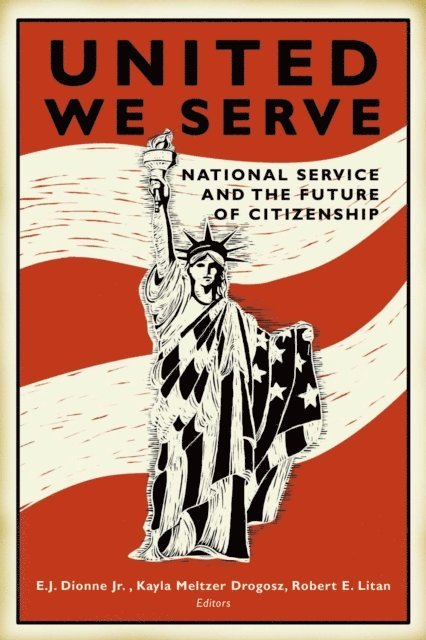
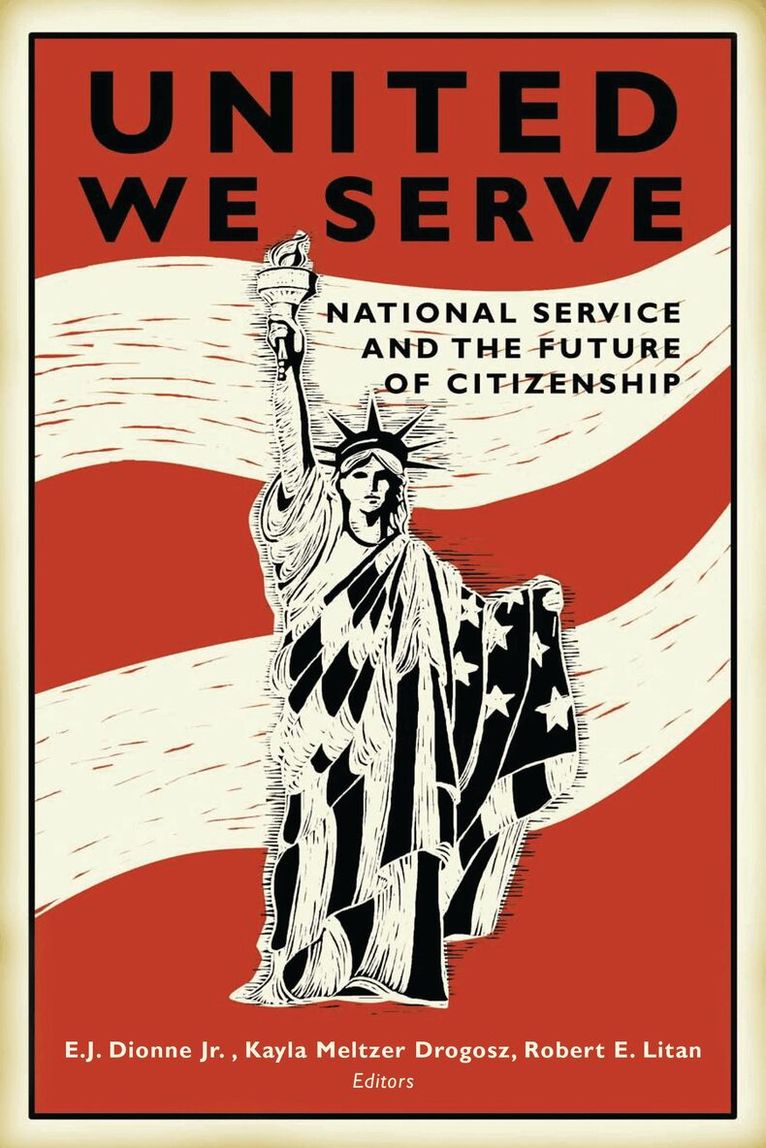
Public rhetoric in the United States has always laid heavy stress on the obligations of citizenship. Bill Clinton praised the idea of service, and so does George W. Bush. Since September 11, the debate over service and the obligations of citizenship has become even more urgent. United We Serve gathers many diverse voices on civic life and civic obligation to explore the idea of national service as it relates to citizenship. Activists and practitioners discuss the rise of the service movement, its practical successes, and its challenges. Policymakers and political leaders explore the links between service and problem solving. Political scientists and philosophers connect the service debate to larger concerns about democratic participation. The book also includes a lively debate over whether the U.S. should reconsider compulsory national service. The discussion about service is a debate over how Americans think of themselves and their nationand about what the ""new patriotism"" means. Contributors include: Daniel Blumenthal, Harry Boyte, John M. Bridgeland, Louis Caldera, Bruce Chapman, former President Bill Clinton, Charles Cobb Jr., Jane Eisner, Jean Bethke Elshtain, William Galston, Stephen Goldsmith, Robert D. Haas, Stephen Hess, Peter D. Hart and Mario A. Brossard, Alan Khazei, John Lehman, Leslie Lenkowsky, Paul C. Light, Michael Lind, Tod Lindberg, Will Marshall and Marc Magee, Senator John McCain, Charles Moskos, Robert Putnam, Representative Charles Rangel, Alice M. Rivlin, Michael Schudson, Mark Shields, Carmen Sirianni, Theda Skocpol, Andrew L. Stern, Jeff Swartz, Steven Waldman, Caspar Weinberger, David Winston, Harris Wofford, and Robert Wuthnow.
274 kr
Skickas inom 10-15 vardagar
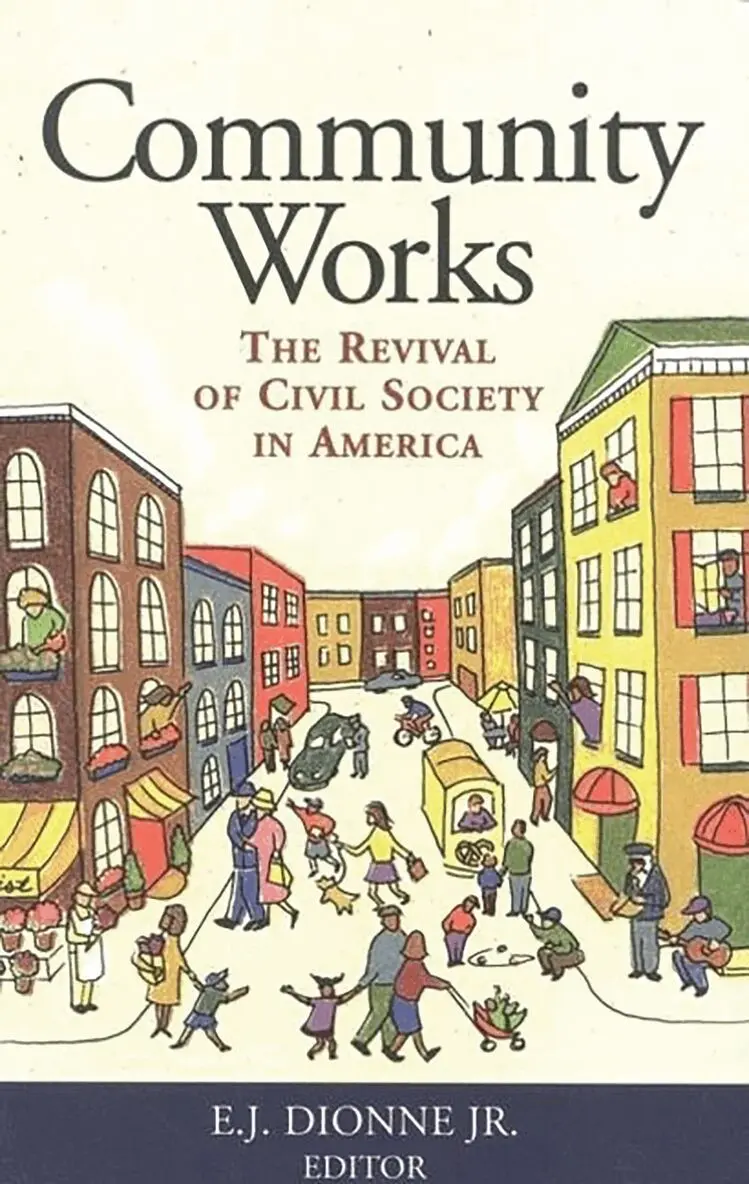
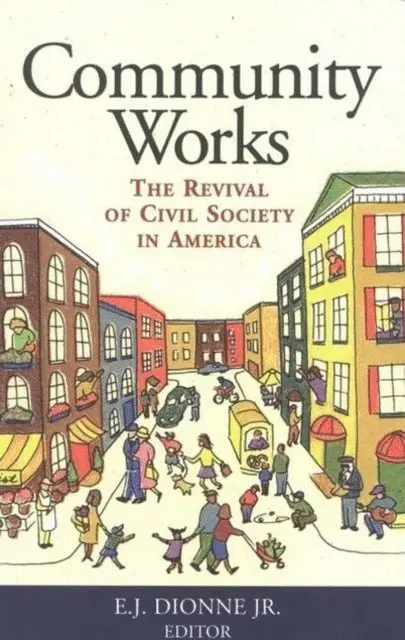
America is experiencing a boom of voluntarism and civic mindedness. Community groups are working together to clean up their cities and neighborhoods. People are rejoining churches, civic associations, and Little Leagues. And, at every opportunity, local and national leaders are exhorting citizens to pitch in and do their part.Why has the concept of a civil society--an entire nation of communities, associations, civic and religious groups, and individuals all working toward the common good--become so popular? Why is so much hope being invested in the voluntary sector? Why is a civil society so important to us?This book looks at the growing debate over the rise, importance, and consequences of civil society. E.J. Dionne puts the issues of the debate in perspective and explains the deep-rooted developments that are reflected in civil society's revival. Alan Wolfe and Jean Bethke Elshtain discuss reasons why the idea of a civil society is important today. Theda Skocpol and William A. Schambra offer two opposing viewpoints on where successful voluntary civic action originates--nationally or at the local grass roots. John J. DiIulio Jr. shines a light on the success of faith-based programs in the inner-city, and Bruce Katz studies the problems caused by concentrated poverty in those same neighborhoods. Jane Eisner underscores the extent to which the volunteer sector needs organization and support to effectively complete its work. Other contributors include Bill Bradley, William A. Galston, and Gertrude Himmelfarb.
274 kr
Skickas inom 10-15 vardagar
More than two hundred years have passed since the Constitution was written, yet Americans still cannot make up their minds whether religion is primarily private, public, or a combination of the two. This collection of essays explores the unsettledand often unsettlingquestion of organized religion's role in contemporary public life. Richard N. Ostling reviews religious belief and practice in the United States in a survey of the ever-changing religious landscape, while Robert J. Blendon and others compare the political, moral, and religious values of the 1960s with those of the 1990s. Patrick Glynn and Alan Wolfe examine different religious responses to the recent presidential scandal, and James Q. Wilson, John J. DiIulio Jr., and Ram Cnaan examine the rise of faith-based social programs, including the shift of private funds to social service providers, the role of black churches in the inner city, and social and community work by urban religious congregations. Additional contributors include Taylor Branch, Kurt Schmoke, Cal Thomas, and Peter Wehner.