E. Kiran - Böcker
Visar alla böcker från författaren E. Kiran. Handla med fri frakt och snabb leverans.
4 produkter
4 produkter
2 121 kr
Skickas inom 10-15 vardagar
Supercritical fluids which are neither gas nor liquid, but can be compressed gradually from low to high density, are gaining increasing importance as tunable solvents and reaction media in the chemical process industry. By adjusting the pressure, or more strictly the density, the properties of these fluids are customized and manipulated for the particular process at hand, be it a physical transformation, such as separation or solvation, or a chemical transformation, such as a reaction or reactive extraction. Supercritical fluids, however, differ from both gases and liquids in many respects. In order to properly understand and describe their properties, it is necessary to know the implications of their nearness to criticality, to be aware of the complex types of phase separation (including solid phases) that occur when the components of the fluid mixture are very different from each other, and to develop theories that can cope with the large differences in molecular size and shape of the supercritical solvent and the solutes that are present.
2 333 kr
Skickas inom 10-15 vardagar
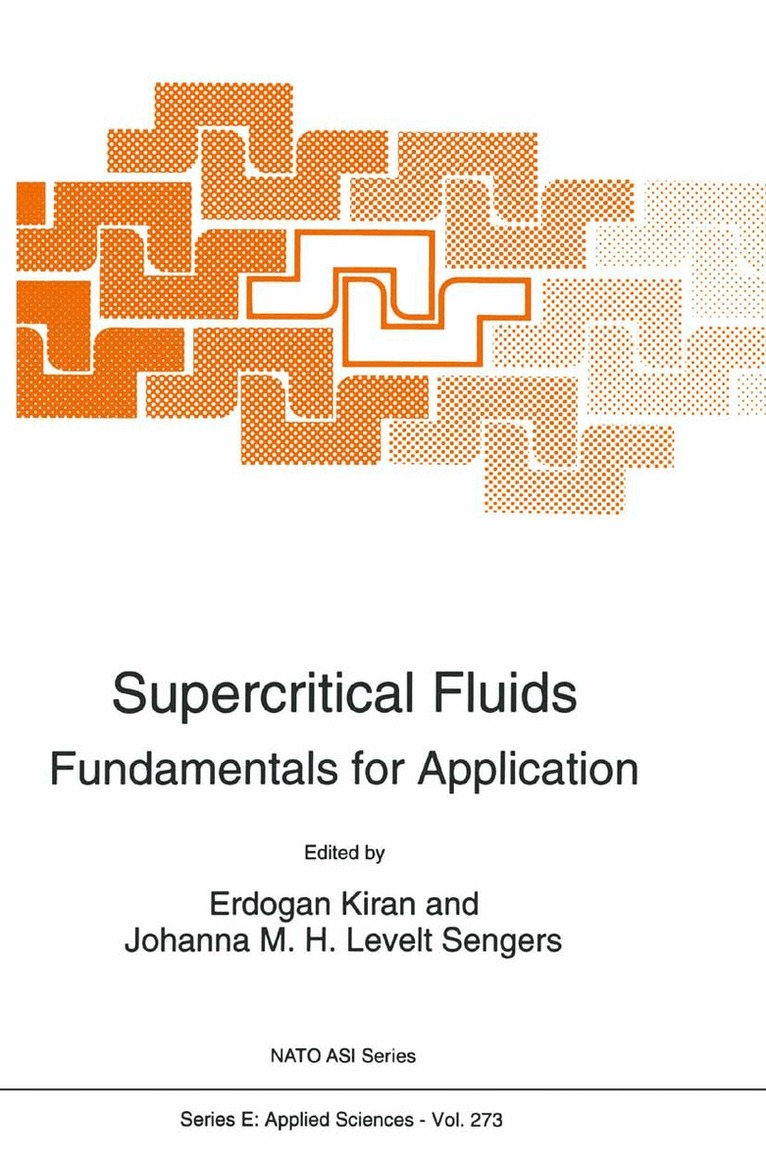
Supercritical fluids are neither gas nor liquid, but can be compressed gradually from low to high density and they are therefore interesting and important as tunable solvents and reaction media in the chemical process industry. By adjusting the density the properties of these fluids, they can be customized and manipulated for a given process - physical or chemical transformation. Separation and processing using supercritical solvents such as CO2 are currently on-line commercially in the food, essential oils and polymer industries. Many agencies and industries are considering the use of supercritical water for waste remediation. Supercritical fluid chromatography represents another, major analytical application. Significant advances have recently been made in materials processing, ranging from particle formation to the creation of porous materials.The chapters in this book provide tutorial accounts of topical areas centred around: phase equilibria, thermodynamics and equations of state; critical behaviour and crossover effects; transport and interfacial properties; molecular modelling and computer simulation; reactions and spectroscopy; phase separation kinetics; extractions; applications to polymers, pharmaceuticals, natural materials and chromatography; and process scale-up.
2 333 kr
Skickas inom 10-15 vardagar
Supercritical fluids are neither gas nor liquid, but can be compressed gradually from low to high density and they are therefore interesting and important as tunable solvents and reaction media in the chemical process industry. By adjusting the density the properties of these fluids, they can be customized and manipulated for a given process - physical or chemical transformation. Separation and processing using supercritical solvents such as CO2 are currently on-line commercially in the food, essential oils and polymer industries. Many agencies and industries are considering the use of supercritical water for waste remediation. Supercritical fluid chromatography represents another, major analytical application. Significant advances have recently been made in materials processing, ranging from particle formation to the creation of porous materials.The chapters in this book provide tutorial accounts of topical areas centred around: phase equilibria, thermodynamics and equations of state; critical behaviour and crossover effects; transport and interfacial properties; molecular modelling and computer simulation; reactions and spectroscopy; phase separation kinetics; extractions; applications to polymers, pharmaceuticals, natural materials and chromatography; and process scale-up.
2 121 kr
Skickas inom 10-15 vardagar
Supercritical fluids which are neither gas nor liquid, but can be compressed gradually from low to high density, are gaining increasing importance as tunable solvents and reaction media in the chemical process industry. By adjusting the pressure, or more strictly the density, the properties of these fluids are customized and manipulated for the particular process at hand, be it a physical transformation, such as separation or solvation, or a chemical transformation, such as a reaction or reactive extraction. Supercritical fluids, however, differ from both gases and liquids in many respects. In order to properly understand and describe their properties, it is necessary to know the implications of their nearness to criticality, to be aware of the complex types of phase separation (including solid phases) that occur when the components of the fluid mixture are very different from each other, and to develop theories that can cope with the large differences in molecular size and shape of the supercritical solvent and the solutes that are present.