E. Mannix - Böcker
Visar alla böcker från författaren E. Mannix. Handla med fri frakt och snabb leverans.
2 produkter
2 produkter
1 953 kr
Skickas inom 5-8 vardagar
This book comprises the work of scholars who gathered in May, 1998, at a conference held at Stanford University's Graduate School of Business Administration. The conference was part of an ongoing series presenting cutting edge research on teams. Presented first, are those articles that address particular macro aspects of team context and their influences on team process and effectiveness and ultimately their effectiveness as performing units. The following chapters address: how the organizational context shapes the timing of behavior in teams; process outcome and the effects of organizational performance on top management teams; group process and the nature of contextual features; and, conditions under which working teams actively manage their external environments and consequences of those actions. The work concludes with an overview of the multiple ways that contexts affect and are affected by group behavior, helping the reader to organize and to extend their understanding of contextual phenomena.
Del 4 - Research on Managing Groups and Teams
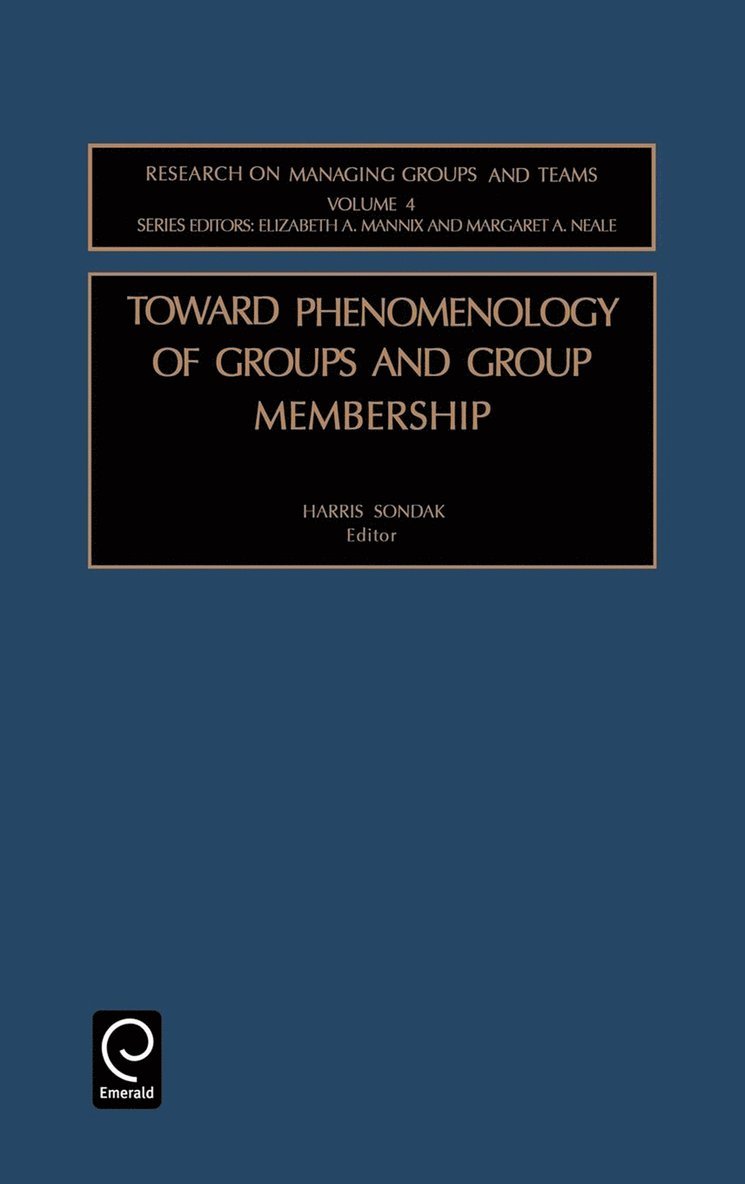
Toward Phenomenology of Groups and Group Membership
Inbunden, Engelska, 2002
1 310 kr
Skickas inom 7-10 vardagar
The papers in this volume were presented in May 2000, at a conference held at Stanford University's Graduate School of Business. The purpose of the conference was to explore individual motivation and sensemaking in the context of group membership. This volume presents the papers discussed at that conference, and brings attention to the problem of understanding how group members understand their own experience in their groups. In creating both individual and shared understandings of group membership, group members reflect on their participation in the group, the group process, group outcomes, the group itself, and the organization in which the group is embedded. The papers in this volume address a variety of topics including the use of methods from phenomenological psychology; how individuals choose which groups to join, and how they develop a sense that they belong to one or another group; groups' orientations toward learning, pacing, and time; and familiarity, trust, perspective taking, and intergroup relations. The research presented in these papers employs diverse methods including qualitative field studies, laboratory experiments, and the use of archival data. Some of the papers presented here are more directly phenomenological than others. Even the chapters whose methods are furthest from a typical phenomenological approach, however, provide interesting insights into how individuals experience and make sense of group membership.