E. R. Lewis - Böcker
Visar alla böcker från författaren E. R. Lewis. Handla med fri frakt och snabb leverans.
2 produkter
2 produkter
1 714 kr
Skickas inom 7-10 vardagar
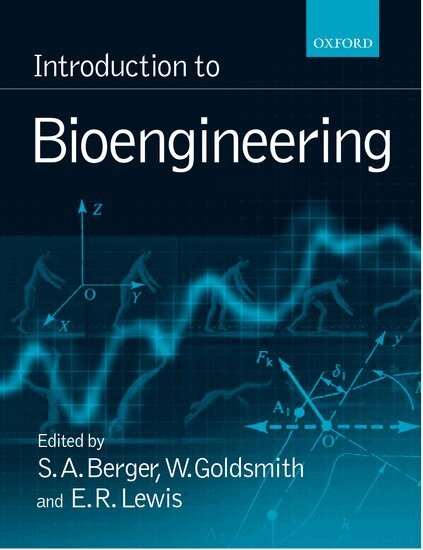
Bioengineering in this textbook is taken to be the application of the concepts and methods of the physical sciences and mathematics in an engineering approach to problems in the life sciences. The aims of such studies is to understand the physical processes and engineering aspects of a systems performance both under normal and abnormal conditions, and to design and use diagnostic or artificial devices meant to measure, improve, safeguard, or replace life functions. An experienced team of instructors in mechanical, electrical, chemical and nuclear engineering from the University of California at Berkeley developed the book including contributions on orthopaedics and biodynamics. The topics covered mirror the fundamental engineering science taught, usually at intermediate university level, and are each applied to problems in the biological world. The basic principles of engineering science are presented so that students will be able to grasp the essence of a particular topic quickly, whatever their background. Many worked examples and problems (together with selected solutions) are included throughout the text.
536 kr
Skickas inom 10-15 vardagar
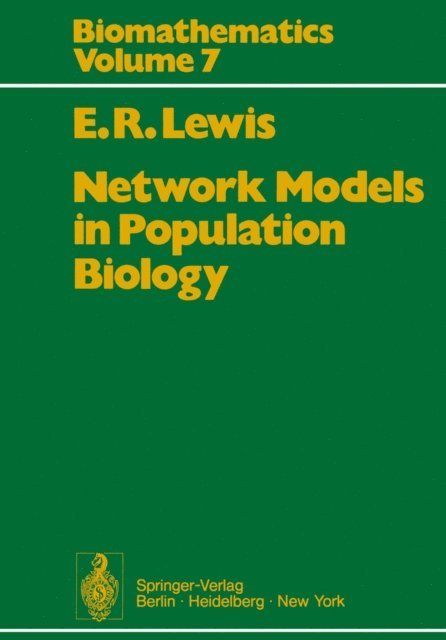
This book is an outgrowth of one phase of an upper-division course on quantitative ecology, given each year for the past eight at Berkeley. I am most grateful to the students in that course and to many graduate students in the Berkeley Department of Zoology and Colleges of Engineering and Natural Resources whose spirited discussions inspired much of the book's content. I also am deeply grateful to those faculty colleagues with whom, at one time or another, I have shared courses or seminars in ecology or population biology, D.M. Auslander, L. Demetrius, G. Oster, O.H. Paris, F.A. Pitelka, A.M. Schultz, Y. Takahashi, D.B. Tyler, and P. Vogelhut, all of whom contributed substantially to the development of my thinking in those fields, to my Depart mental colleagues E. Polak and A.J. Thomasian, who guided me into the litera ture on numerical methods and stochastic processes, and to the graduate students who at one time or another have worked with me on population-biology projects, L.M. Brodnax, S-P. Chan, A. Elterman, G.C. Ferrell, D. Green, C. Hayashi, K-L. Lee, W.F. Martin Jr., D. May, J. Stamnes, G.E. Swanson, and I. Weeks, who, together, undoubtedly provided me with the greatest inspiration. I am indebted to the copy-editing and production staff of Springer-Verlag, especially to Ms. M. Muzeniek, for their diligence and skill, and to Mrs. Alice Peters, biomathematics editor, for her patience.