E. Roy Weintraub – författare
Visar alla böcker från författaren E. Roy Weintraub. Handla med fri frakt och snabb leverans.
12 produkter
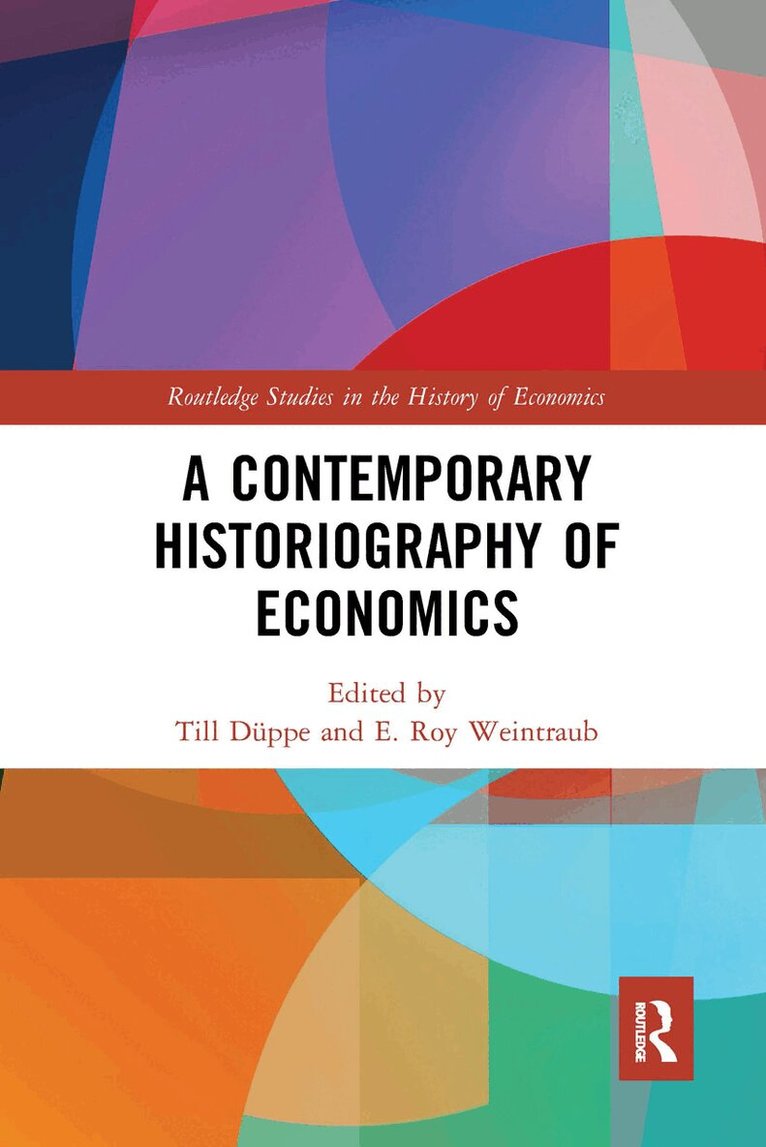
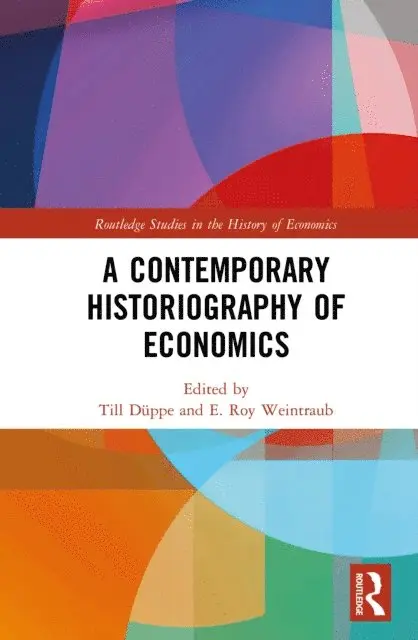
Contemporary Historiography of Economics
Av Till Düppe, E. Roy Weintraub
Häftad, 2020
741 kr
Lägg i varukorg
In recent years, the focus of historians of economic thought has changed to also include the ideas and practices of contemporary economists. This has opened up new questions regarding the utilization of sources, choice of method, narrative styles, and ethical issues, as well as a new awareness of …
Mathematics for Economists
An Integrated Approach
Häftad, 1983
530 kr
Lägg i varukorg
The responses to questions such as 'What is the explanation for changes in the unemployment rate?' frequently involve the presentation of a mathematical relationship, a function that relates one set of variables to another set of variables. It should become apparent that as one's understanding of …
Microfoundations
The Compatibility of Microeconomics and Macroeconomics
Av E. Roy Weintraub, John Pencavel
Häftad, 1979
720 kr
Lägg i varukorg
This is the first full-length survey of current work which examines the compatibility of microeconomics and macroeconomics. Its particular distinction is that it makes accessible, to non-specialists, those extensive modern refinements of general equilibrium theory which are linked to macroeconomics …
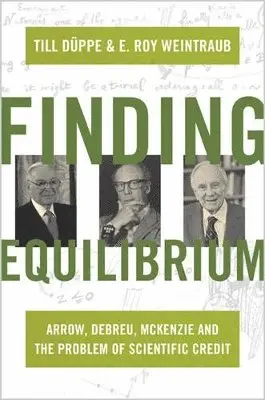
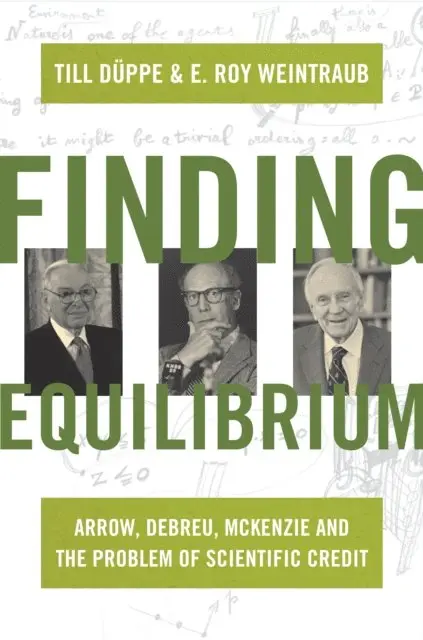
Finding Equilibrium
Arrow, Debreu, McKenzie and the Problem of Scientific Credit
Av Till Düppe, E. Roy Weintraub
Inbunden, 2014
458 kr
Lägg i varukorg
Finding Equilibrium explores the post-World War II transformation of economics by constructing a history of the proof of its central dogma--that a competitive market economy may possess a set of equilibrium prices. The model economy for which the theorem could be proved was mapped out in 1954 by …
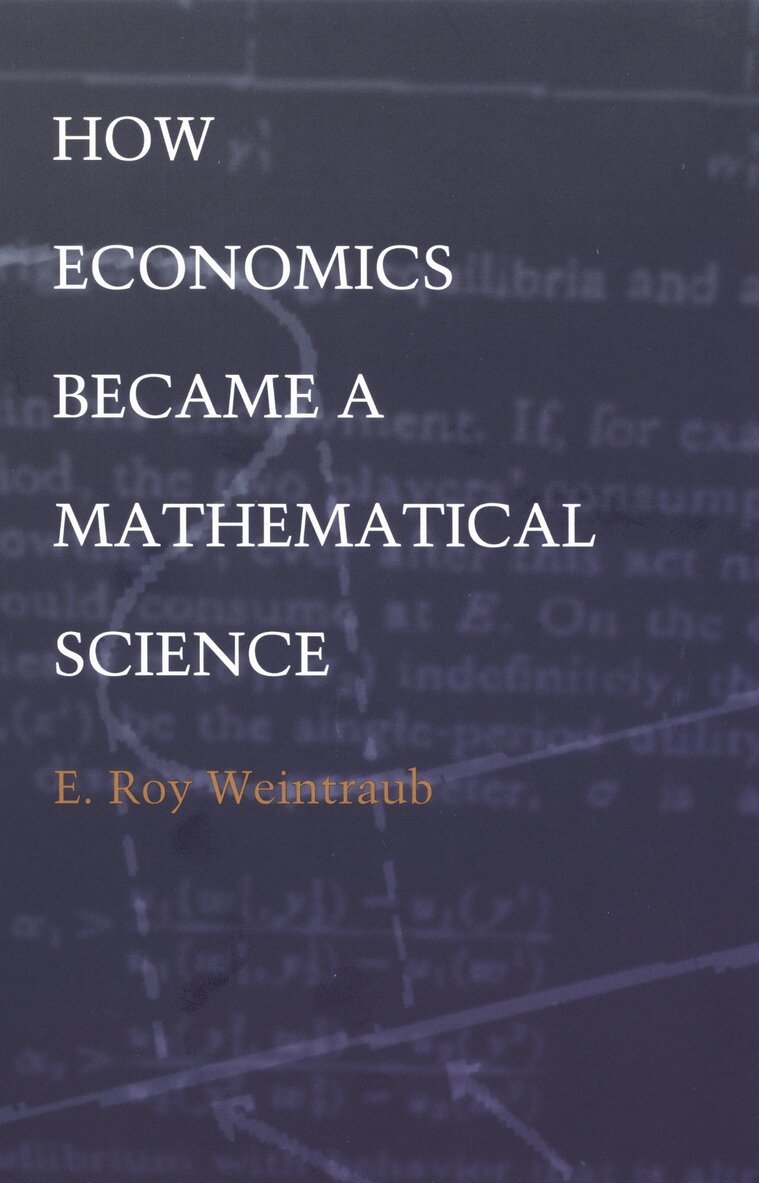
How Economics Became a Mathematical Science
Häftad, 2002
385 kr
Lägg i varukorg
In How Economics Became a Mathematical Science E. Roy Weintraub traces the history of economics through the prism of the history of mathematics in the twentieth century. As mathematics has evolved, so has the image of mathematics, explains Weintraub, such as ideas about the standards for accepting …
How Economics Became a Mathematical Science
E-bok, 2002
552 kr
Lägg i varukorg
In How Economics Became a Mathematical Science E. Roy Weintraub traces the history of economics through the prism of the history of mathematics in the twentieth century. As mathematics has evolved, so has the image of mathematics, explains Weintraub, such as ideas about the standards for accepting …
Contemporary Historiography of Economics
Av Till Düppe, E. Roy Weintraub
Inbunden, 2018
2590 kr
Lägg i varukorg
In recent years, the focus of historians of economic thought has changed to also include the ideas and practices of contemporary economists. This has opened up new questions regarding the utilization of sources, choice of method, narrative styles, and ethical issues, as well as a new awareness of …
Contemporary Historiography of Economics
Av E. Roy Weintraub, Till Duppe
E-bok, 2018
846 kr
Lägg i varukorg
In recent years, the focus of historians of economic thought has changed to also include the ideas and practices of contemporary economists. This has opened up new questions regarding the utilization of sources, choice of method, narrative styles, and ethical issues, as well as a new awareness of …
Finding Equilibrium
Arrow, Debreu, McKenzie and the Problem of Scientific Credit
Av E. Roy Weintraub, Till Duppe
E-bok, 2014
642 kr
Lägg i varukorg
The remarkable story and personalities behind one of the most important theories in modern economics Finding Equilibrium explores the post–World War II transformation of economics by constructing a history of the proof of its central dogma—that a competitive market economy may possess a set of …
How Economics Became a Mathematical Science
Inbunden, 2002
1325 kr
Tillfälligt slut
In How Economics Became a Mathematical Science E. Roy Weintraub traces the history of economics through the prism of the history of mathematics in the twentieth century. As mathematics has evolved, so has the image of mathematics, explains Weintraub, such as ideas about the standards for accepting …
Economists Lives
Biography and Autobiography in the History of Economics
Av E. Roy Weintraub, Evelyn L. Forget m. fl.
Inbunden, 2007
722 kr
Tillfälligt slut
This collection of essays, a supplement to History of Political Economy, brings together prominent scholars from economics, sociology, literature, and history to examine the role of biography and autobiography in the history of economics. The first of its kind, this volume looks at the relevance of …
MIT and the Transformation of American Economics
Inbunden, 2014
700 kr
Tillfälligt slut
MIT and the Transformation of American Economics seeks to remedy the historians’ neglect of the influential and luminary economics department at the Massachusetts Institute of Technology. The department, bolstered by an influx of innovative young scholars, was one of the most distinguished research …