
edited by Kenneth L. Taylor – författare
Visar alla böcker från författaren edited by Kenneth L. Taylor. Handla med fri frakt och snabb leverans.
2 produkter
2 produkter
680 kr
Skickas inom 10-15 vardagar
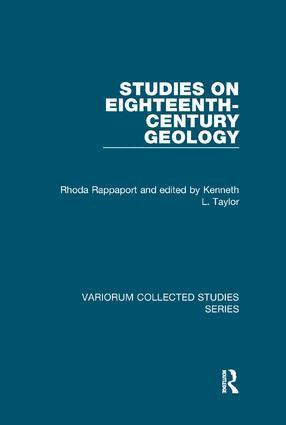
In a scholarly career spanning five decades, Rhoda Rappaport published perceptive analyses of science in the culture of early Modern Europe, France in particular, with strong emphasis on geology's early development. Of the sixteen papers in this volume, most focus on aspects of geology's cultivation during the 'long' 18th century, from the times of Hooke, Leibniz, and Fontenelle to those of Lavoisier, Werner, and Cuvier. Among the topics most closely treated here are the French mineralogical mapping project initiated by Guettard; contemporary efforts to interpret the earth historically (such as through Noah's Flood); and difficulties presented by the vocabulary often used in traditional histories of geology. Much of Rappaport's research addressed two problems prevalent within 18th-century earth science: the proper understanding of petrifactions, or fossil objects; and struggles to establish reliable knowledge of the earth's past. She also examined the chemistry of G.-F. Rouelle, which she saw as effectively an attempt at systematic comprehension of the entire mineral realm; trans-national features of scientific pursuits as illustrated in the careers of the naturalist Vallisneri and the mineralogist (and philosophe) d'Holbach; and aspects of science's promotion in France through government patronage and academic privilege.
1 591 kr
Tillfälligt slut
In a scholarly career spanning five decades, Rhoda Rappaport published perceptive analyses of science in the culture of early Modern Europe, France in particular, with strong emphasis on geology's early development. Of the sixteen papers in this volume, most focus on aspects of geology's cultivation during the 'long' 18th century, from the times of Hooke, Leibniz, and Fontenelle to those of Lavoisier, Werner, and Cuvier. Among the topics most closely treated here are the French mineralogical mapping project initiated by Guettard; contemporary efforts to interpret the earth historically (such as through Noah's Flood); and difficulties presented by the vocabulary often used in traditional histories of geology. Much of Rappaport's research addressed two problems prevalent within 18th-century earth science: the proper understanding of petrifactions, or fossil objects; and struggles to establish reliable knowledge of the earth's past. She also examined the chemistry of G.-F. Rouelle, which she saw as effectively an attempt at systematic comprehension of the entire mineral realm; trans-national features of scientific pursuits as illustrated in the careers of the naturalist Vallisneri and the mineralogist (and philosophe) d'Holbach; and aspects of science's promotion in France through government patronage and academic privilege.