Edmund V. Sullivan - Böcker
Visar alla böcker från författaren Edmund V. Sullivan. Handla med fri frakt och snabb leverans.
2 produkter
2 produkter
279 kr
Skickas inom 10-15 vardagar
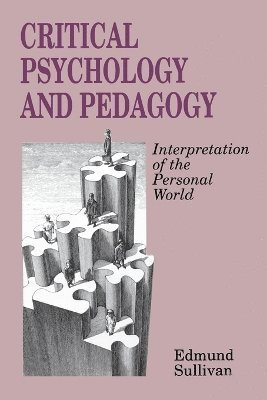
Edmund Sullivan describes the working of his book as an elaboration of its title Critical Psychology and Pedagogy: Interpretation of the Personal World. Sullivan thoroughly develops his meaning of critical psychology and demonstrates its relationship to the personal world. His bottom line: psychology is extraordinarily relevant to the current working of society, playing an important role in the organization and maintenance of its institutions. Developing this critical pedagogy for the interpretation of the personal world, Sullivan completes his work with concrete examples of how critical psychology addresses applied problems. While his examples come from his own background in education, this pedagogy can be applied productively to the psychological discourse of any area or discipline.Critical Psychology and Pedagogy holds the individual and society in dynamic tension. In his first three chapters Sullivan critiques the notion of individualism, abandons it, and develops the concept of the `personal'. Embarking on an interdisciplinary venture, he broadens psychological discourse to deal with the personal world as it is linked to society and systematically examines the issues of power dynamics. Theory becomes moments of reflection in action. Finally, he proposes a radical orientation in which emancipatory interest in human freedom (is) based on the intentional action of persons. He completes his study by applying his pedagogy to concrete examples.
1 064 kr
Skickas inom 10-15 vardagar
If the reader will excuse a brief anecdote from my own intellectual history, I would like to use it as an introduction to this book. In 1957, I was a sophomore at an undergraduate liberal arts college major ing in medieval history. This was the year that we were receiving our first introduction to courses in philosophy, and I took to this study with a passion. In pursuing philosophy, I discovered the area called "philosophical psychology," which was a Thomistic category of inquiry. For me, "philosophical psychology" meant a more intimate study of the soul (psyche), and I immediately concluded that psychology as a discipline must be about this pursuit. This philosophical interest led me to enroll in my first introductory psychology course. Our text for this course was the first edition of Ernest Hilgaard's Introduction to Psychology. My reasons for entering this course were anticipated in the introductory chapter of Hilgaard's book, where the discipline and its boundaries were discussed, and this introduction was to disabuse me of my original intention for enrolling in the course. I was to learn that, in the 20th century, people who called themselves psychologists were no longer interested in perennial philosophical questions about the human psyche or person. In fact, these philosophical questions were considered to be obscurantist and passe. Psychology was now the "scientific" study of human behavior. This definition of psychology by Hilgaard was by no means idiosyncratic to this introductory textbook.