Edward Keene - Böcker
Visar alla böcker från författaren Edward Keene. Handla med fri frakt och snabb leverans.
5 produkter
5 produkter
2 280 kr
Skickas inom 5-8 vardagar
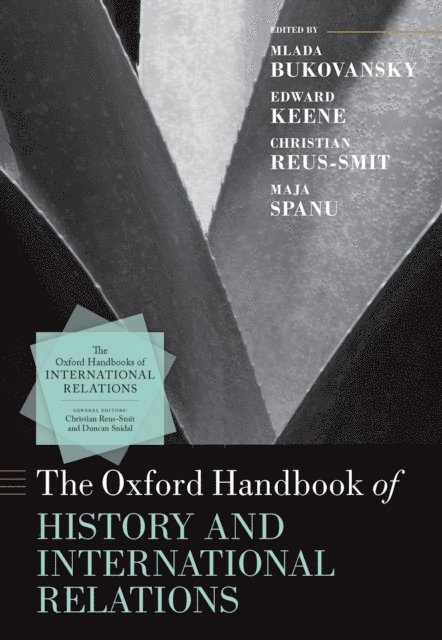
Historical approaches to the study of world politics have always been a major part of the academic discipline of International Relations, and there has recently been a resurgence of scholarly interest in this area. This Oxford Handbook examines the past and present of the intersection between history and IR, and looks to the future by laying out new questions and directions for research. Seeking to transcend well-worn disciplinary debates between historians and IR scholars, the Handbook asks authors from both fields to engage with the central themes of 'modernity' and 'granularity'. Modernity is one of the basic organising categories of speculation about continuity and discontinuity in the history of world politics, but one that is increasingly questioned for privileging one kind of experience and marginalizing others. The theme of granularity highlights the importance of how decisions about the scale and scope of historical research in IR shape what can be seen, and how one sees it. Together, these themes provide points of affinity across the wide range of topics and approaches presented here.The Handbook is organized into four parts. The first, 'Readings', gives a state-of-the-art analysis of numerous aspects of the disciplinary encounter between historians and IR theorists. Thereafter, sections on 'Practices', 'Locales', and 'Moments' offer a wide variety of perspectives, from the longue durée to the ephemeral individual moment, and challenge many conventional ways of defining the contexts of historical enquiry about international relations. Contributors come from a range of academic backgrounds, and present a diverse array of methodological and philosophical ideas, as well as their various historical interests. The Oxford Handbooks of International Relations is a twelve-volume set of reference books offering authoritative and innovative engagements with the principal sub-fields of International Relations.The series as a whole is under the General Editorship of Christian Reus-Smit of the University of Queensland and Duncan Snidal of the University of Oxford, with each volume edited by specialists in the field. The series both surveys the broad terrain of International Relations scholarship and reshapes it, pushing each sub-field in challenging new directions. Following the example of Reus-Smit and Snidal's original Oxford Handbook of International Relations, each volume is organized around a strong central thematic by scholars drawn from different perspectives, reading its sub-field in an entirely new way, and pushing scholarship in challenging new directions.
428 kr
Skickas inom 7-10 vardagar
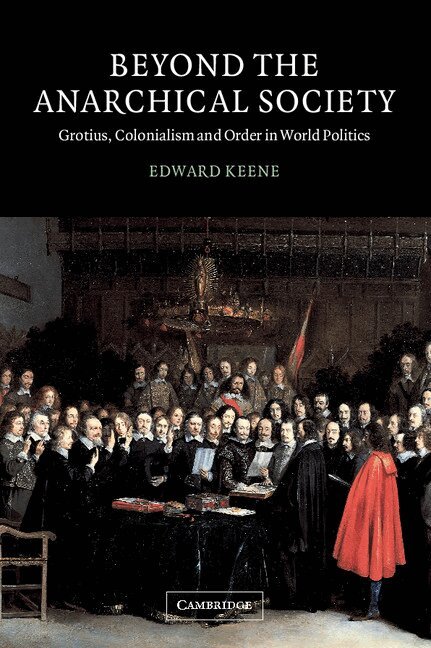
Edward Keene argues that the conventional idea of an 'anarchical society' of equal and independent sovereign states is an inadequate description of order in modern world politics. International political and legal order has always been dedicated to two distinct goals: to try to promote the toleration of different ways of life, while advocating the adoption of one specific way, that it labels 'civilization'. The nineteenth-century solution to this contradiction was to restrict the promotion of civilization to the world beyond Europe. That discriminatory way of thinking has now broken down, with the result that a single, global order is supposed to apply to everyone, but opinion is still very much divided as to what the ultimate purpose of this global order should be, and how its political and legal structure should be organised.
Beyond the Anarchical Society
Grotius, Colonialism and Order in World Politics
Inbunden, Engelska, 2002
771 kr
Skickas inom 7-10 vardagar
Edward Keene argues that the conventional idea of an 'anarchical society' of equal and independent sovereign states is an inadequate description of order in modern world politics. International political and legal order has always been dedicated to two distinct goals: to try to promote the toleration of different ways of life, while advocating the adoption of one specific way, that it labels 'civilization'. The nineteenth-century solution to this contradiction was to restrict the promotion of civilization to the world beyond Europe. That discriminatory way of thinking has now broken down, with the result that a single, global order is supposed to apply to everyone, but opinion is still very much divided as to what the ultimate purpose of this global order should be, and how its political and legal structure should be organised.
719 kr
Skickas inom 7-10 vardagar
This volume offers an accessible and wide-ranging introduction to the history of international political thought. Taking as its starting-point the various concepts people have used to think about differences between political communities, the book explores changing perceptions of international politics from antiquity to the twentieth century. As well as discussing well-known themes such as relations between independent sovereign states and the tension between raison d'état and a universal code of natural law, it also examines less familiar ideas which have influenced the development of international political thought such as the distinction between civilization, national culture and barbarism, religious attitudes towards infidels, and theories about racial difference and imperialism. Among the key thinkers covered are Thucydides, Machiavelli, Hobbes, Kant, Marx and Morgenthau, alongside less commonly studied figures such as Herodotus, Pope Innocent IV, Herder, Constant and Zimmern. Each chapter concludes with a guide to further reading which will help students to develop a more detailed understanding of the subject.Written with the beginner student in mind, this lively textbook is an ideal introduction for anyone studying international political thought.
294 kr
Skickas inom 5-8 vardagar
This volume offers an accessible and wide-ranging introduction to the history of international political thought. Taking as its starting-point the various concepts people have used to think about differences between political communities, the book explores changing perceptions of international politics from antiquity to the twentieth century. As well as discussing well-known themes such as relations between independent sovereign states and the tension between raison d'état and a universal code of natural law, it also examines less familiar ideas which have influenced the development of international political thought such as the distinction between civilization, national culture and barbarism, religious attitudes towards infidels, and theories about racial difference and imperialism. Among the key thinkers covered are Thucydides, Machiavelli, Hobbes, Kant, Marx and Morgenthau, alongside less commonly studied figures such as Herodotus, Pope Innocent IV, Herder, Constant and Zimmern. Each chapter concludes with a guide to further reading which will help students to develop a more detailed understanding of the subject.Written with the beginner student in mind, this lively textbook is an ideal introduction for anyone studying international political thought.