Efstathios Vassiliou - Böcker
Visar alla böcker från författaren . Handla med fri frakt och snabb leverans.
3 produkter
3 produkter
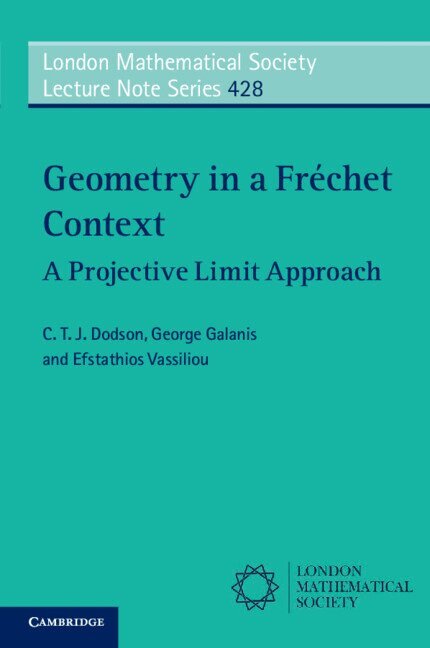
Del 428 - London Mathematical Society Lecture Note Series
Geometry in a Fréchet Context
A Projective Limit Approach
Häftad, Engelska, 2015
876 kr
Skickas inom 7-10 vardagar
Many geometrical features of manifolds and fibre bundles modelled on Fréchet spaces either cannot be defined or are difficult to handle directly. This is due to the inherent deficiencies of Fréchet spaces; for example, the lack of a general solvability theory for differential equations, the non-existence of a reasonable Lie group structure on the general linear group of a Fréchet space, and the non-existence of an exponential map in a Fréchet-Lie group. In this book, the authors describe in detail a new approach that overcomes many of these limitations by using projective limits of geometrical objects modelled on Banach spaces. It will appeal to researchers and graduate students from a variety of backgrounds with an interest in infinite-dimensional geometry. The book concludes with an appendix outlining potential applications and motivating future research.
1 062 kr
Skickas inom 10-15 vardagar
L' inj' ' enuit' ' m eme d' un regard neuf (celui de la science l'est toujours) peut parfois ' 'clairer d' un jour nouveau d' anciens probl' emes. J.Monod [77, p. 13] his book is intended as a comprehensive introduction to the theory of T principalsheaves andtheirconnections inthesettingofAbstractDi?- ential Geometry (ADG), the latter being initiated by A. Mallios'sGeometry of Vector Sheaves [62]. Based on sheaf-theoretic methods and sheaf - homology, the presentGeometry of Principal Sheaves embodies the classical theory of connections on principal and vector bundles, and connections on vector sheaves, thus paving the way towards a uni?ed (abstract) gauge t- ory and other potential applications to theoretical physics. We elaborate on the aforementioned brief description in the sequel. Abstract (ADG) vs. Classical Di?erential Geometry (CDG). M- ern di?erential geometry is built upon the fundamental notions of di?er- tial (smooth) manifolds and ?ber bundles, based,intheir turn, on ordinary di?erential calculus.However, the theory of smooth manifolds is inadequate to cope, for - stance, with spaces like orbifolds, spaces with corners, or other spaces with more complicated singularities. This is a rather unfortunate situation, since one cannot apply the powerful methods of di?erential geometry to them or to any spaces that do not admit an ordinary method of di?erentiation. The ix x Preface same inadequacy manifests in physics, where many geometrical models of physical phenomena are non-smooth.
1 062 kr
Skickas inom 10-15 vardagar
L' inj' ' enuit' ' m eme d' un regard neuf (celui de la science l'est toujours) peut parfois ' 'clairer d' un jour nouveau d' anciens probl' emes. J.Monod [77, p. 13] his book is intended as a comprehensive introduction to the theory of T principalsheaves andtheirconnections inthesettingofAbstractDi?- ential Geometry (ADG), the latter being initiated by A. Mallios'sGeometry of Vector Sheaves [62]. Based on sheaf-theoretic methods and sheaf - homology, the presentGeometry of Principal Sheaves embodies the classical theory of connections on principal and vector bundles, and connections on vector sheaves, thus paving the way towards a uni?ed (abstract) gauge t- ory and other potential applications to theoretical physics. We elaborate on the aforementioned brief description in the sequel. Abstract (ADG) vs. Classical Di?erential Geometry (CDG). M- ern di?erential geometry is built upon the fundamental notions of di?er- tial (smooth) manifolds and ?ber bundles, based,intheir turn, on ordinary di?erential calculus.However, the theory of smooth manifolds is inadequate to cope, for - stance, with spaces like orbifolds, spaces with corners, or other spaces with more complicated singularities. This is a rather unfortunate situation, since one cannot apply the powerful methods of di?erential geometry to them or to any spaces that do not admit an ordinary method of di?erentiation. The ix x Preface same inadequacy manifests in physics, where many geometrical models of physical phenomena are non-smooth.