Elgene E. O. Box - Böcker
Visar alla böcker från författaren Elgene E. O. Box. Handla med fri frakt och snabb leverans.
6 produkter
6 produkter
Vegetation Science in Forestry
Global Perspective based on Forest Ecosystems of East and Southeast Asia
Inbunden, Engelska, 1995
2 101 kr
Skickas inom 10-15 vardagar
Volume 12 of the "Handbook of Vegetation Science", dealt with the application of vegetation science in forestry, mostly European forestry. It was well received by the critics with the exception that they wanted a more diversified demonstration of forestry-related vegetation science work and a wider representation of forest types from different continents. The topics covered in this volume, 12/1, widen the scope of vegetation science work in forestry over the phytosociological work which was the main focus in the previous volume. Topics covered include forest ecosystems of East and Southeast Asia in a global perspective; climatic relations of the forests of East and Southeast Asia; species diversity in East Asia in global perspective; evergreen forest regions; summergreen forest regions; montane/boreal regions; and tropical forest regions.
3 149 kr
Skickas inom 10-15 vardagar
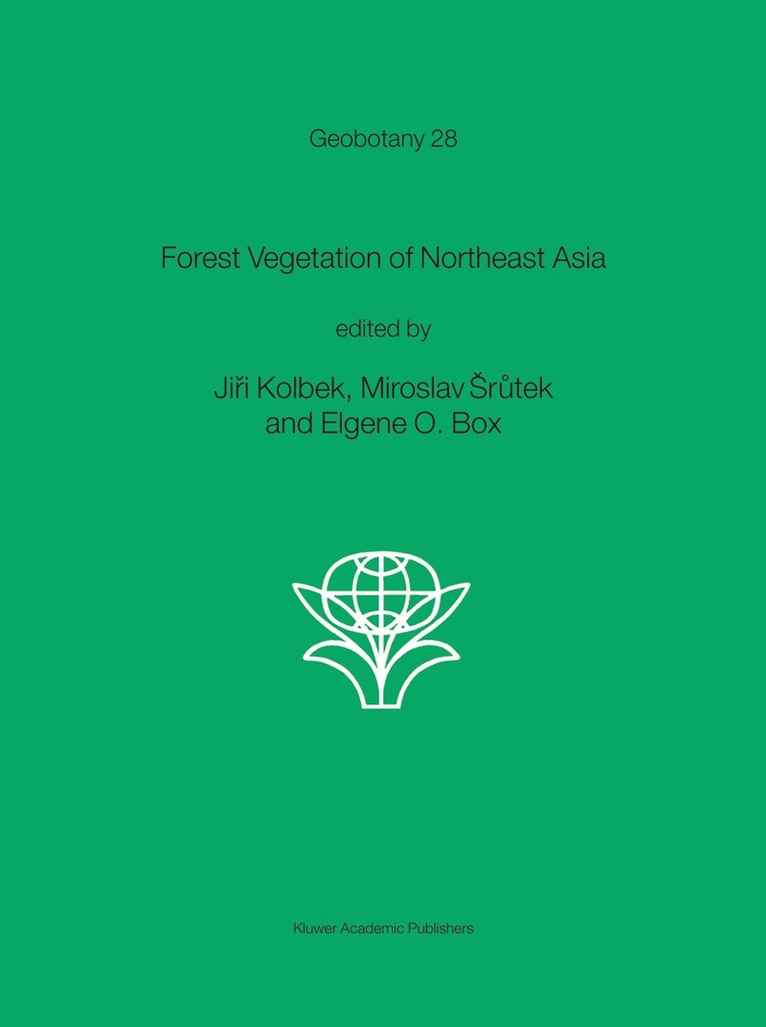
This title presents a detailed survey of the forest vegetation of northeast Asia, a vast, mainly boreal or cool-temperate region that includes the Russian Far East (easternmost Siberia, Kamchatka, Sakhalin and Kuril Islands), Manchuria (northeastern China and adjacent), and northern Korea and Japan. Vegetation descriptions were prepared by local and foreign vegetation scientists, partly from literature sources but also from local field experience, including the several Czech-Slovak botanical expeditions to North Korea during the 1990s. Regional integration is provided in chapters on physical conditions and biogeography, and in a chapter comparing vegetation syntaxa. Two methodologies are used: 1) Exploration and forest classification following the Sukachev school of forest types (Manchuria and Russian Far East); and 2) Forest classification by Zurich-Montpellier (Braun-Blanquet) methodology (Japan and North Korea).
Vegetation Science in Forestry
Global Perspective based on Forest Ecosystems of East and Southeast Asia
Häftad, Engelska, 2010
2 101 kr
Skickas inom 10-15 vardagar
More than a decade has passed since Professor Gisela Jahn completed Volume 12 of the Handbook of Vegetation Science, dealing with the application of vegetation science in forestry, mostly European forestry. The volume was well received by the critics with the exception that they wanted a more diversified demonstration of forestry-related vegetation science work and a wider representation of forest types from different continents. The topics covered in this volume, 12/1, widen the scope of vegetation science work in forestry over the phytosociological work which was the main focus in the Handbook as perceived by Dr Tuxen. Section 1. Overview T. Kira: Forest Ecosystems of East and Southeast Asia in a Global Perspective; E.O. Box: Climatic Relations of the Forests of East and Southeast Asia; K. Iwatsuki: Species Diversity in East Asia in Global Perspective. The remaining contributions are divided into the following sections: Evergreen Forest Region; Summergreen Forest Region; Montane/Boreal Region; Tropical Forest Region.
3 149 kr
Skickas inom 10-15 vardagar
This book presents the first detailed survey, in English, of the forest vegetation of northeast Asia, a vast, mainly boreal or cool-temperate region that includes the Russian Far East (easternmost Siberia, Kamchatka, Sakhalin and Kuril Islands), Manchuria (northeastern China and adjacent), and northern Korea and Japan. Vegetation descriptions were prepared by local and foreign vegetation scientists, partly from literature sources but also from local field experience, including the several Czech-Slovak botanical expeditions to North Korea during the 1990s. Regional integration is provided in chapters on physical conditions and biogeography, and in a chapter comparing vegetation syntaxa. Two methodologies are used: 1) Exploration and forest classification following the Sukachev school of forest types (Manchuria and Russian Far East); and 2) Forest classification by Zurich-Montpellier (Braun-Blanquet) methodology (Japan and North Korea). The book should be valuable to vegetation scientists, conservation biologists, and anyone interested in the regional vegetation and landscapes, including students.
Macroclimate and Plant Forms
An Introduction to Predictive Modeling in Phytogeography
Inbunden, Engelska, 1981
2 101 kr
Skickas inom 10-15 vardagar
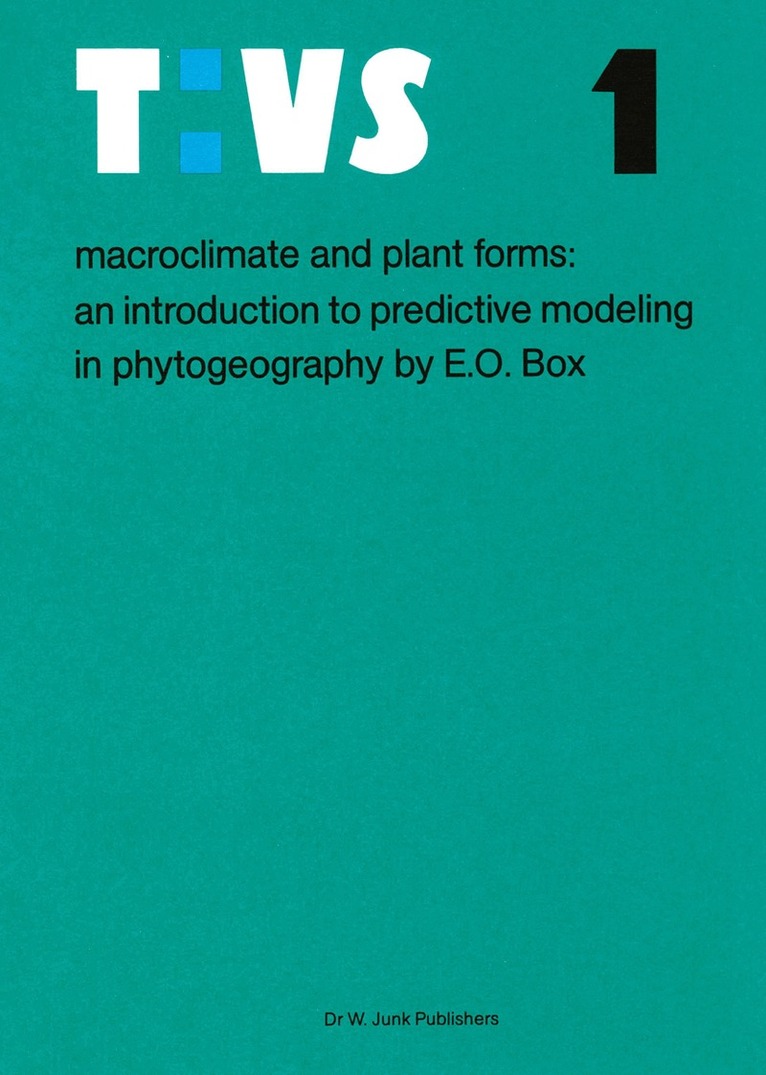
This study arose out ofthe old question of what actually determines vegetation structure and distributions. Is climate the overriding control, as one would suppose from reading the more geographically oriented literature? Or is climate only incidental, as suggested by more site and/ or taxon-oriented writers? The question might be phrased more realistically: How much does climate control vegetation processes, structures, and distributions? It seemed to me, as an ambitious doctoral student, that one way to attempt an answer might be to try to predict world vegetation from climate alone and then compare the predicted results with actual vegetation patterns. If climatic data were sufficient to reproduce the world's actual vegetation patterns, then one could conclude that climate is the main control. This book represents an expanded, second-generation version of that original thesis. It presents world-scale vegetation and ecoclimatic models and a methodology for applying such models to predict vegetation and for evaluating model results. This approach also provides a means of geographical simulation of vegetation patterns and changes, which represent necessary data inputs in other fields such as atmospheric chemistry and biogeochemical cycling. It has been fairly well accepted that climatic and other environmental conditions are associated with the evolution of particular aspects of plant form (convergent evolution). The particular configurations of plant size, photosynthetic surface area and structure (e. g. sclerophylly, stomatal 'resistance'), and their seasonal variations represent what one can recognize fairly readily as distinct growth forms.
Macroclimate and Plant Forms
An Introduction to Predictive Modeling in Phytogeography
Häftad, Engelska, 2011
2 101 kr
Skickas inom 10-15 vardagar
This study arose out ofthe old question of what actually determines vegetation structure and distributions. Is climate the overriding control, as one would suppose from reading the more geographically oriented literature? Or is climate only incidental, as suggested by more site and/ or taxon-oriented writers? The question might be phrased more realistically: How much does climate control vegetation processes, structures, and distributions? It seemed to me, as an ambitious doctoral student, that one way to attempt an answer might be to try to predict world vegetation from climate alone and then compare the predicted results with actual vegetation patterns. If climatic data were sufficient to reproduce the world's actual vegetation patterns, then one could conclude that climate is the main control. This book represents an expanded, second-generation version of that original thesis. It presents world-scale vegetation and ecoclimatic models and a methodology for applying such models to predict vegetation and for evaluating model results. This approach also provides a means of geographical simulation of vegetation patterns and changes, which represent necessary data inputs in other fields such as atmospheric chemistry and biogeochemical cycling. It has been fairly well accepted that climatic and other environmental conditions are associated with the evolution of particular aspects of plant form (convergent evolution). The particular configurations of plant size, photosynthetic surface area and structure (e. g. sclerophylly, stomatal 'resistance'), and their seasonal variations represent what one can recognize fairly readily as distinct growth forms.