Elia R.G. Pusterla - Böcker
Visar alla böcker från författaren Elia R.G. Pusterla. Handla med fri frakt och snabb leverans.
3 produkter
3 produkter
1 273 kr
Skickas inom 10-15 vardagar
This book presents an innovative and thought-provoking argument regarding the foundations of politics and its ethical implications, exploring the difference between what politics is (and/or can be) and what it is not (and/or cannot be). It distinguishes between two fundamental forms of political poverty, namely ontological poverty and theoretical poverty. Ontological poverty depicts the negative foundation upon which the political relies—an absence that, paradoxically, underpins the political existence. In contrast, theoretical poverty emerges when this ontological datum is self-delusively denied by politics itself, leading to the loss of political properties of politics, or political poverty, and the resulting dehumanisation of the political subject. Drawing on Aristotelian logic, the volume discloses the aporetic condition of political ontology, deploying phenomenological inquiry through deconstruction. Through close readings of Kafka, Agamben, Derrida, Levinas, and Schmitt among others, it maps the porous threshold between the political and the non-political, illuminating how this tension—between being and becoming—is conditional to politics itself and simultaneously the site of its potential impoverishment. In this context, theoretical poverty is recognised as the prodromic moment when politics ceases to carry its own name, severing its ties to the ethical and ontological relations that sustain it. This work makes a significant contribution to contemporary debates in political philosophy, political theory, political ontology, and ethics. It will particularly appeal to scholars engaged with continental philosophy and literary theory. It opens a new avenue of inquiry into the political foundations by questioning what politics is and what it risks not becoming.
534 kr
Skickas inom 10-15 vardagar
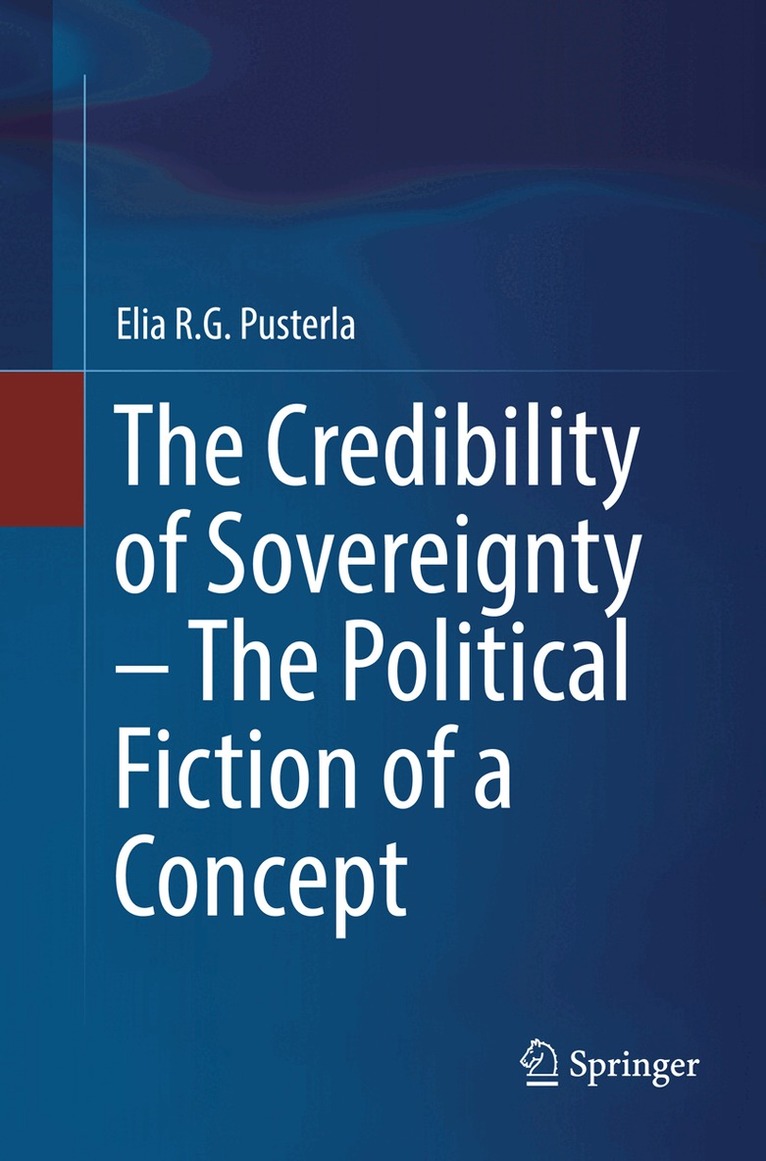
The book deeply analyses the bilateral relations between Switzerland and the European Union and their effect on the former's sovereignty in the context of Europeanisation. This touches on philosophical debates on the complexity of sovereignty. What sovereignty is at stake when talking about Swiss-EU relations? This issue not only faces the elusiveness of sovereignty as a concept, but also the proliferation of hypocrisy on its presence within states. The book encounters the deconstructionist hypothesis stating that there is nothing to worry about but the belief there is something to worry about. Derrida’s deconstruction of sovereignty allows indeed one to grasp the fictional essence of sovereignty based on the metaphysics of presence. The presence of self-positing sovereign ipseity is fictional since absent in the present, but spectrally present in the belief of its presence to come. Sovereignty is a matter of credibility, or the credible promise of a normative statement to come. Hence, the book challenges the realist/neorealist argument stating that states are credibly sovereign until proven otherwise and explains that the debate on state sovereignty calls for the unveiling of this hypocritical epistemology cunningly disguised as an objective presence. Swiss-EU relations thus become the cornerstone to not only theorise but also test sovereignty and deconstruct the two ontological and epistemological sides of the same coin, or the modern hypocrisy of sovereignty. This deconstruction constitutes the very problématique of any attempt to understand whether and how a state can be sovereign and solve the problem as to how to neutralise the différance and identify the difference between credible and incredible claims of sovereignty. This problématique connects the theory and practice of sovereignty innovatively, providing positivist evidence on the arguable credibility of the Swiss claim of sovereignty and confirming the presence of a theological dimension within politics.
534 kr
Skickas inom 10-15 vardagar
Hence, the book challenges the realist/neorealist argument stating that states are credibly sovereign until proven otherwise and explains that the debate on state sovereignty calls for the unveiling of this hypocritical epistemology cunningly disguised as an objective presence.