Elijah Chudnoff – författare
Visar alla böcker från författaren Elijah Chudnoff. Handla med fri frakt och snabb leverans.
11 produkter
Intuition
E-bok, 2013
495 kr
Lägg i varukorg
We know about our immediate environment--about the people, animals, and things around us--by having sensory perceptions. According to a tradition that traces back to Plato, we know about abstract reality--about mathematics, morality, and metaphysics--by having intuitions, which can be thought of as …
Intuition
E-bok, 2013
495 kr
Lägg i varukorg
We know about our immediate environment--about the people, animals, and things around us--by having sensory perceptions. According to a tradition that traces back to Plato, we know about abstract reality--about mathematics, morality, and metaphysics--by having intuitions, which can be thought of as …
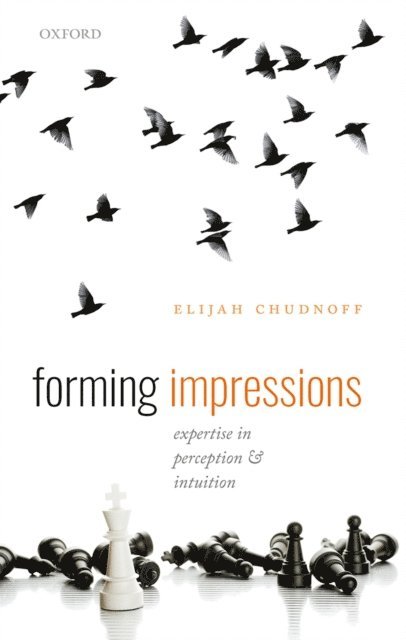
Forming Impressions
Expertise in Perception and Intuition
E-bok, 2020
1100 kr
Lägg i varukorg
Perception and intuition are our basic sources of knowledge about the concrete world around us, and more abstract matters such as mathematics, metaphysics, and morality. Perception and intuition, however, are also capacities we deliberately improve in ways that draw on our knowledge about these …
Forming Impressions
Expertise in Perception and Intuition
E-bok, 2020
1100 kr
Lägg i varukorg
Perception and intuition are our basic sources of knowledge about the concrete world around us, and more abstract matters such as mathematics, metaphysics, and morality. Perception and intuition, however, are also capacities we deliberately improve in ways that draw on our knowledge about these …
Intuition
Häftad, 2016
666 kr
Lägg i varukorg
We know about our immediate environment--about the people, animals, and things around us--by having sensory perceptions. According to a tradition that traces back to Plato, we know about abstract reality--about mathematics, morality, and metaphysics--by having intuitions, which can be thought of as …
Forming Impressions
Expertise in Perception and Intuition
Inbunden, 2020
1233 kr
Lägg i varukorg
Perception and intuition are our basic sources of knowledge about the concrete world around us, and more abstract matters such as mathematics, metaphysics, and morality. Perception and intuition, however, are also capacities we deliberately improve in ways that draw on our knowledge about these …
Intuition
Inbunden, 2013
1811 kr
Lägg i varukorg
We know about our immediate environment--about the people, animals, and things around us--by having sensory perceptions. According to a tradition that traces back to Plato, we know about abstract reality--about mathematics, morality, and metaphysics--by having intuitions, which can be thought of as …
Cognitive Phenomenology
Inbunden, 2015
2744 kr
Lägg i varukorg
Phenomenology is about subjective aspects of the mind, such as the conscious states associated with vision and touch, and the conscious states associated with emotions and moods, such as feelings of elation or sadness. These states have a distinctive first-person ‘feel’ to them, called their …
Cognitive Phenomenology
Häftad, 2015
735 kr
Lägg i varukorg
Phenomenology is about subjective aspects of the mind, such as the conscious states associated with vision and touch, and the conscious states associated with emotions and moods, such as feelings of elation or sadness. These states have a distinctive first-person ‘feel’ to them, called their …
Cognitive Phenomenology
E-bok, 2015
866 kr
Lägg i varukorg
Phenomenology is about subjective aspects of the mind, such as the conscious states associated with vision and touch, and the conscious states associated with emotions and moods, such as feelings of elation or sadness. These states have a distinctive first-person ‘feel’ to them, called their …
Cognitive Phenomenology
E-bok, 2015
866 kr
Lägg i varukorg
Phenomenology is about subjective aspects of the mind, such as the conscious states associated with vision and touch, and the conscious states associated with emotions and moods, such as feelings of elation or sadness. These states have a distinctive first-person ‘feel’ to them, called their …