Elisa Freschi - Böcker
Visar alla böcker från författaren Elisa Freschi. Handla med fri frakt och snabb leverans.
2 produkter
2 produkter
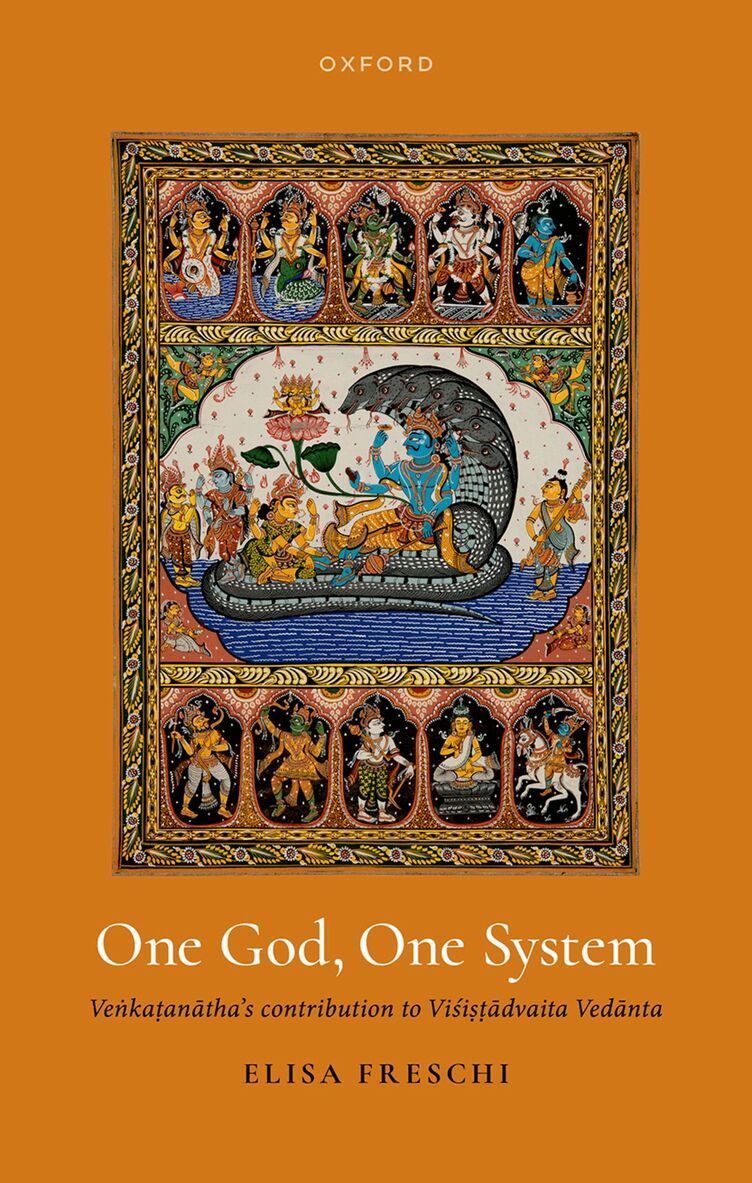
One God, One System
Ven:&kat.&ana¯&tha's Contribution to Vis´&is.&t.&a¯&dvaita Veda¯&nta
Inbunden, Engelska, 2026
1 105 kr
Kommande
One God, One System charts a history of Sanskrit philosophy in the absence of an agreed-upon canon, timeline, principal thinkers, or core philosophical questions. Contrary to previous ahistorical approaches centered on unchanging 'schools', Elisa Freschi focuses on andreconstructs the intellectual figure of Veṅkaṭanātha and his philosophical and theological contribution to what we now call 'Viśiṣṭādvaita Vedānta'.This volume explores how Viśiṣṭādvaita Vedānta as we know it now is largely a product of Veṅkaṭanātha's unique philosophical and theological contributions. He connected various texts and theories so that readers and practitioners looking at the time before Veṅkaṭanātha now recognize them as parts of a unitary whole. Once Veṅkaṭanātha's contribution is in place it is in fact easy to look back at authors before him and recognize them as pieces of the same jigsaw puzzle. Freschi presents a novel reading of Veṅkaṭanātha through focused chapters on his epistemology, ontology, soteriology, and theology, examining both the range and theoretical basis of his synthesis and methodology.
Rule-extension Strategies in Ancient India
Ritual, Exegetical and Linguistic Considerations on the "tantra"- and "prasaṅga"-Principles
Inbunden, Engelska, 2013
660 kr
Skickas inom 5-8 vardagar
This study focuses on the devices implemented in Classical Indian texts on ritual and language in order to develop a structure of rules in an economic and systematic way. These devices presuppose a spatial approach to ritual and language, one which deals for instance with absences as substitutions within a pre-existing grid, and not as temporal disappearances. In this way, the study reveals a key feature of some among the most influential schools of Indian thought.The sources are Kalpasūtra, Vyākaraṇa and Mīmāṃsā, three textual traditions which developed alongside each other, sharing – as the volume shows – common presuppositions and methodologies. The book will be of interest for Sanskritists, scholars of ritual exegesis and of the history of linguistics.