Elisabeth Dutton - Böcker
Visar alla böcker från författaren Elisabeth Dutton. Handla med fri frakt och snabb leverans.
10 produkter
10 produkter
363 kr
Skickas inom 5-8 vardagar
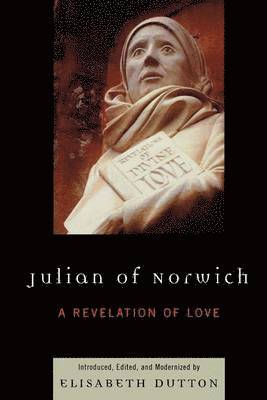
Written in a time of plague and persecution, Julian of Norwich's Revelation of Love grapples with the problem of evil and the challenge it presents to those who wish to believe in a loving God. Julian's sixteen revelations about sin and redemption are some of the first theological works written in English. While her reassuring wisdom has gained in popularity over time, her struggles to reconcile her inner questioning with the teachings she had received through the church and through her mystical visions will also ring true to many readers today.In this new version, Elisabeth Dutton preserves the beauty and ambiguity in the original language, while rendering this classic accessible to modern readers. Dutton's introduction provides essential background information on Julian of Norwich, explores her role as a woman in church, and sheds light on how her ideas relate to modern issues.
Del 3 - Westfield Medieval Studies
John Gower, Trilingual Poet
Language, Translation, and Tradition
Inbunden, Engelska, 2010
1 625 kr
Skickas inom 7-10 vardagar
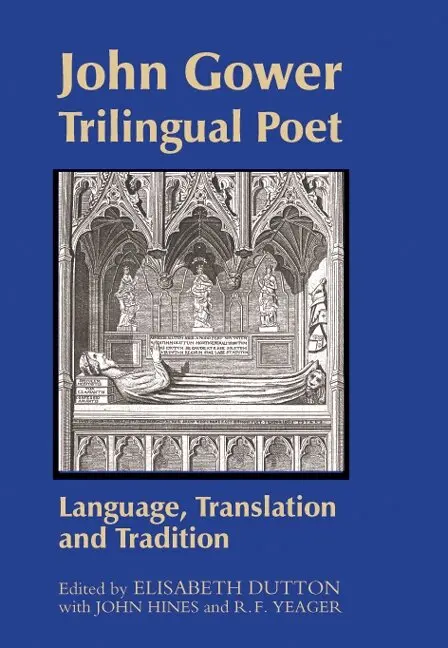
New essays demonstrate Gower's mastery of the three languages of medieval England, and provide a thorough exploration of the voices he used and the discourses in which he participated.John Gower wrote in three languages - Latin, French, and English - and their considerable and sometimes competing significance in fourteenth-century England underlies his trilingualism. The essays collected in this volume start from Gower as trilingual poet, exploring Gower's negotiations between them - his adaptation of French sources into his Latin poetry, for example - as well as the work of medieval translators who made Gower's French poetry availablein English. "Translation" is also considered more broadly, as a "carrying over" (its etymological sense) between genres, registers, and contexts, with essays exploring Gower's acts of translation between the idioms of varied literary and non-literary forms; and further essays investigate Gower's writings from literary, historical, linguistic, and codicological perspectives. Overall, the volume bears witness to Gower's merit and his importance to English literary history, and increases our understanding of French and Latin literature composed in England; it also makes it possible to understand and to appreciate fully the shape and significance of Gower's literary achievement and influence, which have sometimes suffered in comparison to Chaucer. ELISABETH DUTTON is Fellow of Worcester College, Oxford.Contributors: Elisabeth Dutton, Jean Pascal Pouzet, Ethan Knapp, Carolyn P. Collette,Elliot Kendall, Robert R. Edwards, George Shuffleton, Nigel Saul, David Carlson, Candace Barrington, Andreea Boboc, Tamara F. O'Callaghan, Stephanie Batkie, Karla Taylor, Brian Gastle, Matthew Irvin, Peter Nicholson, J.A. Burrow,Holly Barbaccia, Kim Zarins, Richard F. Green, Cathy Hume, John Bowers, Andrew Galloway, R.F. Yeager, Martha Driver
323 kr
Skickas inom 7-10 vardagar
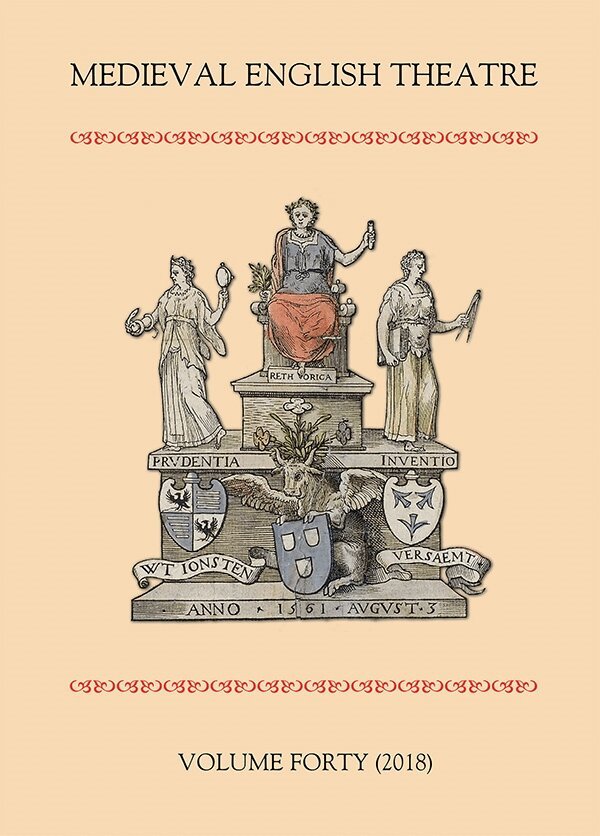
Essays on aspects of early drama.Medieval English Theatre is the premier journal in early theatre studies. Its name belies its wide range of interest: it publishes articles on theatre and pageantry from across the British Isles up to the opening of the London playhouses and the suppression of the civic mystery cycles, and also includes contributions on European and Latin drama, together with analyses of modern survivals or equivalents, and of research productions of medieval plays.The articles in this fortieth volume engage with the key communities for early theatre: royalty, city and household, and religious institutions. Topics include the Royal Entry of Elizabeth Woodville into Norwich (1469); Henry VIII's Robin Hood entertainment for Catherine of Aragon; the sun's contribution to stage effects in the York Corpus Christi Play: the engagement with local worthies in Mankind; and the convent drama of Huy, in the Low Countries.Contributors: Aurélie Blanc, Philip Butterworth, Clare Egan, John Marshall, Olivia Robinson, Michael Spence, Meg Twycross.
323 kr
Skickas inom 7-10 vardagar
Essays on the performance of drama from the middle ages, ranging from the well-known cycles of York to matter from Iran.Medieval English Theatre is the premier journal in early theatre studies. Its name belies its wide range of interest: it publishes articles on theatre and pageantry from across the British Isles up to the opening of the London playhouses and the suppression of the civic mystery cycles, and also includes contributions on European and Latin drama, together with analyses of modern survivals or equivalents, and of research productions of medieval plays.The articles here focus on civic theatre and display. Chester, York, Durham and Newcastle, and London. Practicalities are to the fore: what the Drawers of Dee actually did, how the actors in the York Corpus Christi Play knewwhat time it was, the difficulties presented to London pageantry by unauthorised house-extensions and horse-droppings. Even the stately entertainments of a royal tour by James VI & I featured (in Newcastle, of course) negotiationover the monopoly on coal disguised as a historical event in a play about King Alfred and Canute. Ranging further afield is an introduction to the living tradition of Iranian mystery plays, whose history and development have somethought-provoking parallels with those of medieval waggon plays in the West. Finally, the director and producer discuss their 2019 production of John Redford's Wit and Science by Edward's Boys, the first to be played by aboys' company since the sixteenth century.
Del 42 - Medieval English Theatre
Medieval English Theatre 42
Religious Drama and Community
Häftad, Engelska, 2021
500 kr
Skickas inom 7-10 vardagar
Essays on the performance of drama from the Middle Ages, ranging from the well-known cycles of York to matter from Iran.Medieval English Theatre is the premier journal in early theatre studies. Its name belies its wide range of interest: it publishes articles on theatre and pageantry from across the British Isles up to the opening of the London playhouses and the suppression of the civic mystery cycles, and also includes contributions on European and Latin drama, together with analyses of modern survivals or equivalents, and of research productions of medieval plays.Theatrical performance is central to the groups and communities discussed in this volume, and to their particular and local expressions of faith. The articles presented explore the drama of a variety of different communities from religious orders and houses, through local, medieval and post-medieval lay communities, to contemporary worshippers. Contributors examine complex relationships between theatrical performance and faith, understanding religious theatre as a mode of worship and a method of exploring belief, as well as a site for the study of synchronous and asynchronous connections and fractures within communities. Particular topics addressed include the fragments of play-scripts surviving from the monastery at Mont-St-Michel; the Barking Abbey Easter celebrations; and how the sixteenth-century community which owned the surviving copy of the Towneley plays might have understood them in relation to their own faith. The volume is completed with an exploration of traditional Iranian religious theatre from an ethnographic perspective, in a bid to uncover and understand its very particular effects on the contemporary communities who perform and attend it in the twenty-first century.ELISABETH DUTTON and OLIVA ROBINSON run the Medieval Convent Drama project, based at the University of Fribourg and funded by the Swiss National Science Foundation, which provides the impetus for this special issue of Medieval English Theatre. Contributors: Aurélie Blanc, Eleanor Lucy Deacon, George Gandy, Camille Marshall, James Stokes
323 kr
Skickas inom 7-10 vardagar
The ludic element of drama in the Middle Ages - or drama with early subject matter - is here to the fore.Medieval English Theatre is the premier journal in early theatre studies. Its name belies its wide range of interest: it publishes articles on theatre and pageantry from across the British Isles up to the opening of the London playhouses and the suppression of the civic mystery cycles, and also includes contributions on European and Latin drama, together with analyses of modern survivals or equivalents, and of research productions of medieval plays.This edition combines, perhaps unexpectedly, royalty and games. Games of all kinds, from jousting and "Christmas games" to those usually associated with children, are shown, it is suggested, to be more than they at first appear. Apparently run-of-the-mill entertainments, when presented to the court by the Londoners, by the court to a visiting emperor , or by the retainers of royalty and nobility to the general public for commercial gain, turn out to have unexpected political resonances; while the potential underlying sadism of children's games gains a horrific immediacy when diverted to the torturing of Christ. Even today, the musical SIX says a great deal more about royalty and role-playing than initially might appear, especially when set against eye-witness accounts of the first meeting of Anna of Cleves with Henry VIII, and what modern novelists have made of it . In the process we learn a great deal more about the detail of these games, from the maskerie costumes of James VI and Anna of Denmark to the elaborate fantasy challenges of the jousters in 1400/1401, which incidentally suggest that fourteenth-century court culture, whose language was Anglo-French, is a major missing link in the history of what is usually treated as purely English literature.Contributors: Philip Bennett, Philip Butterworth, Sarah Carpenter, Elisabeth Dutton, James Forse, Gordon Kipling, Michael Pearce, Meg Twycross.
323 kr
Skickas inom 7-10 vardagar
Newest research into drama and performance of the Middle Ages and Tudor period.Medieval English Theatre is the premier journal in early theatre studies. Its name belies its wide range of interest: it publishes articles on theatre and pageantry from across the British Isles up to the opening of the London playhouses and the suppression of the civic religious plays , and also includes contributions on European and Latin drama, together with analyses of modern survivals or equivalents, and of research productions of medieval plays.The papers in this volume explore richly interlocking topics. Themes of royalty and play continue from Volume 43. We have the first in-depth examination of the employment of the now-famous Black Tudor trumpeter, John Blanke, at the royal courts of Henry VII and Henry VIII. An entertaining survey of the popular European game of blanket-tossing accompanies the translation of a raucous, sophisticated, but surprisingly humane Dutch rederijkers farce. The Towneley plays remain fertile ground for further research, and this blanket-tossing farce illuminates a key scene of the well-known Second Shepherd's Play. New exploration of a colloquial reference to 'Stafford Blue' in another Towneley pageant, Noah, not only enlivens the play's social context but contributes to important current re-thinking of the manuscript's date. Two papers bring home the theatrical potential of food and eating. We learn how the Tudor interlude Jacob and Esau dramatises the preparation and provision of food from the Genesis story. Serving and eating meals becomes a means of social, theological, and theatrical manipulation. Contrastingly, in the N. Town Last Supper play and a French convent drama, we see how the bread of Passover, the Last Supper, and the Mass could be evoked, layered and shared in performance. In both these plays the audiences' experiences of theatre and of communion overlap and inform each other.
500 kr
Skickas inom 7-10 vardagar
Newest research into drama and performance from the Middle Ages and the Tudor period. Medieval English Theatre is the premier journal in early theatre studies. Its name belies its wide range of interest: it publishes articles on theatre and pageantry from across the British Isles up to the opening of the London playhouses and the suppression of the civic religious plays, and also includes contributions on European and Latin drama, together with analyses of modern survivals or equivalents, and of research productions of medieval plays. This volume offers new perspectives in three important areas. It opens with an investigation of the tantalising image of the Black Tudor trumpeter, John Blanke, in the Westminster Tournament Roll. Complementing the assessment of the documentary evidence for his employment in our last volume, it uncovers the surprising complexity of how Islamic dress was represented at the court of Henry VIII. Two essays engage with the challenging Croxton Play of the Sacrament, discussing very different issues of bodily integrity. The first revealingly brings together medieval and posthumanist theory, proposing how in performance the play can move to obliterate the distinction between Jewish and Christian bodies. The second considers the play in the light of modern disability theory, before examining the often contrasting evidence of lives lived, and performances informed, by actual disabled performers. The final contributions focus on twentieth- and twenty-first-century performances of medieval material, and how it can be adapted for later times and sensibilities. Investigation of an almost unknown 1924 London performance of a fifteenth-century French nativity play reveals much about early twentieth-century views of medieval drama. Meanwhile, the 2023 coronation of King Charles III prompts an analysis of a spectacular ceremony balanced between asserting its medieval origins and demonstrating its modern relevance. Finally, a review of a story-telling performance assesses how the problematic material of The Seven Sages of Rome might be addressed to modern audiences and preoccupations.
500 kr
Skickas inom 7-10 vardagar
Newest research into drama and performance from the Middle Ages and the Tudor period.Medieval English Theatre is the premier journal in early theatre studies. Its name belies its wide range of interest: it publishes articles on theatre and pageantry from across the British Isles up to the opening of the London playhouses and the suppression of the civic religious plays, and also includes contributions on European and Latin drama, together with analyses of modern survivals or equivalents, and of research productions of medieval plays. This volume is testament to the lively range of current research across the field of medieval theatre. It investigates different traditions of performance, through a variety of theatrical, theological, and material approaches. It opens with an analysis of a fascinating Dutch rhetoricians play-text, revealing how its engagingly disruptive female character, "Everyday Chitchat", proves central to a serious discussion of censorship - in a play which was itself censored. Although no play-text survives from medieval Beverley, the next contribution shows how local records of its Corpus Christi plays offer rich details of a range of pageants and organisation not dissimilar from its more famous neighbour, York. The two following articles investigate theological issues. A nuanced re-reading of The Treatise of Miracles Playing considers how priestly involvement in performance raised anxieties about the role and authority of priests, including at the Mass. Attitudes to "dread", revealed through the taxonomies of fear developed by medieval theologians, then illuminate the didactic role of fear, engendered in the protagonists and audiences of the Macro morality plays. The volume closes with the second part of an investigation into "John Blanke's Hat". Following the first part's demonstration, in the previous volume of METh, that the Black trumpeter's headgear was not a marker of his faith, this uncovers the true identity of the hat, asking how far it can offer evidence for his history. The present volume thus throws new light on familiar texts and questions, offering important contributions to newly developing fields of study.
890 kr
Kommande
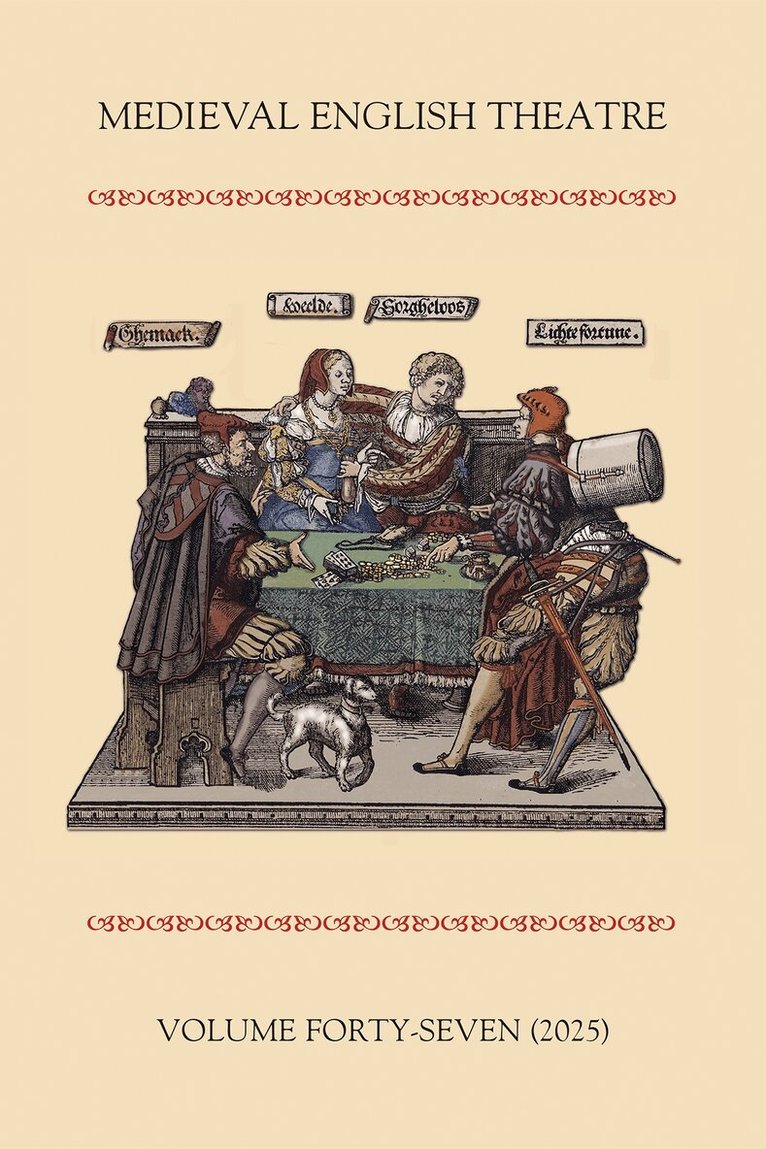
Newest research into drama and performance from the Middle Ages and the Tudor period.Medieval English Theatre is the premier journal in early theatre studies. Its name belies its wide range of interest: it publishes articles on theatre and pageantry from across the British Isles up to the opening of the London playhouses and the suppression of the civic religious plays, and also includes contributions on European, Latin and other cognate drama, together with analyses of modern survivals or equivalents, and of research productions of medieval plays. This volume explores issues of performance and audience-engagement across a wide range of theatrical texts and genres. It opens with a question of sensibilities. An analysis of the French blindman farces examines their now deeply unsettling scenarios of slapstick violence against the vulnerable. Rather than simple callousness, did their staging rely on diverting the audience's attention from the action performed to the skills of the performer? Two essays arise from performances as research. One production, of the Dutch Rhetoricians' play Man's Desire and Fleeting Beauty, drew on its audiencesto evaluate how far prologues, epilogues, and theatrical frames might affect responses to the "message" of a play. Another explored how the implicit performativity of a fifteenth-century narrative poem, The Life of Job, might be realised through the astonishing skills of acrobats. A review of a third production, of the Tudor interlude of Godly Queen Hester, further attests to the current vitality of research through performance. Three new play translations, from Europe and beyond, introduce English speakers to richly varied, and highly actable, performance practices. Two are of 1530s Rhetoricians' plays from Bruges which directly address the economic woes of their home city. The first, censored by the authorities, was replaced by the superficially less critical second; but both address the plight of workers in a recession, in disarmingly comic detail with disconcertingly present-day resonances. The third introduces readers to how the Iranian Taʿziyeh drama movingly stages the struggle between Satan and the prophet Ayoub (Job), presenting an unfamiliarly sympathetic view of the sufferings of Job's Wife.