Elizabeth Irvine - Böcker
Visar alla böcker från författaren Elizabeth Irvine. Handla med fri frakt och snabb leverans.
4 produkter
4 produkter
1 078 kr
Skickas inom 5-8 vardagar
Andy Clark is a leading philosopher of cognitive science, whose work has had an extraordinary impact throughout philosophy, psychology, neuroscience, and robotics. His monographs have led the way for new research programs in the philosophy of mind and cognition: Microcognition (1989) and Associative Engines (1993) introduced the philosophical community to connectionist research and the novel issues it raised; Being There (1997) showed the relevance of embodiment, dynamical systems theory, and minimal computation frameworks for the study of the mind; Natural Born Cyborgs (OUP 2003) presented an accessible development of embodied and embedded approaches to understanding human nature and cognition; Supersizing the Mind (OUP 2008) developed this yet further along with the famous "Extended Mind" hypothesis; and Surfing Uncertainty (OUP 2017) presents a framework for uniting perception, action, and the embodied mind.In Andy Clark and His Critics, a range of high-profile researchers in philosophy of mind, philosophy of cognitive science, and empirical cognitive science, critically engage with Clark's work across the themes of: Extended, Embodied, Embedded, Enactive, and Affective Minds; Natural Born Cyborgs; and Perception, Action, and Prediction. Daniel Dennett provides a foreword on the significance of Clark's work, and Clark replies to each section of the book, thus advancing current literature with original contributions that will form the basis for new discussions, debates and directions in the discipline.
272 kr
Skickas inom 5-8 vardagar
Del 5 - Studies in Brain and Mind
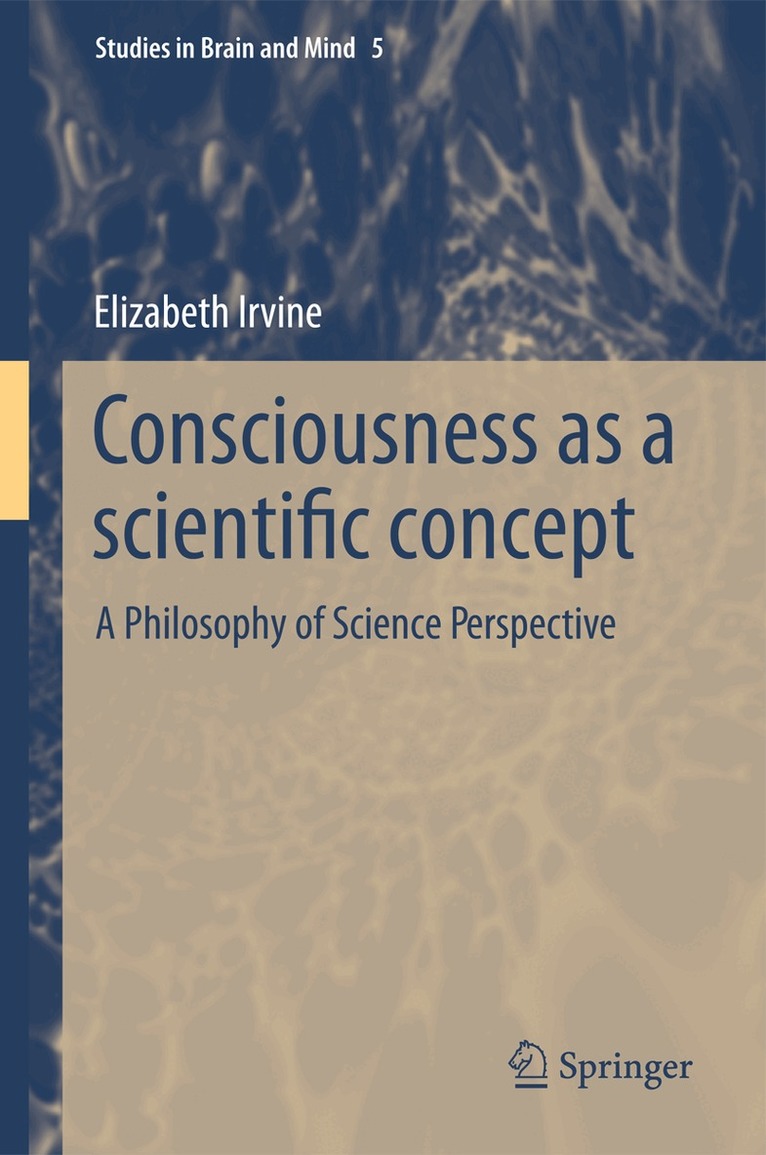
Consciousness as a Scientific Concept
A Philosophy of Science Perspective
Inbunden, Engelska, 2012
1 062 kr
Skickas inom 10-15 vardagar
The source of endless speculation and public curiosity, our scientific quest for the origins of human consciousness has expanded along with the technical capabilities of science itself and remains one of the key topics able to fire public as much as academic interest. Yet many problematic issues, identified in this important new book, remain unresolved. Focusing on a series of methodological difficulties swirling around consciousness research, the contributors to this volume suggest that ‘consciousness’ is, in fact, not a wholly viable scientific concept. Supporting this ‘eliminativist‘ stance are assessments of the current theories and methods of consciousness science in their own terms, as well as applications of good scientific practice criteria from the philosophy of science. For example, the work identifies the central problem of the misuse of qualitative difference and dissociation paradigms, often deployed to identify measures of consciousness. It also examines the difficulties that attend the wide range of experimental protocols used to operationalise consciousness—and the implications this has on the findings of integrative approaches across behavioural and neurophysiological research. The work also explores the significant mismatch between the common intuitions about the content of consciousness, that motivate much of the current science, and the actual properties of the neural processes underlying sensory and cognitive phenomena. Even as it makes the negative eliminativist case, the strong empirical grounding in this volume also allows positive characterisations to be made about the products of the current science of consciousness, facilitating a re-identification of target phenomena and valid research questions for the mind sciences.
Del 5 - Studies in Brain and Mind
Consciousness as a Scientific Concept
A Philosophy of Science Perspective
Häftad, Engelska, 2014
1 062 kr
Skickas inom 10-15 vardagar
The source of endless speculation and public curiosity, our scientific quest for the origins of human consciousness has expanded along with the technical capabilities of science itself and remains one of the key topics able to fire public as much as academic interest. Yet many problematic issues, identified in this important new book, remain unresolved. Focusing on a series of methodological difficulties swirling around consciousness research, the contributors to this volume suggest that ‘consciousness’ is, in fact, not a wholly viable scientific concept. Supporting this ‘eliminativist‘ stance are assessments of the current theories and methods of consciousness science in their own terms, as well as applications of good scientific practice criteria from the philosophy of science. For example, the work identifies the central problem of the misuse of qualitative difference and dissociation paradigms, often deployed to identify measures of consciousness. It also examines the difficulties that attend the wide range of experimental protocols used to operationalise consciousness—and the implications this has on the findings of integrative approaches across behavioural and neurophysiological research. The work also explores the significant mismatch between the common intuitions about the content of consciousness, that motivate much of the current science, and the actual properties of the neural processes underlying sensory and cognitive phenomena. Even as it makes the negative eliminativist case, the strong empirical grounding in this volume also allows positive characterisations to be made about the products of the current science of consciousness, facilitating a re-identification of target phenomena and valid research questions for the mind sciences.