
Elizabeth Van Volkenburgh – författare
Visar alla böcker från författaren Elizabeth Van Volkenburgh. Handla med fri frakt och snabb leverans.
2 produkter
2 produkter

Inbunden, Engelska, 2011
531 kr
Skickas inom 10-15 vardagar
Plants, so predictable, stay where they are. And yet, like all living things, they also move: they grow, adapt, shed leaves and bark, spread roots and branches, snare pollinators, and reward cultivators. This book, the first to thoroughly explore the subject since Darwin’s 1881 treatise on movements in plants, is a comprehensive, up-to-date account of the mechanisms and the adaptive values that move plants.Drawing on examples across the spectrum of plant families—including mosses, ferns, conifers, and flowering plants—the author opens a window on how plants move: within cells, as individual cells, and via organs. Opening with an explanation of how cellular motors work and how cells manage to move organs, Dov Koller considers the movement of roots, tubers, rhizomes, and other plant parts underground, as well as the more familiar stems, leaves, and flowers.Throughout, Koller presents information at the subcellular and cellular levels, including the roles of receptors, signaling pathways, hormones, and physiological responses in motor function. He also discusses the adaptive significance of movements. His book exposes the workings of a world little understood and often overlooked, the world of restless plants and the movements by which they accomplish the necessary functions of their lives.
Inbunden, Engelska, 2016
2 356 kr
Tillfälligt slut
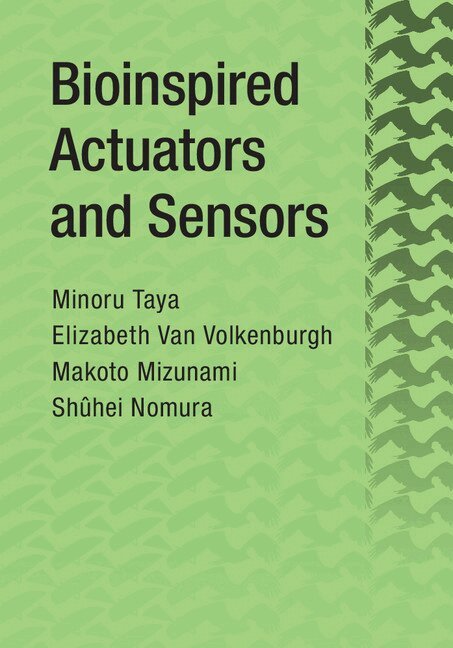
From authors renowned in the fields of engineering and biology, this is the first book to integrate sensor and actuator technology with bioinspired design. Beginning with detailed descriptions of actuation and sensing mechanisms in plants and animals, the authors move on to apply these principles to synthetic design, offering in-depth knowledge of the development of state-of-the-art smart materials and devices. All of this is supported with a range of real-world applications, from tactile sensory systems in insects linked with the development of robotic hands, to the structural colour systems in nature used to inspire camouflage technology. Further examples are given of successful designs along with their integrated autonomous systems, such as flying and swimming, unmanned systems, and autonomous zero-energy building design. With a wide interdisciplinary appeal, this is an ideal resource for any student, practising engineer, or researcher interested in the connection between natural systems and synthetic design.