Emily Polk – författare
Visar alla böcker från författaren Emily Polk. Handla med fri frakt och snabb leverans.
3 produkter
3 produkter
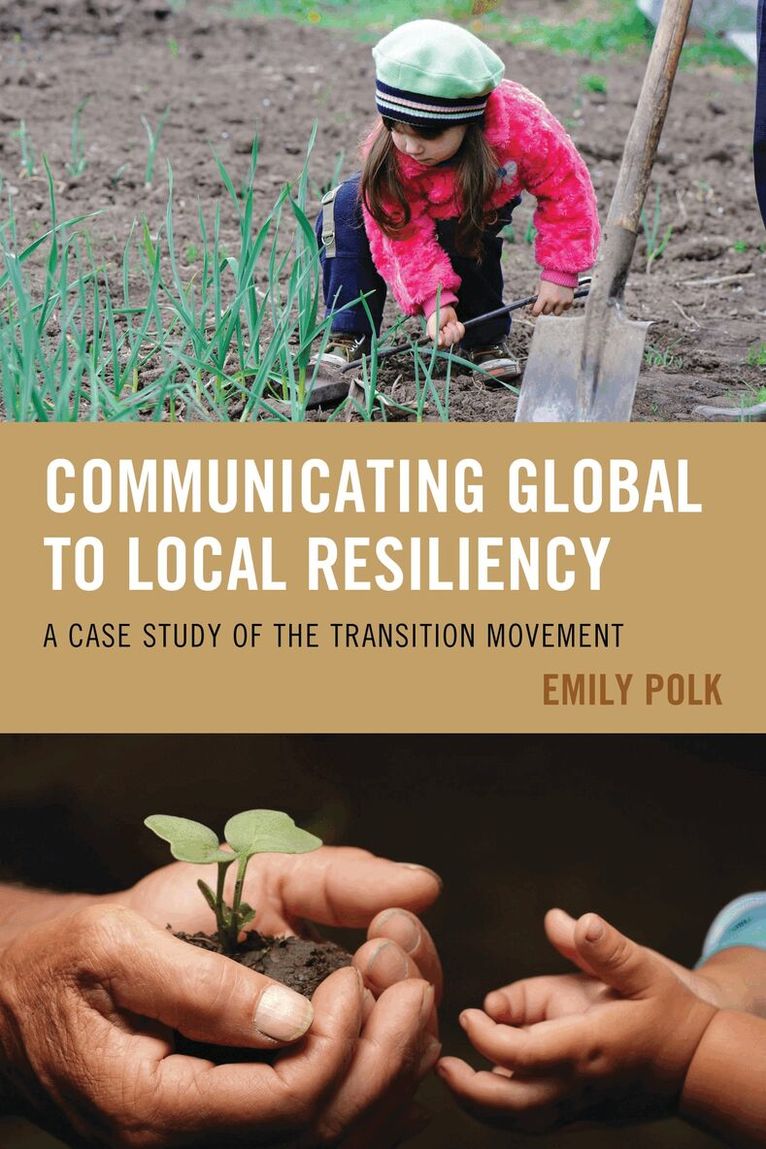
Communicating Global to Local Resiliency
A Case Study of the Transition Movement
Inbunden, Engelska, 2015
1 219 kr
Skickas inom 10-15 vardagar
This book explores the communication processes of the Transition Movement, a community-led global social movement, as it was adapted in a local context. First it analyzes how the movement’s grand narratives of responding to “climate change” and creating greater “resiliency” were communicated into local community-based stories, responses, and actions in the Transition Town of Amherst, Massachusetts. Second, it seeks to understand the multilayered communication processes that facilitate these actions toward sustainable social change. Transition Amherst developed and/or supported projects that addressed reducing dependency on peak-oil, creating community-based-local economies, supporting sustainable food production and consumption, and participating in more efficient transportation, among others. The popularity of the model coincides with an increase in the interest in and use of the term “sustainability” by media, academics and policymakers around the world, and an increase in the global use of digital technology as a resource for information gathering and sharing. Thus this book situates itself at the intersections of a global environmental and economic crisis, the popularization of the term “sustainability,” and an increasingly digitized and networked global society in order to better understand how social change is contextualized and facilitated in a local community via a global network. This book is the first comprehensive analysis of the ways in which the theories of Transition are applied over an extended period of time in practice, on the ground in a Transition town.
541 kr
Kommande
Amid intersecting climate and health crises as well as rapid developments in artificial intelligence and new media forms, the need for communicating science with nuance and care has never been greater. Communicating Science in Public supports science communicators who seek to engage in compelling ways with audiences with varied levels of scientific expertise. The volume provides not a rule book, nor a set of templates and formulas, but rather a portable set of rhetorical strategies for working across science communication genres with the expectation that these genres will continue to change and new ones will emerge. Introductory chapters provide a foundation for communicating science in public across genres. The genre-specific chapters – including chapters on personal essays, op-eds, science exhibits, and podcasts – then offer histories of how a given genre evolved as well as where it fits into broader media ecologies. These chapters provide examples of the genre, key considerations for navigating its affordances and constraints, and a process for brainstorming, composing, revision, and reflection. By taking a genre-based approach, this book asks its readers to reimagine science communication as more than an act of translating complex ideas into simpler terms. Instead, readers learn to reflect on the opportunities and limitations of different forms of communication and how to engage diverse publics in inclusive, accessible ways, developing transferable, transformative rhetorical knowledge. This book will help readers navigate a complex communication landscape and think about rhetorical opportunities broadly. It can be used as a science communication textbook geared toward advanced undergraduate students and graduate students with a foundation in the sciences who are learning how to communicate scientific ideas to non-specialist audiences. Features:Makes communicating science, effectively, a more critical skill than ever.Builds skills for engaging public audiences through multiple genres and modalities beyond print.Offers practical advice for scientists, new and established, who want to communicate their science more broadly.
1 416 kr
Kommande
Amid intersecting climate and health crises as well as rapid developments in artificial intelligence and new media forms, the need for communicating science with nuance and care has never been greater. Communicating Science in Public supports science communicators who seek to engage in compelling ways with audiences with varied levels of scientific expertise. The volume provides not a rule book, nor a set of templates and formulas, but rather a portable set of rhetorical strategies for working across science communication genres with the expectation that these genres will continue to change and new ones will emerge. Introductory chapters provide a foundation for communicating science in public across genres. The genre-specific chapters – including chapters on personal essays, op-eds, science exhibits, and podcasts – then offer histories of how a given genre evolved as well as where it fits into broader media ecologies. These chapters provide examples of the genre, key considerations for navigating its affordances and constraints, and a process for brainstorming, composing, revision, and reflection. By taking a genre-based approach, this book asks its readers to reimagine science communication as more than an act of translating complex ideas into simpler terms. Instead, readers learn to reflect on the opportunities and limitations of different forms of communication and how to engage diverse publics in inclusive, accessible ways, developing transferable, transformative rhetorical knowledge. This book will help readers navigate a complex communication landscape and think about rhetorical opportunities broadly. It can be used as a science communication textbook geared toward advanced undergraduate students and graduate students with a foundation in the sciences who are learning how to communicate scientific ideas to non-specialist audiences. Features:Makes communicating science, effectively, a more critical skill than ever.Builds skills for engaging public audiences through multiple genres and modalities beyond print.Offers practical advice for scientists, new and established, who want to communicate their science more broadly.