Emily S. Bassman - Böcker
Visar alla böcker från författaren Emily S. Bassman. Handla med fri frakt och snabb leverans.
2 produkter
2 produkter
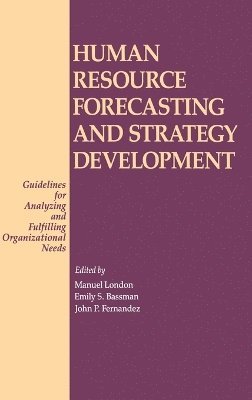
Human Resource Forecasting and Strategy Development
Guidelines for Analyzing and Fulfilling Organizational Needs
Inbunden, Engelska, 1990
901 kr
Skickas inom 10-15 vardagar
A collection of original articles by leading practitioners and researchers, this volume examines methods for human resource forecasting and planning to meet the strategic needs of the organization. As the editors note at the outset, changing characteristics of the workforce and new skill demands mean that human resource planning must become an integral part of corporate strategy development and implementation. In order to compete successfully in an era of rapid technological change, organizations must be able to adequately forecast their needs for different types of employees, consider the extent to which current employees have the needed skills, and examine labor force availability. This book describes ways to collect the necessary environmental data and formulate human resource strategies that recognize current and anticipated changes both in the organization and in the environment in which it operates.The volume begins with a discussion of environmental scanning techniques. The contributors demonstrate how to identify environmental trends, including labor force demographics, and how to apply this information to the development of human resource strategies. The second section considers ways to analyze the organization's future human resource needs by examining employee demographics and job attitudes. In Part Three, the contributors describe how organizations formulate human resource strategies in response to environmental trends and organizational goals. The next group of chapters offers examples of the human resource implications of organizational change. This section includes separate chapters on job loss and employee assistance programs and the effects of a corporate merger, as well as two case studies of the relationship between human resource planning and corporate strategic goals. The contributors conclude by describing organizational reactions to changing environments brought about by an aging workforce, work-at-home jobs, new computer and telecommunications technologies, and the increasing cultural diversity of the workforce. Indispensable for human resource managers and corporate planning executives, this book will also be of significant value to researchers and students in human resource and strategic planning programs.
1 009 kr
Skickas inom 10-15 vardagar
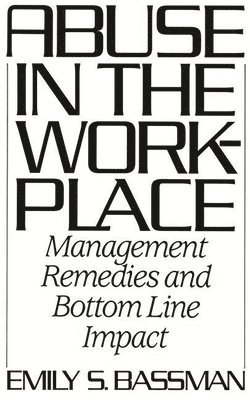
This book identifies a major threat to the productivity, profitability, and competitiveness of American business. This threat is the deteriorating relationship between managers and employees in the face of repeated downsizing, cost-cutting, and demands to accomplish more with fewer resources. Stress brings out dysfunctional, abusive behavior in managers, and a form of generic harassment results. Emily S. Bassman creates a vision of the antithesis of an abusive environment: one that is enpowering, where fair treatment is lived out in daily practices, where employees choose to exert discretionary effort, creating a peak performance culture. In creating this vision, the author applies principles from Total Quality Management to human relationships in the workplace, especially to those between managers and subordinates. The unique contribution is putting W.E. Deming's quality principles into behavioral terms based on psychology and learning theory. The author effectively documents that a transformation of how employees are treated is necessary, and not primarily to increase employee satisfaction. Rather, the primary reason to use these principles is to create the conditions whereby every employee can reach their full potential, thereby maximizing their contribution to the business and achieving transformational, rather than incremental improvements in productivity.Bassman begins by mapping out the problem-defining and describing the various forms of abuse that surface in organizations, and clarifying how employee victims of abuse behave very similarly to victims of other forms of abuse. The unique elements of employee abuse are explained in terms of the nature of power in organizations. Why we persist in self-defeating, punishing interactions is explained with reference to principles of learning, and strategies are outlined for breaking the cycle of punishment and methods of negative behavior control. The author then moves from a consideration of individual abusive relationships to institutional abuse. How employees are treated is positioned as an ethical issue, and related to aspects of corporate culture, policies, and management practices. This leads into a discussion of the impact of employee abuse on organizations. Bassman documents the costs incurred by organizations that tolerate abuse, and describes some of the corporate programs that can be used to assess the extent to which employee abuse exists in the organization. The last section of the book deals with solutions, offering guidance for senior management teams that choose to involve themselves in an assessment and cultural change effort. This book is designed to educate management and senior leadership about the issues, and provide a roadmap for change, both for leaders and managers, and for those change agents (consultants, human resource managers) who may work with them.