Enrico Giunchiglia – författare
Visar alla böcker från författaren Enrico Giunchiglia. Handla med fri frakt och snabb leverans.
5 produkter
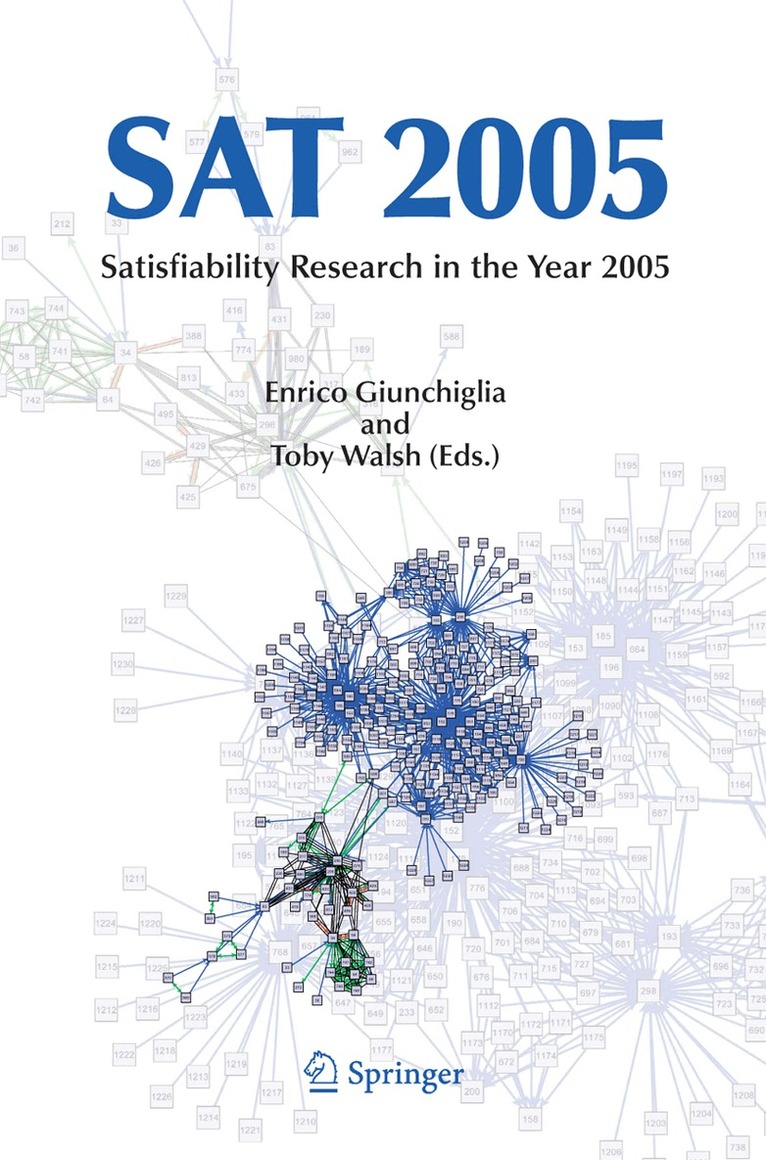
SAT 2005
Satisfiability Research in the Year 2005
Av Enrico Giunchiglia, Toby Walsh
Inbunden, 2006
1688 kr
Lägg i varukorg
This book is devoted to recent progress made in solving propositional satisfiability and related problems. Propositional satisfiability is a powerful and general formalism used to solve a wide range of important problems including hardware and software verification. The core of many reasoning …
SAT 2005
Satisfiability Research in the Year 2005
Av Toby Walsh, Enrico Giunchiglia
E-bok, 2007
2174 kr
Lägg i varukorg
This book is devoted to recent progress made in solving propositional satisfiability and related problems. Propositional satisfiability is a powerful and general formalism used to solve a wide range of important problems including hardware and software verification. The core of many reasoning …
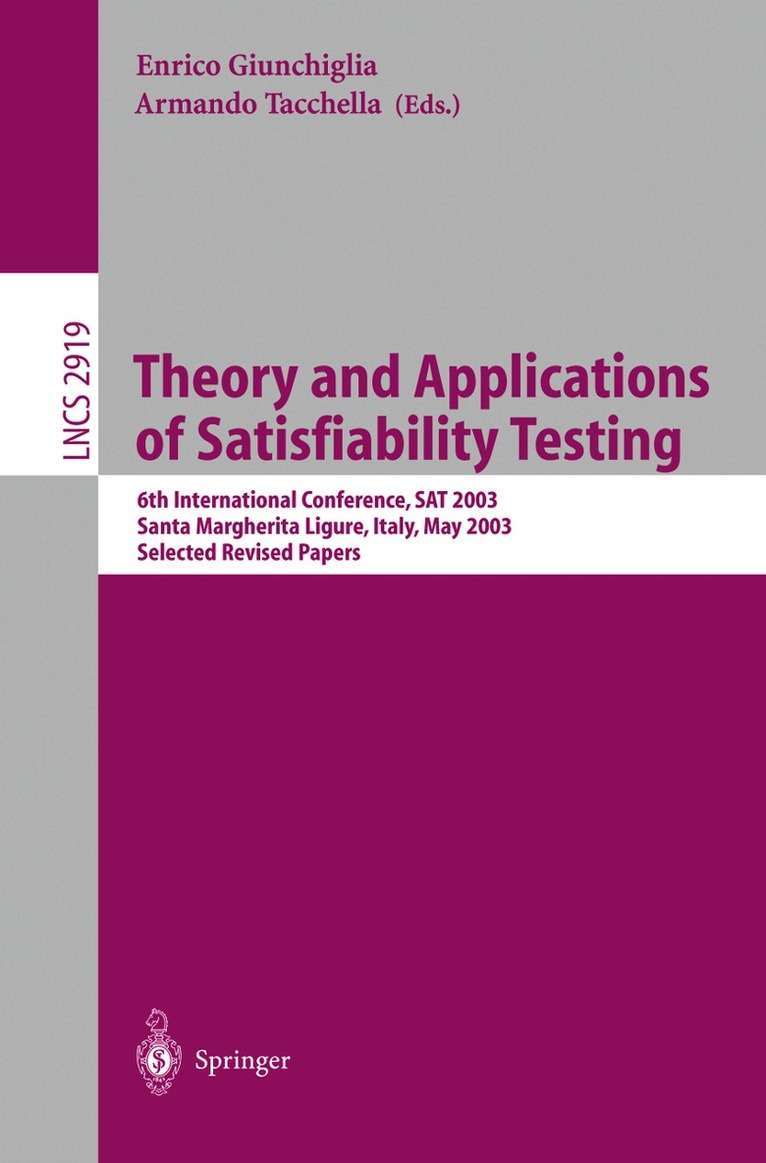
Theory and Applications of Satisfiability Testing
6th International Conference, SAT 2003. Santa Margherita Ligure, Italy, May 5-8, 2003, Selected Revised Papers
Av Enrico Giunchiglia, Armando Tacchella
Häftad, 2004
552 kr
Lägg i varukorg
This book is devoted to the 6th International Conference on Theory and - plications of Satis?ability Testing (SAT 2003) held in Santa Margherita Ligure (Genoa,Italy), during May5-8,2003. SAT 2003followedthe WorkshopsonS- is?ability held in Siena (1996), Paderborn (1998), and Renesse (2000), and the …
Theory and Applications of Satisfiability Testing
6th International Conference, SAT 2003. Santa Margherita Ligure, Italy, May 5-8, 2003, Selected Revised Papers
Av Armando Tacchella, Enrico Giunchiglia
E-bok, 2004
734 kr
Lägg i varukorg
SAT 2005
Satisfiability Research in the Year 2005
Av Enrico Giunchiglia, Toby Walsh
Häftad, 2014
1692 kr
Lägg i varukorg
This book is devoted to recent progress made in solving propositional satisfiability and related problems. Propositional satisfiability is a powerful and general formalism used to solve a wide range of important problems including hardware and software verification. The core of many reasoning …