Eric Dietrich – författare
Visar alla böcker från författaren Eric Dietrich. Handla med fri frakt och snabb leverans.
14 produkter
Excellent Beauty
The Naturalness of Religion and the Unnaturalness of the World
Inbunden, 2015
571 kr
Lägg i varukorg
Flipping convention on its head, Eric Dietrich argues that science uncovers awe-inspiring, enduring mysteries, while religion, regarded as the source for such mysteries, is a biological phenomenon. Just like spoken language, Dietrich shows that religion is an evolutionary adaptation. Science is the …
Cognitive Dynamics
Conceptual and Representational Change in Humans and Machines
Av Eric Dietrich, Arthur B. Markman
Häftad, 2020
719 kr
Lägg i varukorg
Recent work in cognitive science, much of it placed in opposition to a computational view of the mind, has argued that the concept of representation and theories based on that concept are not sufficient to explain the details of cognitive processing. These attacks on representation have focused on …
Cognitive Dynamics
Conceptual and Representational Change in Humans and Machines
Av Eric Dietrich, Arthur B. Markman
Inbunden, 2000
2128 kr
Lägg i varukorg
Recent work in cognitive science, much of it placed in opposition to a computational view of the mind, has argued that the concept of representation and theories based on that concept are not sufficient to explain the details of cognitive processing. These attacks on representation have focused on …
Cognitive Dynamics
Conceptual and Representational Change in Humans and Machines
Av Arthur B. Markman, Eric Dietrich
E-bok, 2014
849 kr
Lägg i varukorg
Recent work in cognitive science, much of it placed in opposition to a computational view of the mind, has argued that the concept of representation and theories based on that concept are not sufficient to explain the details of cognitive processing. These attacks on representation have focused on …
Cognitive Dynamics
Conceptual and Representational Change in Humans and Machines
Av Arthur B. Markman, Eric Dietrich
E-bok, 2014
824 kr
Lägg i varukorg
Recent work in cognitive science, much of it placed in opposition to a computational view of the mind, has argued that the concept of representation and theories based on that concept are not sufficient to explain the details of cognitive processing. These attacks on representation have focused on …
Great Philosophical Objections to Artificial Intelligence
The History and Legacy of the AI Wars
Av Eric Dietrich, Chris Fields m. fl.
Inbunden, 2026
1064 kr
Lägg i varukorg
An entertaining introduction to the clashes between philosophy and AI over the last 70 years, from claims and counter-claims about the ability to implement consciousness, to arguments about cognitive architecture and ChatGPT.Now updated to include the latest developments in AI, this is an …
Great Philosophical Objections to Artificial Intelligence
The History and Legacy of the AI Wars
Av Eric Dietrich, Chris Fields m. fl.
Häftad, 2026
356 kr
Lägg i varukorg
An entertaining introduction to the clashes between philosophy and AI over the last 70 years, from claims and counter-claims about the ability to implement consciousness, to arguments about cognitive architecture and ChatGPT.Now updated to include the latest developments in AI, this is an …
Great Philosophical Objections to Artificial Intelligence
The History and Legacy of the Ai Wars
Av Eric Dietrich, Chris Fields m. fl.
E-bok, 2025
390 kr
Lägg i varukorg
An entertaining introduction to the clashes between philosophy and AI over the last 70 years, from claims and counter-claims about the ability to implement consciousness, to arguments about cognitive architecture and ChatGPT.Now updated to include the latest developments in AI, this is an …
Great Philosophical Objections to Artificial Intelligence
The History and Legacy of the Ai Wars
Av Eric Dietrich, Chris Fields m. fl.
E-bok, 2025
390 kr
Lägg i varukorg
An entertaining introduction to the clashes between philosophy and AI over the last 70 years, from claims and counter-claims about the ability to implement consciousness, to arguments about cognitive architecture and ChatGPT.Now updated to include the latest developments in AI, this is an …
Great Philosophical Objections to Artificial Intelligence
The History and Legacy of the Ai Wars
Av Eric Dietrich, Chris Fields m. fl.
E-bok, 2021
530 kr
Lägg i varukorg
A 2022 Choice Outstanding Academic Title This book surveys and examines the most famous philosophical arguments against building a machine with human-level intelligence. From claims and counter-claims about the ability to implement consciousness, rationality, and meaning, to arguments about …
Great Philosophical Objections to Artificial Intelligence
The History and Legacy of the Ai Wars
Av Eric Dietrich, Chris Fields m. fl.
E-bok, 2021
530 kr
Lägg i varukorg
A 2022 Choice Outstanding Academic Title This book surveys and examines the most famous philosophical arguments against building a machine with human-level intelligence. From claims and counter-claims about the ability to implement consciousness, rationality, and meaning, to arguments about …
Great Philosophical Objections to Artificial Intelligence
The History and Legacy of the AI Wars
Av Eric Dietrich, Chris Fields m. fl.
Häftad, 2021
486 kr
Lägg i varukorg
A 2022 Choice Outstanding Academic TitleThis book surveys and examines the most famous philosophical arguments against building a machine with human-level intelligence. From claims and counter-claims about the ability to implement consciousness, rationality, and meaning, to arguments about …
Great Philosophical Objections to Artificial Intelligence
The History and Legacy of the AI Wars
Av Eric Dietrich, Chris Fields m. fl.
Inbunden, 2021
1699 kr
Lägg i varukorg
A 2022 Choice Outstanding Academic TitleThis book surveys and examines the most famous philosophical arguments against building a machine with human-level intelligence. From claims and counter-claims about the ability to implement consciousness, rationality, and meaning, to arguments about …
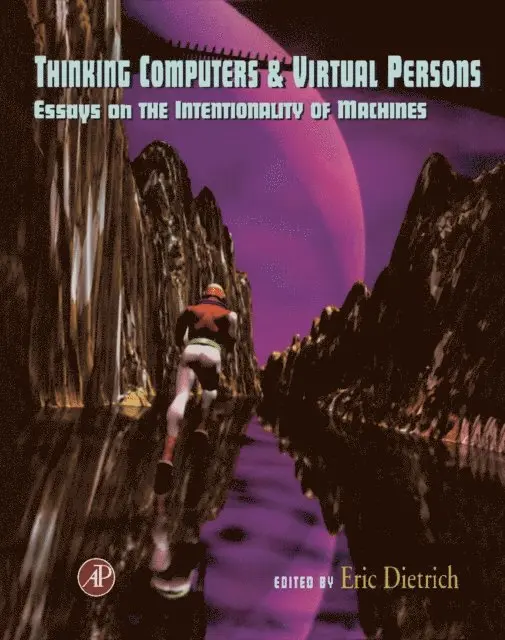
Thinking Computers and Virtual Persons
Essays on the Intentionality of Machines
E-bok, 2014
807 kr
Lägg i varukorg
Thinking Computers and Virtual Persons: Essays on the Intentionality of Machines explains how computations are meaningful and how computers can be cognitive agents like humans. This book focuses on the concept that cognition is computation. Organized into four parts encompassing 13 chapters, this …