Eric Gans - Böcker
Visar alla böcker från författaren Eric Gans. Handla med fri frakt och snabb leverans.
5 produkter
5 produkter
912 kr
Skickas inom 7-10 vardagar
Starting from the minimal principle of generative anthropology—that human culture originates as "the deferral of violence through representation"—the author proposes a new understanding of the fundamental concepts of metaphysics and an explanation of the historical problematic that underlies the postmodern "end of culture."Part I begins with the paradoxical emergence of the "vertical" sign from the "horizontal" world of appetite. Two persons reaching for the same object are a minimal model of this emergence; their "pragmatic paradox" can be resolved only by substituting the representation of the object for its appropriation. The nature of paradox and the related notion of irony, as well as the fundamental concepts of being, thinking, and signification, are rethought on the basis of this triangular model, leading to an anthropological interpretation of the origin of philosophy and semiotics in Plato's Ideas. Part I concludes with an exploration of the psychoanalytic categories of the unconscious and the erotic.Part II develops the idea that material exchange originates in the sparagmos or violent rendering of the sacrificial victim from which each participant obtains a roughly equal portion. The dependence of the process on the central victimary figure culminates in the Holocaust, the extermination of the Jews, whose crucial role in Western culture is their rejection of the central image in favor of peripheral exchange. As a result, postmodern dialogue becomes dominated by the rhetoric of victimage, and the culture of centrality gives way to an aesthetic of the marginal.
806 kr
Skickas inom 10-15 vardagar
The Scenic Imagination argues that the uniquely human phenomenon of representation, as manifested in language, art, and ritual, is a scenic event focused on a central object designated by a sign. The originary hypothesis posits the necessity of conceiving the origin of the human as such an event. In traditional societies, the scenic imagination through which this scene of origin is conceived manifests itself in sacred creation narratives. Modern thought is defined by the independent use of the scenic imagination to create anthropological models of the origin of human institutions, beginning with the social contract scene in Hobbes's Leviathan that puts an end to the reciprocal violence of the state of nature. Eric Gans follows the work of the scenic imagination in selected writings of twenty thinkers including Locke, Rousseau, Kant, Hegel, Marx, Nietzsche, Durkheim, Boas, and Freud and concludes his book with a critical examination of contemporary writing on the origins of religion and language. In the process, he demonstrates that the originary hypothesis offers the most cohesive explanation of the origin and function of these fundamental institutions.
342 kr
Skickas inom 7-10 vardagar
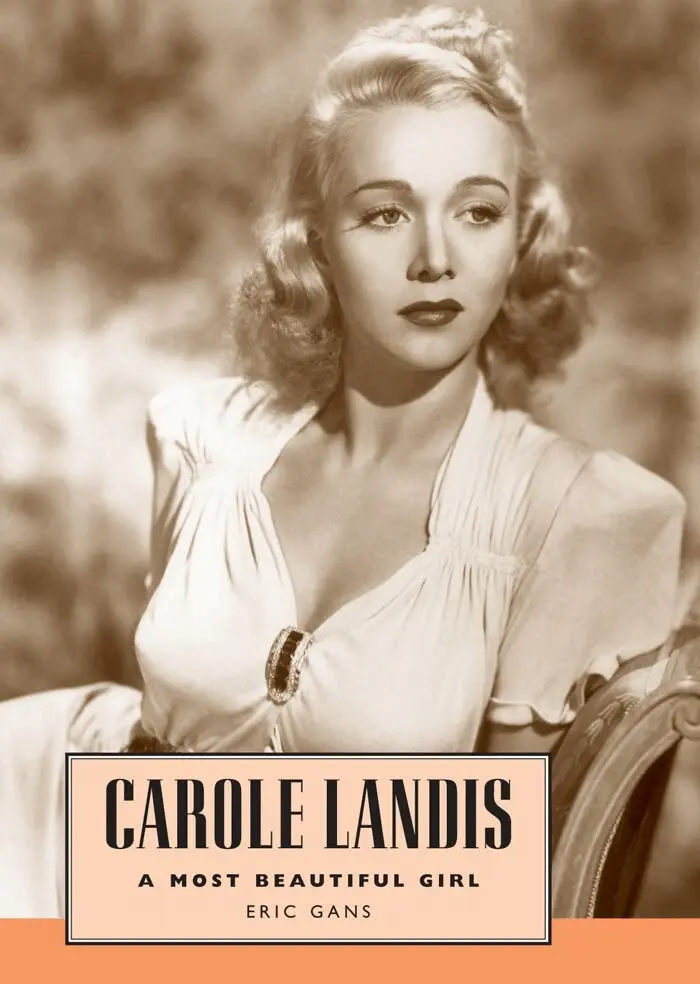
Despite appearing in twenty-eight movies in little over a decade, Carole Landis (1919-1948) never quite became the major Hollywood star her onscreen presence should have afforded her. Although she acted in such enduring films as A Scandal in Paris and Moon over Miami, she was most often relegated to supporting roles. Even when she played the major role in a feature, as she did in The Powers Girl and the film noir I Wake Up Screaming!, she was billed second or third behind other actors. This biography traces Landis's life, chronicling her beginnings as a dance hall entertainer in San Francisco, her career in Hollywood and abroad, her USO performances, and ultimately her suicide. Using interviews with actors who worked with Landis, contemporary movie magazines and journals, and correspondence, biographer Eric Gans reveals a tragic figure whose life was all too brief. Landis's big break came in 1940 with Hal Roach's One Million B.C. She appeared in thirteen Twentieth Century-Fox pictures between 1941 and 1946. In 1942-43, Landis entertained troops in England and North Africa in the only all-female USO tour. The trip led to her memoir, Four Jills in a Jeep, and a Fox movie of the same title. After her last American film in 1947, she completed two projects in England while having an affair with married actor Rex Harrison. Tormented by a love that could not lead to matrimony and depressed about growing older, she took a fatal drug overdose on July 5, 1948.
256 kr
Skickas inom 3-6 vardagar
312 kr
Skickas inom 3-6 vardagar