Eric Rothstein - Böcker
Visar alla böcker från författaren Eric Rothstein. Handla med fri frakt och snabb leverans.
6 produkter
6 produkter
238 kr
Skickas inom 10-15 vardagar
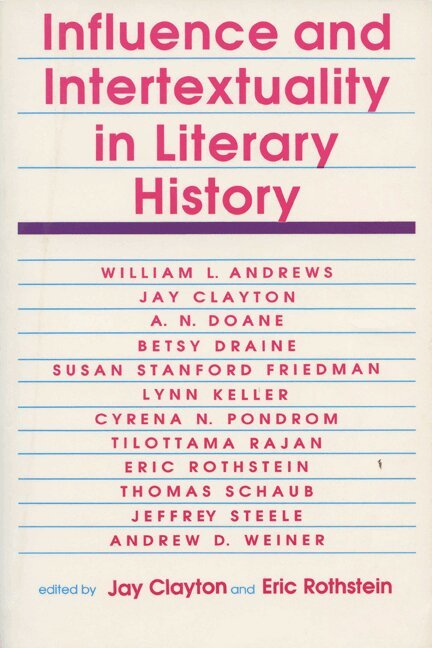
This collection explores and clarifies two of the most contested ideas in literary theory - influence and intertextuality. The study of influence tends to centre on major authors and canonical works, identifying prior documents as ""sources"" or ""contexts"" for a given author. Intertextuality, on the other hand, is a concept unconcerned with authors as individuals; it treats all texts as part of a network of discourse that includes culture, history and social practices as well as other literary works. In thirteen essays drawing on the entire spectrum of English and American literary history, this volume considers the relationship between these two terms across the whole range of their usage. Debates about these two concepts have been crucial to the ""new historicism"" and the resurgence of interest in literary history. The essays in this volume employ a wide array of examples from that history - poetry of the Renaissance and the 20th century, Old English texts, and postmodernist productions that have served as recurrent ""intertexts"" for contemporary theory. The contributors examine such questions as the role of the author, canon formation, gender, causality and the social dimension of texts. They hope to illuminate old assumptions and new ideas about agency that lie behind notions of influence, examining in the process models of an anonymous textual field that lie behind notions of intertextuality.
764 kr
Skickas inom 3-6 vardagar
Systems of Order and Inquiry in Later Eighteenth-Century Fiction by Eric Rothstein reconceives the “rules” of the novel not as prescriptive poetics but as interacting systems—of narrative order and epistemological inquiry—shared by five famously unlike works: Rasselas, Tristram Shandy, Humphry Clinker, Amelia, and Caleb Williams. Rejecting eighteenth-century critics’ elusive search for universal principles, Rothstein demonstrates how techniques such as analogy, modification, surrogacy, and incremental repetition generate coherence while sustaining variety, aligning formal pattern with the novels’ central concern: how one knows in a world governed by probability rather than certitude. The result is a historically grounded account in which Fielding, Johnson, Smollett, Sterne, and Godwin articulate cognate strategies for managing perspective, character, and causation—without collapsing their singular achievements into a single “ought.”Rothstein’s method pairs close modeling of each novel’s internal logic with a crisp intellectual genealogy—from Locke and Hartley to Butler and Hume—showing how Enlightenment debates over “esprit de système,” empiricism, and analogy inform narrative design. By tracing how readerly inference and character judgment are orchestrated through patterned variation, the book offers critics a powerful vocabulary for explaining why these fictions feel both rigorously shaped and provocatively open. Scholars of eighteenth-century literature, narrative theory, and the history of ideas will find here a compelling framework that clarifies the kinship among diverse forms—sentimental, epistolary, picaresque, Gothic—while sharpening our sense of what the period’s novels can (and cannot) make knowable.This title is part of UC Press's Voices Revived program, which commemorates University of California Press’s mission to seek out and cultivate the brightest minds and give them voice, reach, and impact. Drawing on a backlist dating to 1893, Voices Revived makes high-quality, peer-reviewed scholarship accessible once again using print-on-demand technology. This title was originally published in 1975.
1 690 kr
Skickas inom 3-6 vardagar
Systems of Order and Inquiry in Later Eighteenth-Century Fiction by Eric Rothstein reconceives the “rules” of the novel not as prescriptive poetics but as interacting systems—of narrative order and epistemological inquiry—shared by five famously unlike works: Rasselas, Tristram Shandy, Humphry Clinker, Amelia, and Caleb Williams. Rejecting eighteenth-century critics’ elusive search for universal principles, Rothstein demonstrates how techniques such as analogy, modification, surrogacy, and incremental repetition generate coherence while sustaining variety, aligning formal pattern with the novels’ central concern: how one knows in a world governed by probability rather than certitude. The result is a historically grounded account in which Fielding, Johnson, Smollett, Sterne, and Godwin articulate cognate strategies for managing perspective, character, and causation—without collapsing their singular achievements into a single “ought.”Rothstein’s method pairs close modeling of each novel’s internal logic with a crisp intellectual genealogy—from Locke and Hartley to Butler and Hume—showing how Enlightenment debates over “esprit de système,” empiricism, and analogy inform narrative design. By tracing how readerly inference and character judgment are orchestrated through patterned variation, the book offers critics a powerful vocabulary for explaining why these fictions feel both rigorously shaped and provocatively open. Scholars of eighteenth-century literature, narrative theory, and the history of ideas will find here a compelling framework that clarifies the kinship among diverse forms—sentimental, epistolary, picaresque, Gothic—while sharpening our sense of what the period’s novels can (and cannot) make knowable.This title is part of UC Press's Voices Revived program, which commemorates University of California Press’s mission to seek out and cultivate the brightest minds and give them voice, reach, and impact. Drawing on a backlist dating to 1893, Voices Revived makes high-quality, peer-reviewed scholarship accessible once again using print-on-demand technology. This title was originally published in 1975.
662 kr
Skickas inom 10-15 vardagar
Restoration and Eighteenth-Century Poetry 1660-1780, originally published in 1981, considers poetry written between 1660 and 1780, a period which, although largely recovered from its nineteenth-century reputation, still attracts widely varying critical responses. Abandoning the old labels such as ‘neoclassicism’, ‘romanticism’ and ‘sensibility’, the author focuses on descriptions of genres and their formal elements and traces the broader patterns of literary and historical change running through the period. Eric Rothstein describes different poetic modes- panegyric, satire, pastoral and topographical poetry, the epistle, and the ode- to suggest their aesthetical possibilities as well as their process of change. He also considers style and the uses of the past, topics which have often caused particular problems for the students of the period. What becomes clear is the extraordinary originality, flexibility and power with which Restoration and eighteenth-century poets handles the stylistic assumptions and the body of poems they inherited and employed in their own works.
320 kr
Skickas inom 10-15 vardagar
Restoration and Eighteenth-Century Poetry 1660-1780, originally published in 1981, considers poetry written between 1660 and 1780, a period which, although largely recovered from its nineteenth-century reputation, still attracts widely varying critical responses. Abandoning the old labels such as ‘neoclassicism’, ‘romanticism’ and ‘sensibility’, the author focuses on descriptions of genres and their formal elements and traces the broader patterns of literary and historical change running through the period. Eric Rothstein describes different poetic modes- panegyric, satire, pastoral and topographical poetry, the epistle, and the ode- to suggest their aesthetical possibilities as well as their process of change. He also considers style and the uses of the past, topics which have often caused particular problems for the students of the period. What becomes clear is the extraordinary originality, flexibility and power with which Restoration and eighteenth-century poets handles the stylistic assumptions and the body of poems they inherited and employed in their own works.
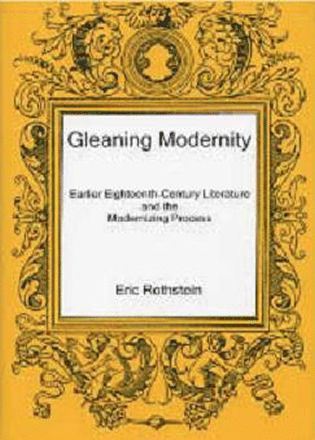
Gleaning Modernity
Earlier Eighteenth-Century Literature and the Modernizing Process
Inbunden, Engelska, 2007
1 444 kr
Skickas inom 7-10 vardagar
Gleaning Modernity shows how earlier eighteenth-century literary texts might have eased the way for Britain's increasing modernity. They allowed Modern scenarios to be played out imaginatively, as simulations for experimental, predictive ends. The process spoke to the needs and desires of readers in a world of rapid, managed change. It worked unobtrusively first because of the practice of recycling old forms, as Pope and Richardson did, for example, with Horatian and tragic models, respectively; and second because given texts offered different readers a range of interpretative options. Along with providing original readings of such major texts as Gulliver's Travels and Clarissa, this study enlarges our sense of the Modernizing process. It also shows how a consumer-driven Darwinian model of adaptive change, affecting literature and its readership, can help us understand the ways in which literature can have social efficacy.