Erik Meinema - Böcker
Visar alla böcker från författaren Erik Meinema. Handla med fri frakt och snabb leverans.
3 produkter
3 produkter
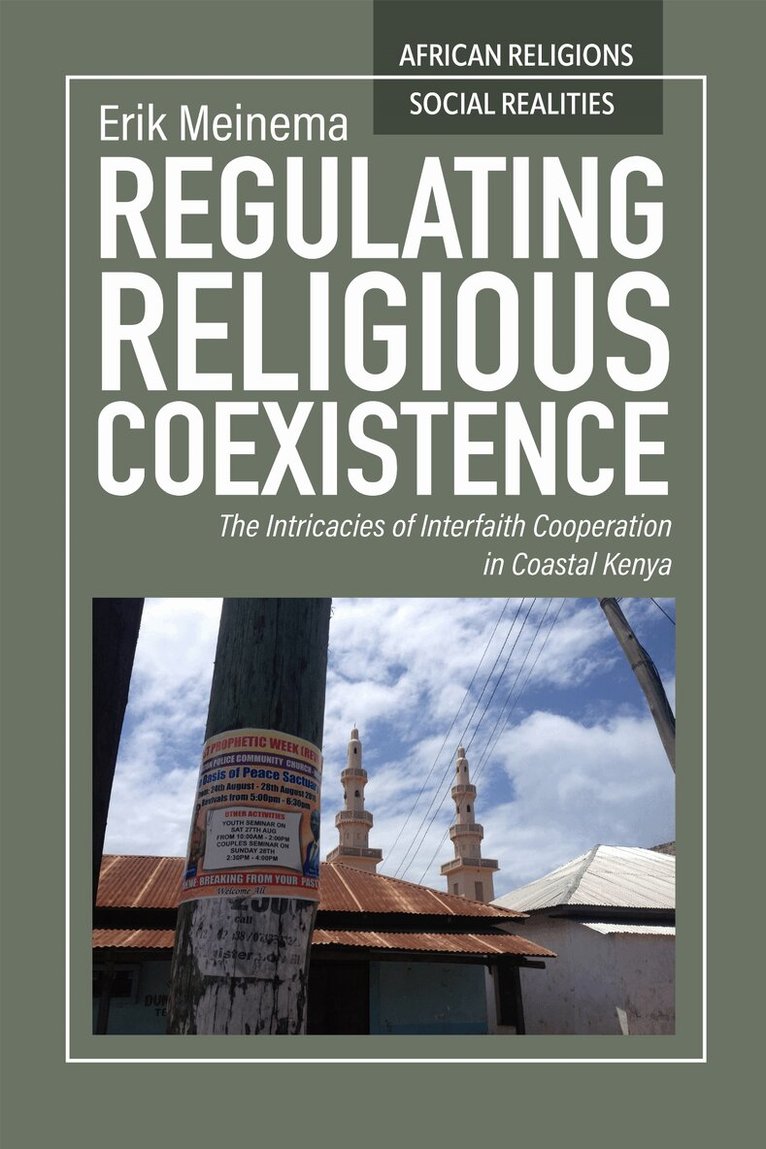
Regulating Religious Coexistence
The Intricacies of Interfaith Cooperation in Coastal Kenya
Inbunden, Engelska, 2026
1 308 kr
Kommande
Regulating Religious Coexistence offers a compelling ethnographic analysis of how Muslims, Christians, and practitioners of indigenous African religions negotiate coexistence in Kenya’s coastal region. The book conceptualizes religious diversity as a dynamic field shaped by multiple partly intersecting and partly conflicting models of interaction. These include the political secularism promoted by the Kenyan state and civil society organizations focused on interfaith harmony, forms of competition between religious groups, and pluralistic practices in which individuals draw on multiple traditions to meet spiritual needs.Through a close examination of civil society initiatives funded by Western donors to foster peacebuilding and to counter violent extremism, the book investigates how these models for coexistence are negotiated and contested and how they intersect with historical and contemporary patterns. It demonstrates that modes of religious coexistence in coastal Kenya have been shaped by colonial and postcolonial governance, transregional connections, and interactions between Christians, Muslims, and Traditionalists across time.As one of the few monographs on political secularism in an African context, Regulating Religious Coexistence makes a significant contribution to scholarship on religious diversity and coexistence. It situates Christianity, Islam, and indigenous African traditions within a single conceptual framework, broadening earlier studies that mostly treated them in isolation. This book is essential reading for scholars of religion, anthropology, African studies, and political theory, offering fresh insights into the complex realities of religious diversity in Africa and beyond.
Regulating Religious Coexistence
The Intricacies of Interfaith Cooperation in Coastal Kenya
Häftad, Engelska, 2026
397 kr
Kommande
Regulating Religious Coexistence offers a compelling ethnographic analysis of how Muslims, Christians, and practitioners of indigenous African religions negotiate coexistence in Kenya’s coastal region. The book conceptualizes religious diversity as a dynamic field shaped by multiple partly intersecting and partly conflicting models of interaction. These include the political secularism promoted by the Kenyan state and civil society organizations focused on interfaith harmony, forms of competition between religious groups, and pluralistic practices in which individuals draw on multiple traditions to meet spiritual needs.Through a close examination of civil society initiatives funded by Western donors to foster peacebuilding and to counter violent extremism, the book investigates how these models for coexistence are negotiated and contested and how they intersect with historical and contemporary patterns. It demonstrates that modes of religious coexistence in coastal Kenya have been shaped by colonial and postcolonial governance, transregional connections, and interactions between Christians, Muslims, and Traditionalists across time.As one of the few monographs on political secularism in an African context, Regulating Religious Coexistence makes a significant contribution to scholarship on religious diversity and coexistence. It situates Christianity, Islam, and indigenous African traditions within a single conceptual framework, broadening earlier studies that mostly treated them in isolation. This book is essential reading for scholars of religion, anthropology, African studies, and political theory, offering fresh insights into the complex realities of religious diversity in Africa and beyond.
Meaning of Weapons
Material and Discursive Negotiations in Culture and Religion
Inbunden, Engelska, 2026
2 088 kr
Skickas inom 10-15 vardagar
This book studies the role, representation, and materiality of weapons, focusing on what they mean to communities and individuals in various cultural, social, political, and religious settings.Drawing on a range of case studies from across the globe, the chapters examine (1) how weapons are understood and used in different social, cultural, religious, theological, and ritual contexts; (2) their role within infrastructures of violence, that is, the socio-material, juridical, and spatial arrangements of weapons that enable or constrain violence; (3) processes of human socialization with weapons; (4) the infliction of violence through weapons; and (5) the representation of weapons in popular culture, games, myths, museums, and monuments.The volume brings together insights from various disciplines including anthropology, religious studies, philosophy, history, and conflict studies. In doing so, it lays the groundwork for highly needed new theoretical and methodological directions to understand the meaning of weapons in our times.