Ernest Nicholson - Böcker
Visar alla böcker från författaren Ernest Nicholson. Handla med fri frakt och snabb leverans.
4 produkter
4 produkter
1 137 kr
Skickas inom 7-10 vardagar
The essays in this volume give an account of how the agenda for theology and religious studies was set and reset throughout the twentieth century - by rapid and at times cataclysmic changes (wars, followed by social and academic upheavals in the 1960s), by new movements of thought, by a bounty of archaeological discoveries, and by unprecedented archival research. Further new trends of study and fresh approaches (existentialist, Marxian, postmodern) have in more recent years generated new quests and horizons for reflection and research. Theological enquiry in Great Britain was transformed in the late nineteenth century through the gradual acceptance of the methods and results of historical criticism. New agendas emerged in the various sub-disciplines of theology and religious studies. Some of the issues raised by biblical criticism, for example Christology and the 'quest of the historical Jesus', were to remain topics of controversy throughout the twentieth century. In other important and far-reaching ways, however, the agendas that seemed clear in the early part of the century were abandoned, or transformed and replaced, not only as a result of new discoveries and movements of thought, but also by the unfolding events of a century that brought the appalling carnage and horror of two world wars. Their aftermath brought a shattering of inherited world views, including religious world views, and disillusion with the optimistic trust in inevitable progress that had seemed assured in many quarters and found expression in widely influential 'liberal' theological thought of the time. The centenary of the British Academy in 2002 has provided a most welcome opportunity for reconsidering the contribution of British scholarship to theological and religious studies in the last hundred years.
1 247 kr
Skickas inom 3-6 vardagar
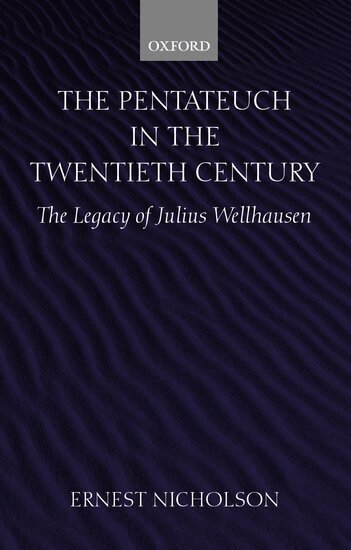
Despite innumerable studies from at least the time of the Reformation, it was not until little more than a century ago that one hypothesis concerning the origin of the Pentateuch, the so-called `Documentary Theory' formulated by Julius Wellhausen, established itself as the point of departure for all subsequent study of this topic. This has remained so until recently, but during the past twenty-five years the study of the Pentateuch has been once more in turmoil, and new theories have proliferated. This book arises from the conviction that much in current Pentateuchal research needs to be subjected to rigorous scrutiny and that much, indeed, is radically mistaken. Dr Nicholson argues that the work of Wellhausen, for all that it needs revision and development in detail, remains the securest basis for understanding the Pentateuch. The book is not a mere call to go `back to Wellhausen', however, for Dr Nicholson also shows that much in the intervening debate has significantly modified his conclusions, as well as asking questions that were not on Wellhausen's agenda. But the Documentary Hypothesis should remain our primary point of reference, and it alone provides the most dependable perspective from which to approach this most difficult of areas in the study of the Old Testament.
2 164 kr
Skickas inom 3-6 vardagar
In Deuteronomy and the Judaean Diaspora Ernest Nicholson challenges the widely accepted view that Deuteronomy was the 'book of the law' described in 2 Kings 22-3 as the basis of king Josiah's cultic reformation in 621 BCE. He argues that the notice in this narrative that Josiah abolished the rural, local altars throughout Judah and supposedly relocated their priests to Jerusalem is based upon a misreading. Rather, he contends, Deuteronomy derived from thinkers and writers who lived among the Judaean exiles in Babylonia in the sixth century, and in significant ways represents a break with pre-exilic Israelite religion occasioned by the urgent need to confront the challenges to national identity and cultural survival of the Judaean Diaspora community. Leading features of the book such as its zealous monolatry, its self-presentation as 'scripture', its concept of the relationship with God as covenanted choice, its pervasive fear of religious encroachment, its character as 'oppositional' literature--these and other themes of the book suggest such a provenance. Issues arising include, for example, information from Babylonian sources, some of it new, about the Judaean exiles, how Israel is characterised in the book, kingship, evidence of the emergence of a body of prophetic 'scripture'. Two final chapters examine the 'Deuteronomistic History' (Joshua-2 Kings) and show that (contrary to some interpretations) it is not 'historiography' such as is represented by, for example, Herodotus' Histories, and that theodicy rather than an interest in the past as a field of critical study best describes its genre.
790 kr
Skickas inom 5-8 vardagar
Despite innumerable studies from at least the time of the Reformation, it was not until little more than a century ago that one hypothesis concerning the origin of the Pentateuch, the so-called `Documentary Theory' formulated by Julius Wellhausen, established itself as the point of departure for all subsequent study of this topic. This has remained so until recently, but during the past twenty-five years the study of the Pentateuch has been once more in turmoil, and new theories have proliferated. This book arises from the conviction that much in current Pentateuchal research needs to be subjected to rigorous scrutiny and that much, indeed, is radically mistaken. Professor Nicholson argues that the work of Wellhausen, for all that it needs revision and development in detail, remains the securest basis for understanding the Pentateuch. The book is not a mere call to go `back to Wellhausen', however, for Professor Nicholson also shows that much in the intervening debate has significantly modified his conclusions, as well as asking questions that were not on Wellhausen's agenda. But the Documentary Hypothesis should remain our primary point of reference, and it alone provides the most dependable perspective from which to approach this most difficult of areas in the study of the Old Testament.