Esha Niyogi De - Böcker
Visar alla böcker från författaren Esha Niyogi De. Handla med fri frakt och snabb leverans.
6 produkter
6 produkter
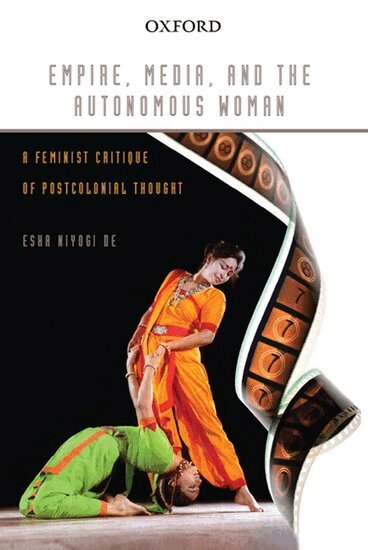
Empire, Media, and the Autonomous Woman
A Feminist Critique of Postcolonial Thought
Inbunden, Engelska, 2011
576 kr
Skickas inom 11-20 vardagar
Autonomy is commonly linked to liberal individualism, the Enlightenment philosophy which gives primacy to personal existence and interests rather than to the person's place in society and in history. Many see the autonomous individual as harbouring the possessive mentalities of western empire. In this groundbreaking work, Esha Niyogi De radically questions this foundational anti-Enlightenment position on which influential models of Postcolonial critique are based. She argues that the 'individual' has been creatively indigenized in non-western modernities: indigenous activist individuals attentive to empire and gender refuse possessive individualism while they invest in certain ethical premises of Enlightenment thought.De weaves her radical argument through a rich tapestry of gender portrayals drawn from two transitional moments of Indian modernity: the rise of humanism under colony and the influx of neoliberal capitalism. This book emphasizes the feminist challenge to sexual and racial orthodoxies posed by critical imaginations of the 'autonomous woman' in postcolonial cultures by studying autobiographical texts by nineteenth-century Bengali prostituted women; point-of-view photography; woman-centred dance dramas and essays by Rabindranth Tagore; representations of Tagore's works on mainstream television, video, and stage in India and Indian American diasporas; and feminist cinema, choreography and performance respectively by Aparna Sen and Manjusri Chaki-Sircar.
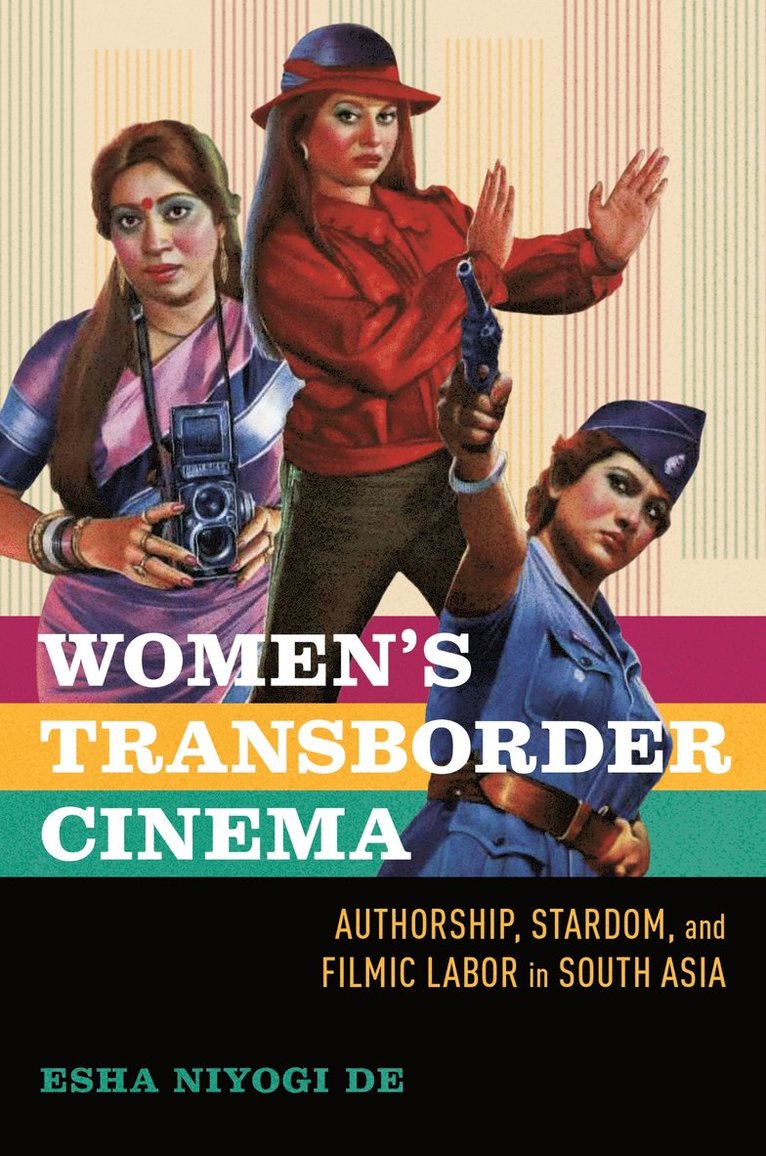
Women's Transborder Cinema
Authorship, Stardom, and Filmic Labor in South Asia
Inbunden, Engelska, 2024
1 361 kr
Skickas inom 7-10 vardagar
Can we write women’s authorial roles into the history of industrial cinema in South Asia? How can we understand women’s creative authority and access to the film business infrastructure in this postcolonial region? Esha Niyogi De draws on rare archival and oral sources to explore these questions from a uniquely comparative perspective, delving into examples of women holding influential positions as stars, directors, and producers across the film industries in India, Pakistan, and Bangladesh. De uses film tropes to examine the ways women directors and film entrepreneurs claim creative control within the contexts of anti-colonial nationalism and global capitalism. The region’s fictional cinemas have become staging grounds for postcolonialism, with colonial and local hierarchies merged into new imperial formations. De’s analysis shows how the gendered intersections of inequity and opportunity shape women’s fiction filmmaking while illuminating the impact of state and market formations on the process. Innovative and essential, Women’s Transborder Cinema examines the works of South Asia’s women filmmakers from a regional perspective.
332 kr
Skickas inom 7-10 vardagar
Can we write women’s authorial roles into the history of industrial cinema in South Asia? How can we understand women’s creative authority and access to the film business infrastructure in this postcolonial region? Esha Niyogi De draws on rare archival and oral sources to explore these questions from a uniquely comparative perspective, delving into examples of women holding influential positions as stars, directors, and producers across the film industries in India, Pakistan, and Bangladesh. De uses film tropes to examine the ways women directors and film entrepreneurs claim creative control within the contexts of anti-colonial nationalism and global capitalism. The region’s fictional cinemas have become staging grounds for postcolonialism, with colonial and local hierarchies merged into new imperial formations. De’s analysis shows how the gendered intersections of inequity and opportunity shape women’s fiction filmmaking while illuminating the impact of state and market formations on the process. Innovative and essential, Women’s Transborder Cinema examines the works of South Asia’s women filmmakers from a regional perspective.
1 789 kr
Skickas inom 7-10 vardagar
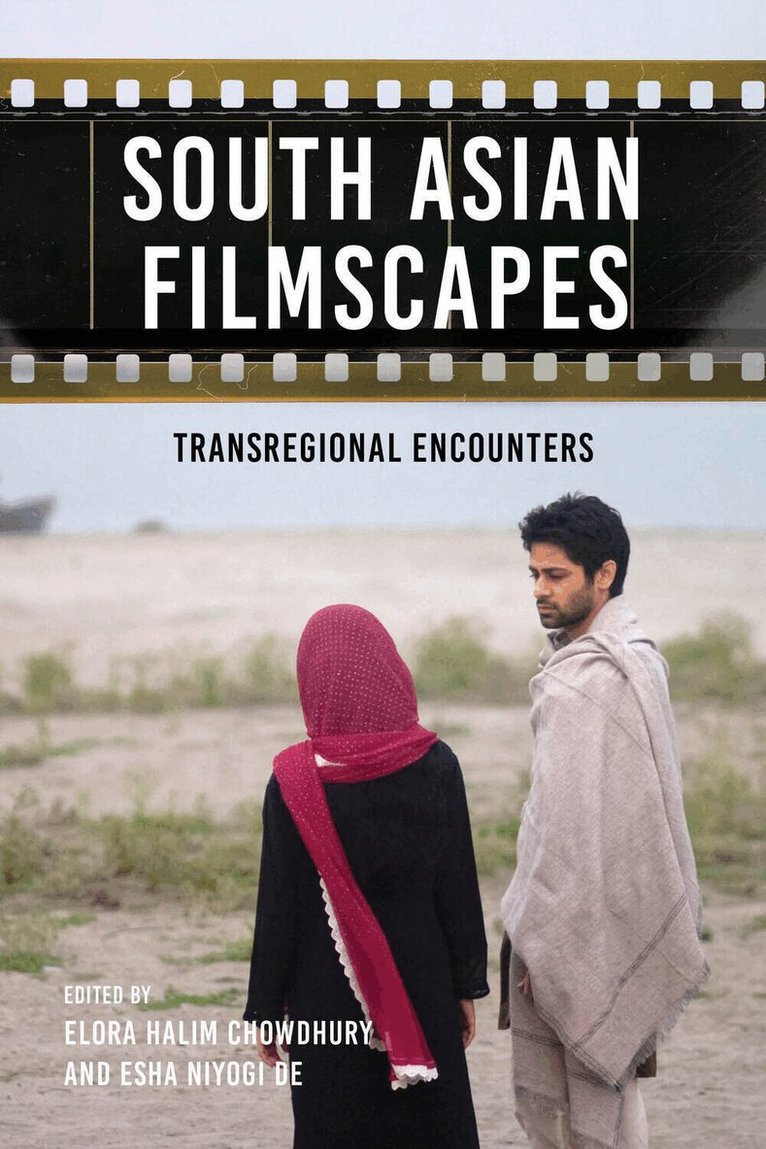
New political realities and shared histories connect film cultures across bordersIn South Asia massive anticolonial movements in the twentieth century created nation-states and reset national borders, forming the basis for emerging film cultures. Following the upheaval of the partition of India and Pakistan in 1947 and the Bangladesh Liberation War of 1971, new national cinemas promoted and reinforced prevailing hierarches of identity and belonging. At the same time, industrial and independent cinemas contributed to remarkably porous and hybrid film cultures, reflecting the intertwining of South Asian histories and their reciprocal cultural influences. This cross-fertilization within South Asian cultural production continues today.South Asian Filmscapes excavates these complex politics and poetics of bordered identity and crossings through selected histories of cinema in South Asia. Several essays reveal ways in which fixed notions of national identity have been destabilized by the cross-border mobility of filmed arts and practitioners, while others interrogate how filmic politics intersects with discourses of nationalism, sexuality and gender, religion, and language. Together, they offer a fluid approach to the multiple histories and encounters that conjure “South Asia” as a geographic and political entity in the region and globally through a cinematic imagination.
517 kr
Skickas inom 7-10 vardagar
New political realities and shared histories connect film cultures across bordersIn South Asia massive anticolonial movements in the twentieth century created nation-states and reset national borders, forming the basis for emerging film cultures. Following the upheaval of the partition of India and Pakistan in 1947 and the Bangladesh Liberation War of 1971, new national cinemas promoted and reinforced prevailing hierarches of identity and belonging. At the same time, industrial and independent cinemas contributed to remarkably porous and hybrid film cultures, reflecting the intertwining of South Asian histories and their reciprocal cultural influences. This cross-fertilization within South Asian cultural production continues today.South Asian Filmscapes excavates these complex politics and poetics of bordered identity and crossings through selected histories of cinema in South Asia. Several essays reveal ways in which fixed notions of national identity have been destabilized by the cross-border mobility of filmed arts and practitioners, while others interrogate how filmic politics intersects with discourses of nationalism, sexuality and gender, religion, and language. Together, they offer a fluid approach to the multiple histories and encounters that conjure “South Asia” as a geographic and political entity in the region and globally through a cinematic imagination.
397 kr
Skickas inom 11-20 vardagar
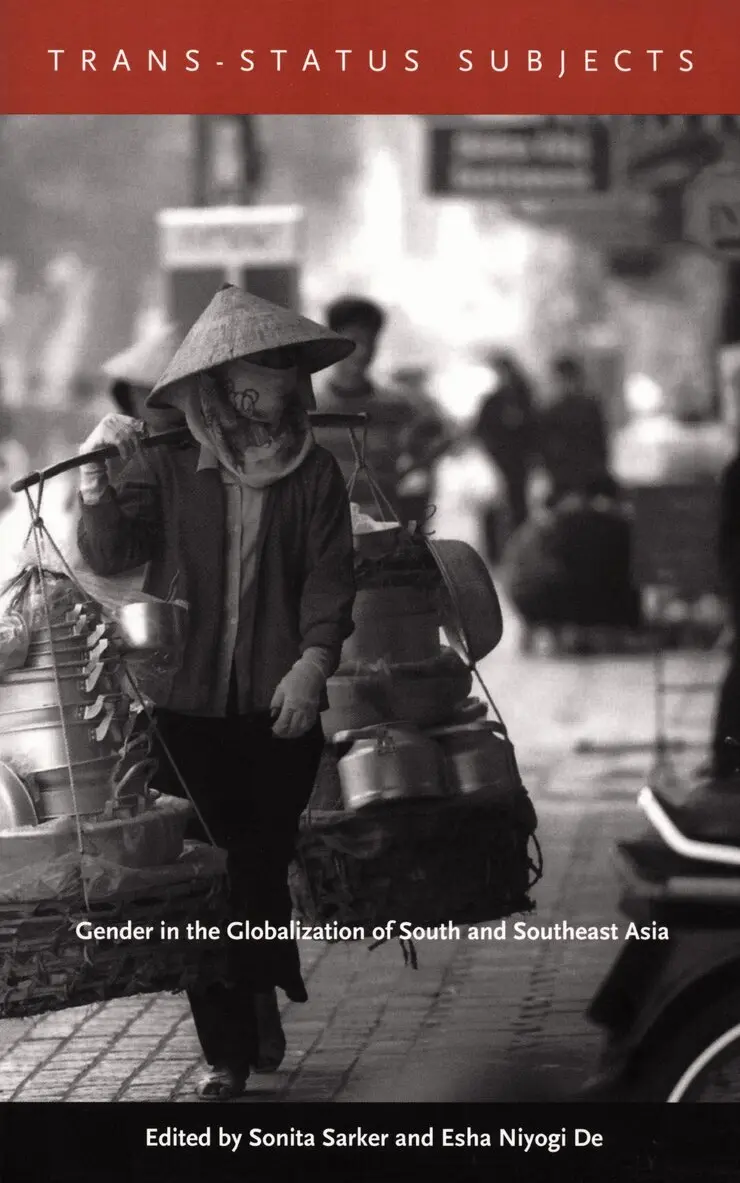
A Thai foodseller on the streets of Bangkok, a cyclo driver in a Vietnamese village, a Pahari migrant laborer in the Himalayas, a Parsi-Christian professional social worker shuttling back and forth between London and Calcutta-Trans-Status Subjects examines how these and other South and Southeast Asians affect and are affected by globalization. While much work has focused on the changes wrought by globalization-describing how people maintain foundations or are permanently destabilized-this collection theorizes the complex ways individuals negotiate their identities and create alliances in the midst of both stability and instability, as what the editors call trans-status subjects. Using gender paradigms, historical time, and geographic space as driving analytic concerns, the essays gathered here consider the various ways South and Southeast Asians both perpetuate and resist various hierarchies despite unequal mobilities within economic, social, cultural, and political contexts. The contributors-including literary and film theorists, geographers, historians, sociologists, and anthropologists-show how the dominant colonial powers prefigured the ideologies of gender and sexuality that neocolonial nation-states have later refigured; investigate economic and artistic production; and explore labor, capital, and social change. The essays cover a range of locales-including Sri Lanka, Vietnam, Thailand, Singapore, Borneo, Indonesia, and the United States. In investigating issues of power, mobility, memory, and solidarity in recent eras of globalization, the contributors-scholars and activists from South Asia, Southeast Asia, England, Australia, Canada, and the United States-illuminate various facets of the new concept of trans-status subjects.Trans-Status Subjects carves out a new area of inquiry at the intersection of feminisim and critical geography, as well as globalization, postcolonial, and cultural studies. Contributors. Anannya Bhattacharjee, Esha Niyogi De, Karen Gaul, Ketu Katrak, Karen Leonard, Philippa Levine, Kathryn McMahon, Andrew McRae, Susan Morgan, Nihal Perera, Sonita Sarker, Jael Silliman, Sylvia Tiwon, Gisele Yasmeen