Estelle Ferrarese - Böcker
Visar alla böcker från författaren Estelle Ferrarese. Handla med fri frakt och snabb leverans.
7 produkter
7 produkter
644 kr
Skickas inom 10-15 vardagar
Vulnerability is a concept with fleeting contours as much it is an idea with assured academic success. In the United States, torturable, "mutilatable," and killable bodies are a wide topic of discussion, especially after September 11 and the ensuing bellicosity. In Europe, current reflection on vulnerability has emerged from a thematic of precarity and exclusion; the term evokes lives that are dispensable, evictable, deportable, and the abandoning of individuals to naked forces of the market. But if the theme has had notable fortune, it also continues to come up against considerable reluctance. The political scope of vulnerability is often denied: it seems inevitably to be relegated to the sphere of "good sentiments." This book aims to address this criticism. It shows that by questioning our hegemonic anthropology, by reinventing the categories of freedom, equality, and being-in-common based on the body, by overthrowing the legitimate grammar of political discourse, and by redefining the political subject – the category of vulnerability, far from being conservative or a-political, works to undo the world such as it is. This book was originally published as a special issue of Critical Horizons.
2 088 kr
Skickas inom 10-15 vardagar
By using the concept of capitalism as a “form of life”, the authors in this volume reconceive capitalism, its mechanisms and effects on our bodies and on our common life.The idea that capitalism is more than a discrete economic system and instead a “form of life” that shapes our relationships with others, our sense of ourselves and our capacities, practices, bodies, and actions in the material world should be rather obvious. Yet efforts – whether through criticism or policy remedies – to redress the vast inequalities, inherent exploitation, alienation, and the manifold destructive effects of capitalism on the environment, typically proceed without grappling fully with the entwinement of the economic with the social and cultural, much less the ethical, ontological, and phenomenological. This volume proposes “form of life” as a heuristic tool, connecting literatures that often remain isolated from one another – the Frankfurt School, neo-materialism, Wittgenstein’s philosophy, Foucault’s and Agamben’s biopolitics, and Marx’s discussion of reproduction. In emphasizing economic practices, as opposed to capitalism as a system, they conceive of “the economic” as an integral and integrated dimension of life, and thus develop new possibilities for critique. Viewing human beings as “economic bios,” provides a needed alternative to analyses that position neoliberalism as an economic logic imposed upon the social and cultural.This book was originally published as a special issue of the Journal for Cultural Research.
617 kr
Skickas inom 10-15 vardagar
By using the concept of capitalism as a “form of life”, the authors in this volume reconceive capitalism, its mechanisms and effects on our bodies and on our common life.The idea that capitalism is more than a discrete economic system and instead a “form of life” that shapes our relationships with others, our sense of ourselves and our capacities, practices, bodies, and actions in the material world should be rather obvious. Yet efforts – whether through criticism or policy remedies – to redress the vast inequalities, inherent exploitation, alienation, and the manifold destructive effects of capitalism on the environment, typically proceed without grappling fully with the entwinement of the economic with the social and cultural, much less the ethical, ontological, and phenomenological. This volume proposes “form of life” as a heuristic tool, connecting literatures that often remain isolated from one another – the Frankfurt School, neo-materialism, Wittgenstein’s philosophy, Foucault’s and Agamben’s biopolitics, and Marx’s discussion of reproduction. In emphasizing economic practices, as opposed to capitalism as a system, they conceive of “the economic” as an integral and integrated dimension of life, and thus develop new possibilities for critique. Viewing human beings as “economic bios,” provides a needed alternative to analyses that position neoliberalism as an economic logic imposed upon the social and cultural.This book was originally published as a special issue of the Journal for Cultural Research.
2 155 kr
Skickas inom 10-15 vardagar
Vulnerability is a concept with fleeting contours as much it is an idea with assured academic success. In the United States, torturable, "mutilatable," and killable bodies are a wide topic of discussion, especially after September 11 and the ensuing bellicosity. In Europe, current reflection on vulnerability has emerged from a thematic of precarity and exclusion; the term evokes lives that are dispensable, evictable, deportable, and the abandoning of individuals to naked forces of the market. But if the theme has had notable fortune, it also continues to come up against considerable reluctance. The political scope of vulnerability is often denied: it seems inevitably to be relegated to the sphere of "good sentiments." This book aims to address this criticism. It shows that by questioning our hegemonic anthropology, by reinventing the categories of freedom, equality, and being-in-common based on the body, by overthrowing the legitimate grammar of political discourse, and by redefining the political subject – the category of vulnerability, far from being conservative or a-political, works to undo the world such as it is. This book was originally published as a special issue of Critical Horizons.
205 kr
Skickas
Estelle Ferrarese argues for an understanding of morality that is materialist and political. Taking the Frankfurt School philosopher Theodor W. Adorno as a point of departure, she questions his social philosophy by submitting it to ideas deriving from theories of care. She thinks through the mechanisms of the social fragility of caring for others, the moral gestures it enjoins, as well as its political stakes. Ferrarese shows that the capitalist form of life, strained by a generalised indifference, produces a compartmentalised attention to others, one limited to very particular tasks and domains and attributed to women. Offering a systematic study of the idea of 'coldness' in Adorno's philosophy, she stages a dialogue between Adornian Critical Theory and the ethics of care. In doing so, Ferrarese approaches old questions in a new light in a bid to give dignity to the singular, to make its specific claims and its moral pertinence heard.
388 kr
Kommande
1 180 kr
Skickas inom 5-8 vardagar
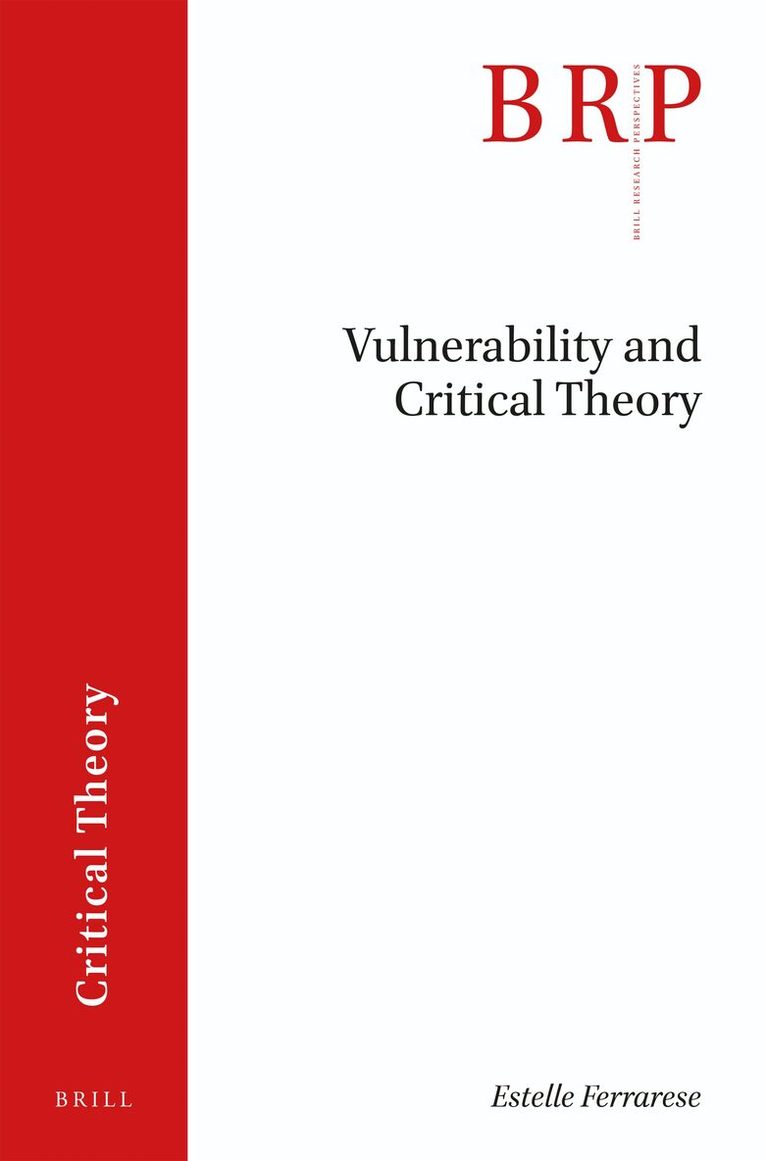
In Vulnerability and Critical Theory, Estelle Ferrarese identifies contemporary developments on the theme of vulnerability within critical theory while also seeking to reconstruct an idea of vulnerability that enables an articulation of the political and demonstrates how it is socially produced. Philosophies that take vulnerability as a moral object contribute to rendering the political, as the site of a specific power and action, foreign to vulnerability and the notion of recognition offered by critical theory does not correct this deficit. Instead, Ferrarese argues that vulnerability, as susceptibility to a harmful event, is above all a breach of normative expectations. She demonstrates that these expectations are not mental phenomena but are situated between subjects and must even be conceived as institutions. On this basis she argues that the link between the political and vulnerability cannot be reduced to the institutional implementation of moral principles. Rather she seeks to rethink the political by taking vulnerability as the starting point and thereby understands the political as simultaneously referring to the advent of a world, the emergence of a relation, and the appearance of a political subject.