Eyal Zamir – författare
Visar alla böcker från författaren Eyal Zamir. Handla med fri frakt och snabb leverans.
11 produkter
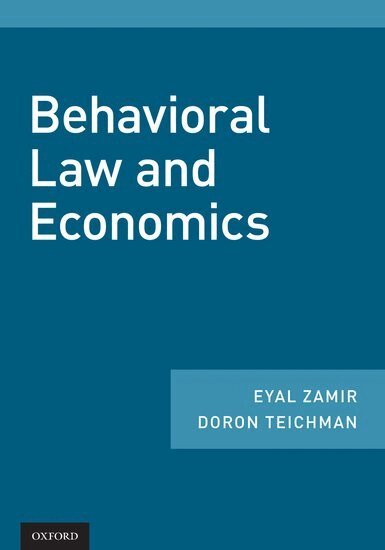
Behavioral Law and Economics
Inbunden, 2018
2290 kr
Lägg i varukorg
In the past few decades, economic analysis of law has been challenged by a growing body of experimental and empirical studies that attest to prevalent and systematic deviations from the assumptions of economic rationality. While the findings on bounded rationality and heuristics and biases were …
Behavioral Law and Economics
Häftad, 2018
1042 kr
Lägg i varukorg
In the past few decades, economic analysis of law has been challenged by a growing body of experimental and empirical studies that attest to prevalent and systematic deviations from the assumptions of economic rationality. While the findings on bounded rationality and heuristics and biases were …
Behavioral Law and Economics
E-bok, 2018
726 kr
Lägg i varukorg
In the past few decades, economic analysis of law has been challenged by a growing body of experimental and empirical studies that attest to prevalent and systematic deviations from the assumptions of economic rationality. While the findings on bounded rationality and heuristics and biases were …
Behavioral Law and Economics
E-bok, 2018
726 kr
Lägg i varukorg
In the past few decades, economic analysis of law has been challenged by a growing body of experimental and empirical studies that attest to prevalent and systematic deviations from the assumptions of economic rationality. While the findings on bounded rationality and heuristics and biases were …
Law, Economics, and Morality
Inbunden, 2010
2352 kr
Lägg i varukorg
Law, Economics, and Morality examines the possibility of combining economic methodology and deontological morality through explicit and direct incorporation of moral constraints into economic models. Economic analysis of law is a powerful analytical methodology. However, as a purely …
Oxford Handbook of Behavioral Economics and the Law
E-bok, 2014
2007 kr
Lägg i varukorg
The past twenty years have witnessed a surge in behavioral studies of law and law-related issues. These studies have challenged the application of the rational-choice model to legal analysis and introduced a more accurate and empirically grounded model of human behavior. This integration of …
Law, Economics, and Morality
E-bok, 2010
1503 kr
Lägg i varukorg
Law, Economics, and Morality examines the possibility of combining economic methodology and deontological morality through explicit and direct incorporation of moral constraints into economic models. Economic analysis of law is a powerful analytical methodology. However, as a purely …
The Oxford Handbook of Behavioral Economics and the Law
Inbunden, 2014
3155 kr
Lägg i varukorg
The past twenty years have witnessed a surge in behavioral studies of law and law-related issues. These studies have challenged the application of the rational-choice model to legal analysis and introduced a more accurate and empirically grounded model of human behavior. This integration of …
Oxford Handbook of Behavioral Economics and the Law
E-bok, 2014
2007 kr
Lägg i varukorg
The past twenty years have witnessed a surge in behavioral studies of law and law-related issues. These studies have challenged the application of the rational-choice model to legal analysis and introduced a more accurate and empirically grounded model of human behavior. This integration of …
Law, Psychology, and Morality
The Role of Loss Aversion
Av Eyal Zamir
Inbunden, 2015
1953 kr
Lägg i varukorg
Kahneman and Tversky's Prospect Theory posits that people do not perceive outcomes as final states of wealth or welfare, but rather as gains or losses in relation to some reference point. People are generally loss averse, meaning that the disutility generated by a loss is greater than the utility …
Law, Psychology, and Morality
The Role of Loss Aversion
Av Eyal Zamir
E-bok, 2014
1265 kr
Lägg i varukorg
Kahneman and Tversky''s Prospect Theory posits that people do not perceive outcomes as final states of wealth or welfare, but rather as gains or losses in relation to some reference point. People are generally loss averse, meaning that the disutility generated by a loss is greater than the utility …