F. Papi - Böcker
Visar alla böcker från författaren F. Papi. Handla med fri frakt och snabb leverans.
3 produkter
3 produkter
2 111 kr
Skickas inom 10-15 vardagar
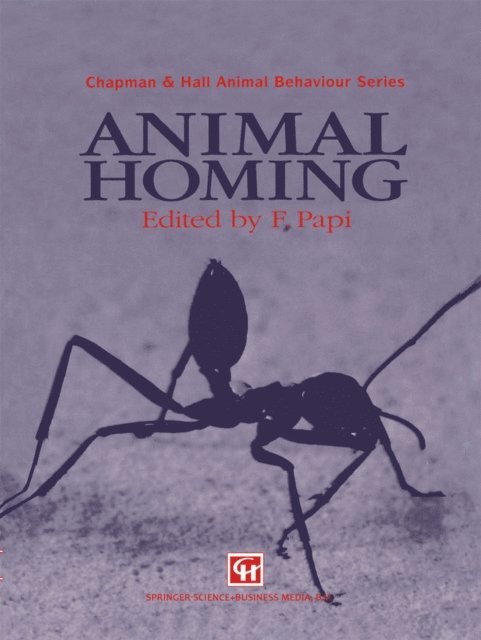
This book is a timely summary of current research on distance orientation in animals, including such phenomena as spatial activity inside familiar areas and long distance migration. This is an area of scientific research fraught with difficult methodological problems to the seemingly unanswerable but fascinating questions about how animals manage to find home and other goals. This volume has collected together the work of leading research figures who have overcome many of these difficulties by innovative research techniques illuminating the how and why animals reach distant goals. It covers a wide range of invertebrates, giving an overview of homing performance in natural and experimental conditions, as well as the state of knowledge about the proximate mechanisms involved, the underlying neurophysiological machinery where known and the wider phylogenetic and evolutionary implications. It will be of interest to a wide range of behavioural scientists and naturalists.
Avian Navigation
International Symposium on Avian Navigation (ISAN) held at Tirrenia (Pisa), September 11–14, 1981
Häftad, Engelska, 2011
1 059 kr
Skickas inom 10-15 vardagar
Right from the start of this century, field observations and the patient ringing of birds have made available a growing mass of data on the breeding and resting areas of migratory species and on the course, period and duration of their seasonal flights. Considered as a whole, this work on migration morphology commands admiration, and when view ed in detail it reveals fascinating insights into the extraordinary naviga tional performances of many bird species, which find their way over enormous distances. Yet only a few dozen physiologists are actively trying to answer the question of how these performances are achieved. Experimental work on migratory birds raises many difficulties, some of them insuperable, so that many researchers carry out their experiments on the homing pigeon, which is constantly motivated by homesickness and ready to display its ability to flyaway home. Many of the problems connected with bird navigation are still un solved, but a rapidly growing body of results is being produced along with a variety of new ideas and approaches. A clear majority of the stu dents of bird navigation met in September 1981 in Tirrenia, a seaside resort on the Tyrrhenian coast, where each of them offered new in sights into his or her recent investigations. Their contributions have been connected in this volume, which provides an up-to-date conspec tus of the stage reached by research in this field.
2 111 kr
Skickas inom 10-15 vardagar
Homing phenomena must be considered an important aspect of animal behaviour on account of their frequent occurrence, their survival value, and the variety of the mechanisms involved. Many species regularly rely on their ability to home or reach other familiar sites, but how they manage to do this is often uncertain. In many cases the goal is attained in the absence of any sensory contact, by mechanisms of indirect orientation whose complexity and sophistication have for a long time challenged the skill and patience of many researchers. A series of problems of increasing difficulty have to be overcome; researchers have to discover the nature of orienting cues, the sensory windows involved, the role of inherited and acquired information, and, eventually, how the central mechanisms process information and control motory responses. Naturally, this book emphasizes targets achieved rather than areas unexplored and mysteries unsolved. Even so, the reader will quickly realize that our knowledge of phenomena and mechanisms has progressed to different degrees in different animal groups, ranging from the mere description of homing behaviour to a satisfactory insight into some underlying mechanisms. In the last few dacades there have been promising developments in the study of animal homing, since new approaches have been tried out, and new species and groups have been investigated. Despite this, homing phenomena have not recently been the object of exhaustive reviews and there is a tendency for them to be neglected in general treatises on animal behaviour.