Federico Pichi - Böcker
Visar alla böcker från författaren Federico Pichi. Handla med fri frakt och snabb leverans.
3 produkter
3 produkter
Del 5 - SISSA Springer Series
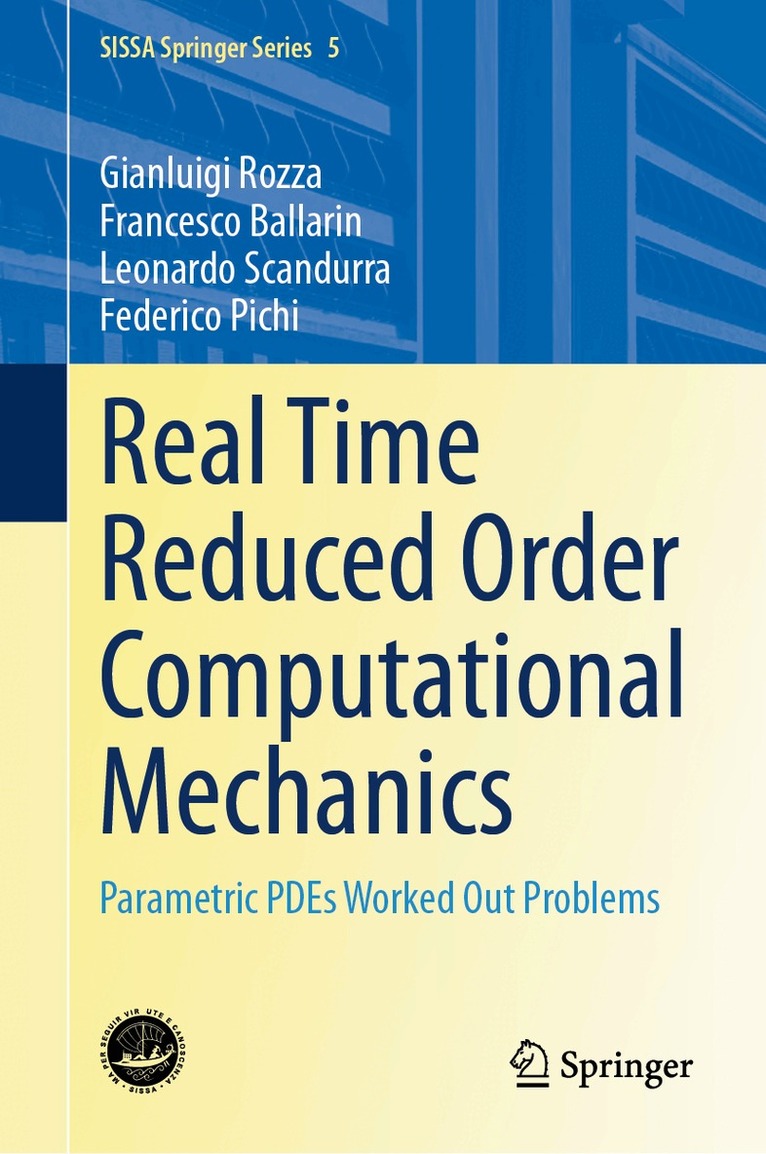
Real Time Reduced Order Computational Mechanics
Parametric PDEs Worked Out Problems
Inbunden, Engelska, 2024
1 276 kr
Skickas inom 7-10 vardagar
The book is made up by several worked out problems concerning the application of reduced order modeling to different parametric partial differential equations problems with an increasing degree of complexity.This work is based on some experience acquired during lectures and exercises in classes taught at SISSA Mathematics Area in the Doctoral Programme “Mathematical Analysis, Modelling and Applications”, especially in computational mechanics classes, as well as regular courses previously taught at EPF Lausanne and during several summer and winter schools. The book is a companion for master and doctoral degree classes by allowing to go more deeply inside some partial differential equations worked out problems, examples and even exercises, but it is also addressed for researchers who are newcomers in computational mechanics with reduced order modeling.In order to discuss computational results for the worked out problems presented in this booklet, we will rely on the RBniCS Project. The RBniCS Project contains an implementation in FEniCS of the reduced order modeling techniques (such as certified reduced basis method and Proper Orthogonal Decomposition-Galerkin methods) for parametric problems that will be introduced in this booklet.
Del 5 - SISSA Springer Series
Real Time Reduced Order Computational Mechanics
Parametric PDEs Worked Out Problems
Häftad, Engelska, 2025
1 276 kr
Skickas inom 10-15 vardagar
The book is made up by several worked out problems concerning the application of reduced order modeling to different parametric partial differential equations problems with an increasing degree of complexity.This work is based on some experience acquired during lectures and exercises in classes taught at SISSA Mathematics Area in the Doctoral Programme “Mathematical Analysis, Modelling and Applications”, especially in computational mechanics classes, as well as regular courses previously taught at EPF Lausanne and during several summer and winter schools. The book is a companion for master and doctoral degree classes by allowing to go more deeply inside some partial differential equations worked out problems, examples and even exercises, but it is also addressed for researchers who are newcomers in computational mechanics with reduced order modeling.In order to discuss computational results for the worked out problems presented in this booklet, we will rely on the RBniCS Project. The RBniCS Project contains an implementation in FEniCS of the reduced order modeling techniques (such as certified reduced basis method and Proper Orthogonal Decomposition-Galerkin methods) for parametric problems that will be introduced in this booklet.
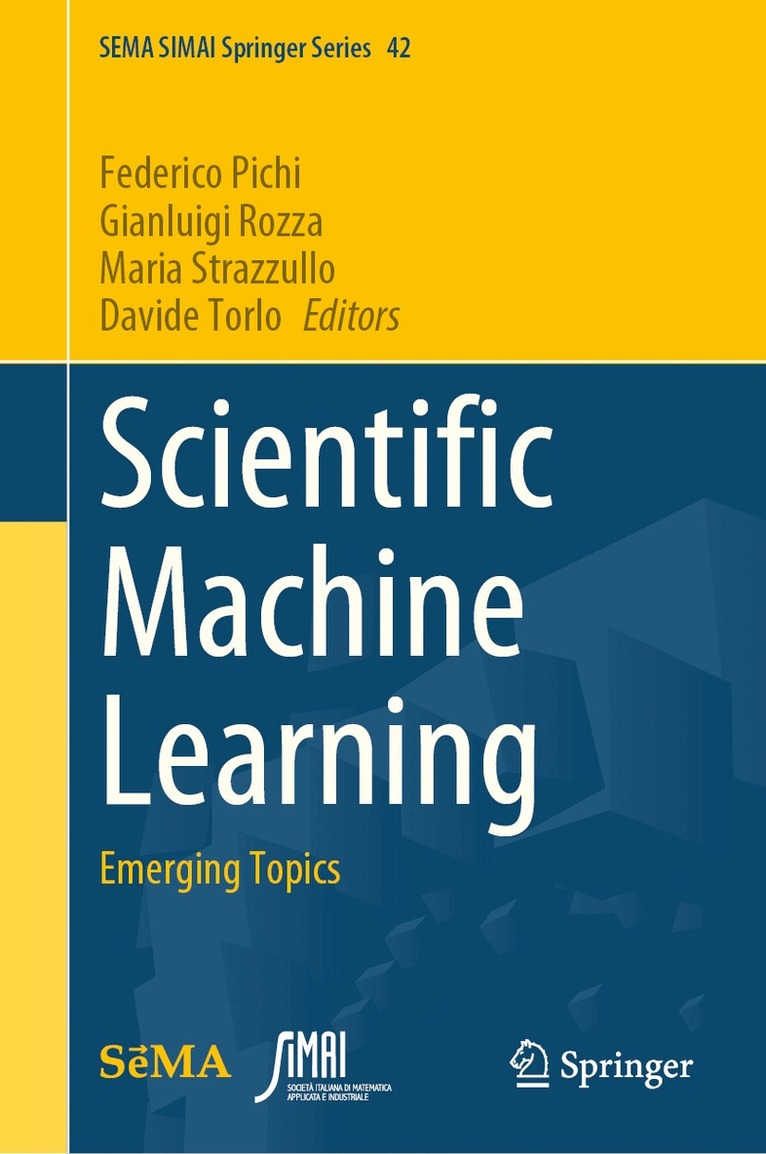
2 311 kr
Skickas inom 10-15 vardagar
This volume gathers peer-reviewed papers from the workshop Scientific Machine Learning: Emerging Topics, held at SISSA in Trieste, Italy. The event gathered leading researchers in mathematics, algorithms, and machine learning. Its goal was to advance the synergy between data-driven models and scientific computing, promoting robust, interpretable, and scalable methods. The works reflect major trends in scientific machine learning (SciML), including optimization, physics-informed learning, neural graph/operators/ODE, transformers, and generative models. Contributions propose physics-based constrained neural networks, advancements in optimization and model reduction, and applications across power systems, chemical kinetics, and biomechanics. Topics span from hybrid models for image classification to generative compression and neural operators for high-dimensional systems. Blending theory and practice, the volume captures the diversity and innovation shaping modern SciML.This volume is addressed to researchers and will provide readers with insight into the current state of the field, sparks new ideas, and encourages further research at the rich intersection of machine learning, mathematics, and scientific computing.