Fernando Vega-Redondo - Böcker
Visar alla böcker från författaren Fernando Vega-Redondo. Handla med fri frakt och snabb leverans.
6 produkter
6 produkter
1 113 kr
Skickas inom 5-8 vardagar
This textbook for advanced undergraduate and postgraduate students of Evolutionary Game Theory covers recent developments in the field, with an emphasis on economic contexts and applications. It begind with the basic ideas as they originated within the field of theoretical biology and then proceeds to the formulation of a theoretical framework that is suitable for the study of social and economic phenomena from an evolutionary perspective. Core topics include the Evolutionary Stable Strategy (EES) and Replicator Dynamics (RD), deterministic dynamic models, and stochastic perturbations. A set of short appendices presents some of the technical material referred to in the main text. Evolutionary theory is widely viewed as one of the most promising appraoches to understanding bounded rationality, learning, and change in complex social environments. New avenues of research are suggested by Vega-Redondo, and plentiful examples illustrate the theory's potential applications. The recent boom experienced by this discipline makes the book's systematic presentation of its essential contributions vital reading for any newcomer to the field.
2 411 kr
Skickas inom 5-8 vardagar
This textbook for advanced undergraduate and postgraduate students of Evolutionary Game Theory covers recent developments in the field, with an emphasis on economic contexts and applications. It begins with the basic ideas as they originated within the field of theoretical biology and then proceeds to the formulation of a theoretical framework that is suitable for the study of social and economic phenomena from an evolutionary perspective. Core topics include the Evolutionary Stable Strategy (EES) and Replicator Dynamics (RD), deterministic dynamic models, and stochastic perturbations. A set of short appendices presents some of the technical material referred to in the main text. Evolutionary theory is widely viewed as one of the most promising appraoches to understanding bounded rationality, learning, and change in complex social environments. New avenues of research are suggested by Vega-Redondo, and plentiful exmples illustrate the theory's potential applications. The recent boom experienced by this dscipline makes the book's systematic presentation of its essential contributions vital reading for newcomer to the field.
473 kr
Skickas inom 7-10 vardagar
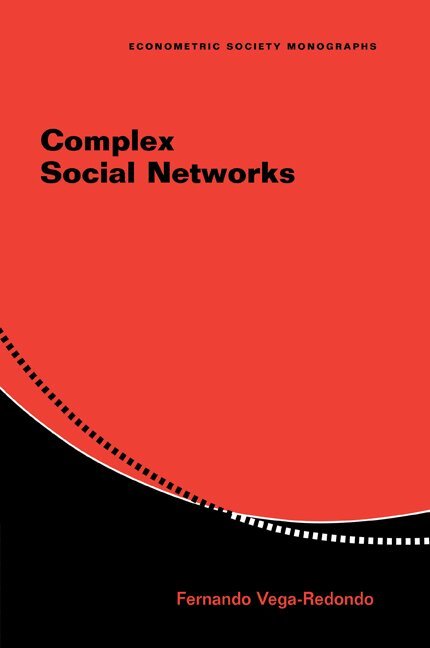
This 2007 book provides a systematic and self-contained account of the fast-developing theory of complex social networks. Social networks are central to the understanding of most socio-economic phenomena in the modern world. The classical approach to studying them relies on a methodology that abstracts from their size and complexity. In contrast, the approach taken in this book keeps complexity at the core, whilst integrating it with the incentive considerations that are preeminent in traditional economic analysis. The treatment starts with a detailed discussion of the basic models that act as 'benchmarks' for the complex-network literature: random networks, small worlds, and scale-free networks, before studying three different forces that underlie almost all network phenomena in social contexts: diffusion, search, and play. Finally, these forces are combined into a unified framework that is brought to bear on the issue of network formation and the coevolution of agents' behaviour and their pattern of interaction.
1 693 kr
Skickas inom 7-10 vardagar
This textbook offers a systematic, self-contained account of the main contributions of modern game theory and its applications to economics. Starting with a detailed description of how to model strategic situations, the discussion proceeds by studying basic solution concepts, their main refinements, games played under incomplete information, and repeated games. For each of these theoretical developments, there is a companion set of applications that cover the most representative instances of game-theoretic analysis in economics, e.g. oligopolistic competition, public goods, coordination failures, bargaining, insurance markets, implementation theory, signaling and auctions. The theory and applications covered in the first part of the book fall under the so-called 'classical' approach to game theory, which is founded on the paradigm of players' unlimited rationality. The second part shifts towards topics that no longer abide by that paradigm. This leads to the study of topics such as the interplay between evolution and rationality.
734 kr
Skickas inom 7-10 vardagar
This textbook offers a systematic, self-contained account of the main contributions of modern game theory and its applications to economics. Starting with a detailed description of how to model strategic situations, the discussion proceeds by studying basic solution concepts, their main refinements, games played under incomplete information, and repeated games. For each of these theoretical developments, there is a companion set of applications that cover the most representative instances of game-theoretic analysis in economics, e.g. oligopolistic competition, public goods, coordination failures, bargaining, insurance markets, implementation theory, signaling and auctions. The theory and applications covered in the first part of the book fall under the so-called 'classical' approach to game theory, which is founded on the paradigm of players' unlimited rationality. The second part shifts towards topics that no longer abide by that paradigm. This leads to the study of topics such as the interplay between evolution and rationality.
1 311 kr
Skickas inom 7-10 vardagar
This 2007 book provides a systematic and self-contained account of the fast-developing theory of complex social networks. Social networks are central to the understanding of most socio-economic phenomena in the modern world. The classical approach to studying them relies on a methodology that abstracts from their size and complexity. In contrast, the approach taken in this book keeps complexity at the core, whilst integrating it with the incentive considerations that are preeminent in traditional economic analysis. The treatment starts with a detailed discussion of the basic models that act as 'benchmarks' for the complex-network literature: random networks, small worlds, and scale-free networks, before studying three different forces that underlie almost all network phenomena in social contexts: diffusion, search, and play. Finally, these forces are combined into a unified framework that is brought to bear on the issue of network formation and the coevolution of agents' behaviour and their pattern of interaction.