Ferruccio Guerrieri - Böcker
Visar alla böcker från författaren Ferruccio Guerrieri. Handla med fri frakt och snabb leverans.
2 produkter
2 produkter
534 kr
Skickas inom 10-15 vardagar
Every year, the Federation of European Biochemical Societies sponsors a series of Advanced Courses designed to acquaint postgraduate students and young postdoctoral fellows with theoretical and practical aspects of topics of current interest in biochemistry, particularly within areas in which significant advances are being made. This volume contains the Proceedings of FEBS Advanced Course No. 88-02 held in Bari, Italy on the topic "Organelles of Eukaryotic Cells: Molecular Structure and Interactions. " It was a deliberate decision of the organizers not to restrict FEBS Advanced Course 88-02 to a discussion of a single organelle or a single aspect but to cover a broad area. One of the objectives of the course was to compare different organelles in order to allow the participants to discern recurrent themes which would illustrate that a basic unity exists in spite of the diversity. A second objective of the course was to acquaint the participants with the latest experimental approaches being used by in vestigators to study different organelles; this would illustrate that methodologies developed for studying the biogenesis of the structure-function relationships in one organelle can often be applied fruitfully to investi gate such aspects in other organelles. A third objective was to impress upon the participants that a study of the interaction between different organelles is intrinsic to understanding their physiological functions. This volume is divided into five sections. Part I is entitled "Structure and Organization of Intracellular Organelles.
Frontiers of Cellular Bioenergetics
Molecular Biology, Biochemistry, and Physiopathology
Häftad, Engelska, 2012
550 kr
Skickas inom 10-15 vardagar
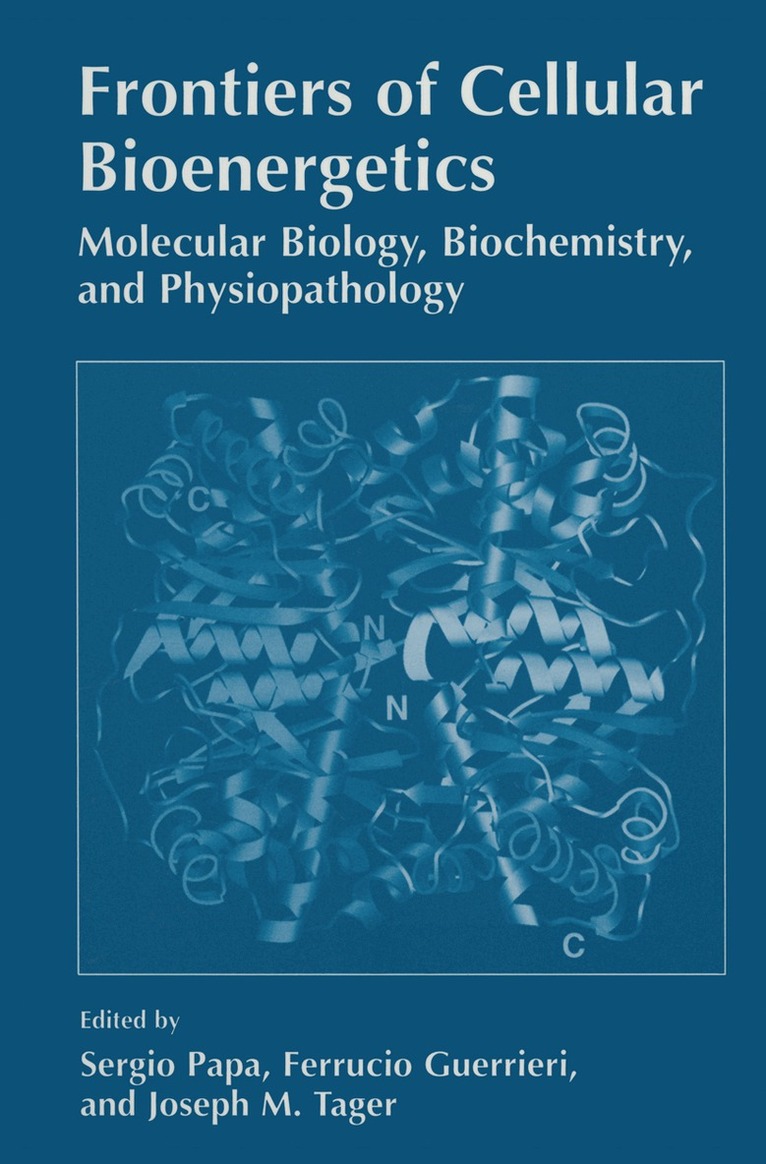
One of the most obvious and fundamental properties of living things is their ability to utilize the potential energy in their environment for their own ends. It is not surprising therefore that the mechanism of this biotransformation of energy-bioenergetics-has long exercised the minds of the leading scientists of their day-from Lavoisier's recognition that respiration is fundamentally the same as combustion, Priestley's discovery of photosynthesis, and Spallan- zani's thesis that respiration is an intracellular process. Until about 30 years ago, the field of bioenergetics was the center of biochemistry, attracting many of the great biochemists of the century, such as Warburg, Keilin, Meyerhof, Engelhardt, Krebs, Lipmann, and Calvin. After the main pathways of intermediary metabolism and electron transfer were estab- lished, however, further progress in elucidating the mechanistic details was slow.This slowdown was due to the absence of sufficient knowledge of the structure of the catalysts involved, even after the innovative proposal by Mitchell on the fundamental role of the translocation of protons across mem- branes, which revolutionized the way in which the mechanism of energy transduction was envisaged and for which he was awarded the Nobel Prize for chemistry in 1978. Competition from other fields of biochemistry in which progress was more spectacular has caused funding difficulties for those work- ing in bioenergetics.