F.G.J. Derkinderen - Böcker
Visar alla böcker från författaren F.G.J. Derkinderen. Handla med fri frakt och snabb leverans.
4 produkter
4 produkter
1 637 kr
Skickas inom 10-15 vardagar
The ending of the decade of the seventies and the dawning of the eighties can be characterized as a period of great uncertainty with prospects for economic political instability. High inflation and fluctuating exchange rates in the de veloped Western world have served to strengthen the forces of disequilibrium in the fmancial markets, leading to an investment situation with several unusual but significant factors. Capital spending by business, leading to the creation of new jobs, has not been reduced substantially during this period of uncertainty, as happened in similar periods in the past. This is shown in part by the continuing low unemployment rates in evidence during the period, which are in contradic tion to the trend exhibited in similar past periods. The expanding financing re quirements resulting from high price inflation have led to an increase in the capital intensity of firms, and thus to enhanced sensitivity of their income streams to economic fluctuations. At the same time, the record high interest rates that companies have had to pay to acquire this inflated amount of capital have caused a deterioration in the safety or quality indica tors by which the creditworthiness of the firms is judged. These developments tend to increase vii viii INTRODUCTION the stakes involved in business decision making. One important repercussion of this is that greater attention is now being focused on improving the quality of investment decisions.
1 636 kr
Skickas inom 10-15 vardagar
The ending of the decade of the seventies and the dawning of the eighties can be characterized as a period of great uncertainty with prospects for economic political instability. High inflation and fluctuating exchange rates in the de veloped Western world have served to strengthen the forces of disequilibrium in the fmancial markets, leading to an investment situation with several unusual but significant factors. Capital spending by business, leading to the creation of new jobs, has not been reduced substantially during this period of uncertainty, as happened in similar periods in the past. This is shown in part by the continuing low unemployment rates in evidence during the period, which are in contradic tion to the trend exhibited in similar past periods. The expanding financing re quirements resulting from high price inflation have led to an increase in the capital intensity of firms, and thus to enhanced sensitivity of their income streams to economic fluctuations. At the same time, the record high interest rates that companies have had to pay to acquire this inflated amount of capital have caused a deterioration in the safety or quality indica tors by which the creditworthiness of the firms is judged. These developments tend to increase vii viii INTRODUCTION the stakes involved in business decision making. One important repercussion of this is that greater attention is now being focused on improving the quality of investment decisions.
550 kr
Skickas inom 10-15 vardagar
Project Set Strategies focuses on an issue of vital concern to corporate managers: the development and implementation of strategy. Regretfully, this topic has received too little attention in the literature of finance and has been treated in completely in the management journals. In fact, not everyone recognizes that it falls within the sphere of finance. However, since the important issues discussed in this book strategically shape the destiny of the company and can seal its fate long before the point is reached where conventional finance considerations come into play, it is essential that this recognition be acknowledged. From the management point of view, it has long been realized that strategic elements playa crucial role in the continued well-being of the firm. Nevertheless, this truth is overlooked to some extent with most management techniques since there is insufficient typification, often leading to unjustified generalizations and inadequate attention to the requirements of the specific situation. Also, these management techniques are not grounded upon the long-established fmancial economic theories of valuations and thus can lead to misdirected guidance. Since the two academic disciplines of "management" and "finance" have much insight to offer each other, this book represents an effort to link the strategic management area to a theoretically sound and usable financial e- xv xvi PREFACE nomic foundation. In this way, the probability of errors of omission or unjusti fied generalizations is decreased and help is offered for ascertaining more relevant goal-directed recommendations.
Del 5 - Nijenrode Studies in Business
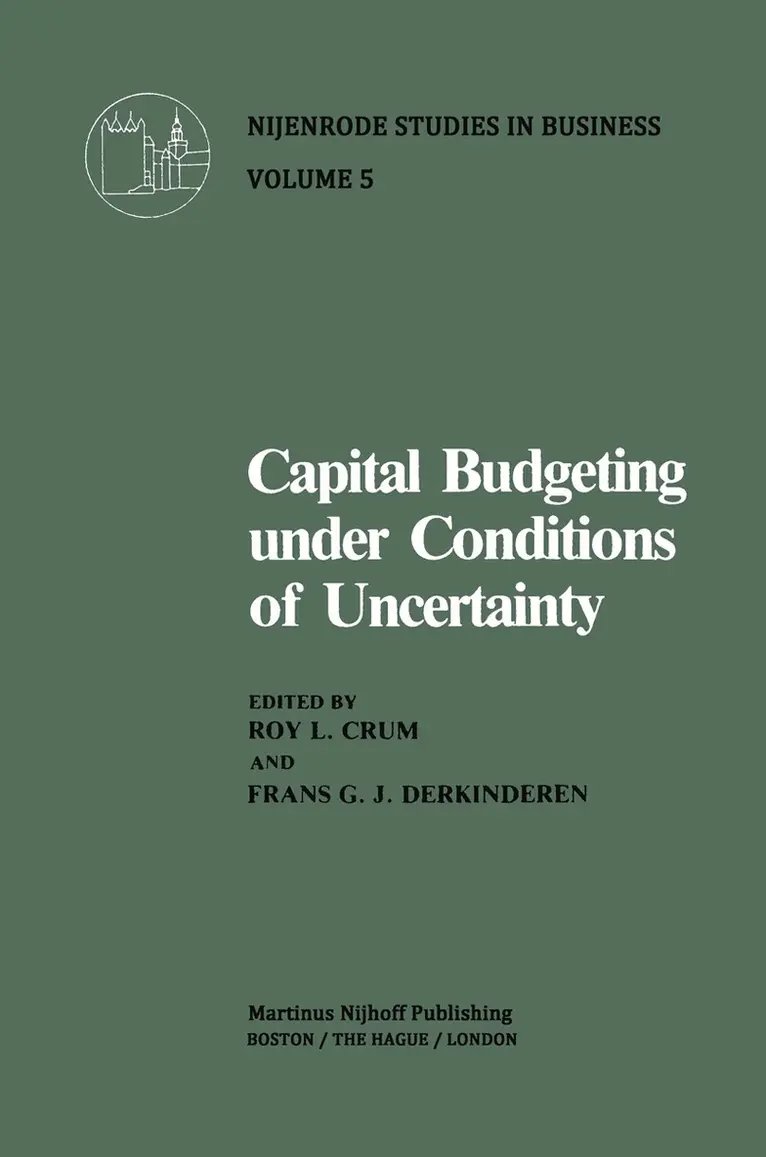
Capital Budgeting Under Conditions of Uncertainty
Häftad, Engelska, 2012
550 kr
Skickas inom 10-15 vardagar
The business environment, particularly after the continuing oil crises of the seventies, can be characterized as evolving rapidly in complex and often unpre dictable ways. Such things as high interest and inflation rates, fluctuating ex change rates, volatile commodity markets, and increasing political turmoil have led to a situation in which explicit consideration of environmental dynamics is becoming much more important for successful business planning than was true in the past. Companies are finding that it is no longer possible to conduct "busi ness as usual" under these changing circumstances. Rather, decision makers are having to be more cognizant of the many sources of uncertainty that could have serious impacts on the continued prosperity of the firm, as well as of actions that can be taken so that the company can thrive in spite of these greater uncertainties. Businesses have responded to these challenges by giving more thorough con sideration to strategic issues. Whereas in the past the steady progression of mar kets and technology was taken for granted, the uncertainties associated with increased worldwide competition, as well as with other exogenous factors, have vii viii INTRODUCTION forced companies to think more about flexibility. This involves not only how best to exploit profitable current options, but also how to position themselves at present to be able to respond appropriately to threats and opportunities as they arise in the future. Unfortunately, in this redirection of outlook, the fmance profession has not kept pace.