Florin Diacu - Böcker
Visar alla böcker från författaren Florin Diacu. Handla med fri frakt och snabb leverans.
3 produkter
3 produkter
282 kr
Skickas inom 7-10 vardagar
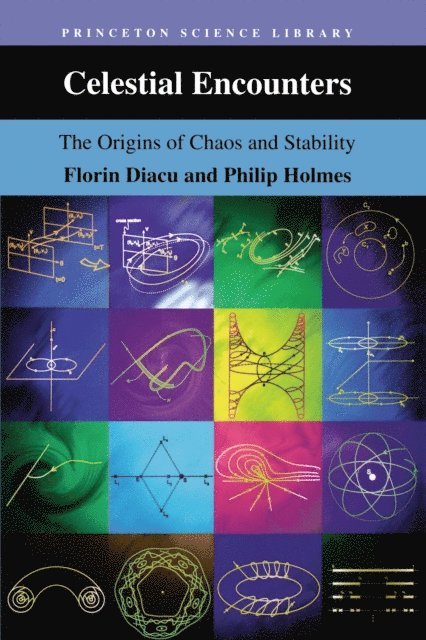
Celestial Encounters is for anyone who has ever wondered about the foundations of chaos. In 1888, the 34-year-old Henri Poincare submitted a paper that was to change the course of science, but not before it underwent significant changes itself. "The Three-Body Problem and the Equations of Dynamics" won a prize sponsored by King Oscar II of Sweden and Norway and the journal Acta Mathematica, but after accepting the prize, Poincare found a serious mistake in his work. While correcting it, he discovered the phenomenon of chaos. Starting with the story of Poincare's work, Florin Diacu and Philip Holmes trace the history of attempts to solve the problems of celestial mechanics first posed in Isaac Newton's Principia in 1686. In describing how mathematical rigor was brought to bear on one of our oldest fascinations--the motions of the heavens--they introduce the people whose ideas led to the flourishing field now called nonlinear dynamics. In presenting the modern theory of dynamical systems, the models underlying much of modern science are described pictorially, using the geometrical language invented by Poincare.More generally, the authors reflect on mathematical creativity and the roles that chance encounters, politics, and circumstance play in it.
1 127 kr
Tillfälligt slut
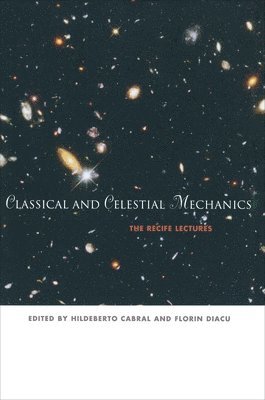
This book brings together a number of lectures given between 1993 and 1999 as part of a special series hosted by the Federal University of Pernambuco, in which internationally established researchers came to Recife, Brazil, to lecture on classical or celestial mechanics. Because of the high quality of the results and the general interest in the lecturers' topics, the editors have assembled nine of the lectures here in order to make them available to mathematicians and students around the world. The material presented includes a good balance of pure and applied research and of complete and incomplete results. Bringing together material that is otherwise quite scattered in the literature and including some important new results, it will serve graduate students and researchers interested in Hamiltonian dynamics and celestial mechanics. The contributors are Dieter Schmidt, Ernesto Perez-Chavela, Mark Levi, Placido Taboas and Jack Hale, Jair Koiller et al., Hildeberto Cabral, Florin Diacu, and Alain Albouy.The topics covered include central configurations and relative equilibria for the N-body problem, singularities of the N-body problem, the two-body problem, normal forms of Hamiltonian systems and stability of equilibria, applications to celestial mechanics of Poincare's compactification, the motion of the moon, geometrical methods in mechanics, momentum maps and geometric phases, holonomy for gyrostats, microswimming, and bifurcation from families of periodic solutions.
Del 1 - Atlantis Studies in Dynamical Systems
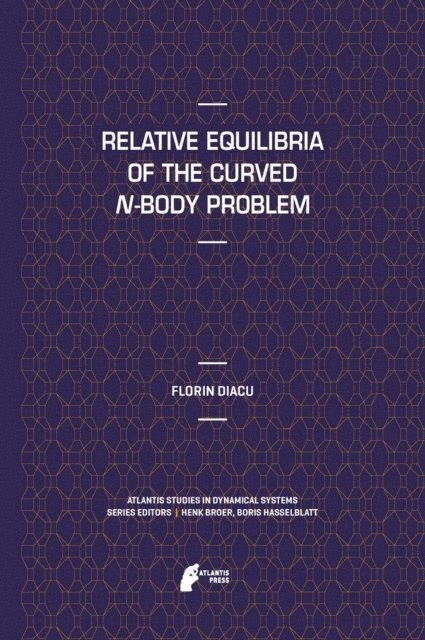
Relative Equilibria of the Curved N-Body Problem
Inbunden, Engelska, 2012
1 011 kr
Skickas inom 10-15 vardagar
The guiding light of this monograph is a question easy to understand but difficult to answer: {What is the shape of the universe? In other words, how do we measure the shortest distance between two points of the physical space? Should we follow a straight line, as on a flat table, fly along a circle, as between Paris and New York, or take some other path, and if so, what would that path look like? If you accept that the model proposed here, which assumes a gravitational law extended to a universe of constant curvature, is a good approximation of the physical reality (and I will later outline a few arguments in this direction), then we can answer the above question for distances comparable to those of our solar system. More precisely, this monograph provides a mathematical proof that, for distances of the order of 10 AU, space is Euclidean. This result is, of course, not surprising for such small cosmic scales. Physicists take the flatness of space for granted in regions of that size. But it is good to finally have a mathematical confirmation in this sense.Our main goals, however, are mathematical. We will shed some light on the dynamics of N point masses that move in spaces of non-zero constant curvature according to an attraction law that naturally extends classical Newtonian gravitation beyond the flat (Euclidean) space. This extension is given by the cotangent potential, proposed by the German mathematician Ernest Schering in 1870. He was the first to obtain this analytic expression of a law suggested decades earlier for a 2-body problem in hyperbolic space by Janos Bolyai and, independently, by Nikolai Lobachevsky. As Newton's idea of gravitation was to introduce a force inversely proportional to the area of a sphere the same radius as the Euclidean distance between the bodies, Bolyai and Lobachevsky thought of a similar definition using the hyperbolic distance in hyperbolic space. The recent generalization we gave to the cotangent potential to any number N ofbodies, led to the discovery of some interesting properties. This new research reveals certain connections among at least five branches of mathematics: classical dynamics, non-Euclidean geometry, geometric topology, Lie groups, and the theory of polytopes.