Francis Jeffrey Pelletier - Böcker
Visar alla böcker från författaren Francis Jeffrey Pelletier. Handla med fri frakt och snabb leverans.
4 produkter
4 produkter
Del 72 - Philosophical Studies Series
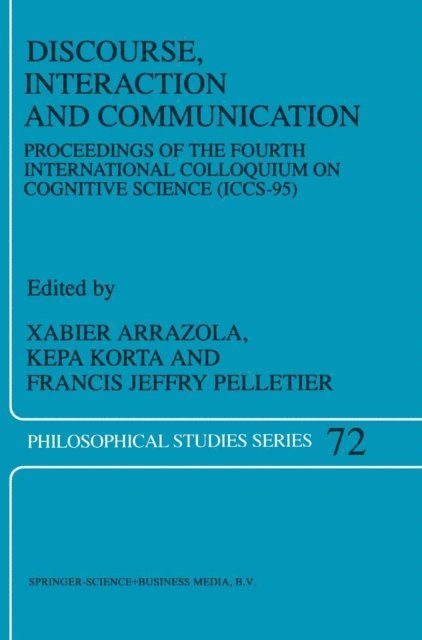
Discourse, Interaction and Communication
Proceedings of the Fourth International Colloquium on Cognitive Science (ICCS-95)
Inbunden, Engelska, 1998
1 034 kr
Skickas inom 10-15 vardagar
The papers in this volume represent work by scholars on discourse, interaction, and communication. They report work done from widely divergent points on the theoretical spectrum of cognitive science, and from different disciplinary starting points (philosophy, logic, linguistics, artificial intelligence). Not only do these works represent the main topics and the wide range of differing positions presented at the fourth International Colloquium on Cognitive Science (ICCS-95), but despite their differences (or perhaps because of these differences) they also display many clear directions for future research in these three central areas of cognitive science.
Del 6 - Studies in Linguistics and Philosophy
Mass Terms: Some Philosophical Problems
Häftad, Engelska, 2005
1 967 kr
Skickas inom 10-15 vardagar
I. MASS TERMS, COUNT TERMS, AND SORTAL TERMS Central examples of mass terms are easy to come by. 'Water', 'smoke', 'gold', etc. , differ in their syntactic, semantic, and pragmatic properties from count terms such as 'man', 'star', 'wastebasket', etc. Syntactically, it seems, mass terms do, but singular count terms do not, admit the quantifier phrases 'much', 'an amount of', 'a little', etc. The typical indefinite article for them is 'some' (unstressed)!, and this article cannot be used with singular count terms. Count terms, but not mass terms, use the quantifiers 'each', 'every', 'some', 'few', 'many'; and they use 'a(n)' as the indefinite article. They can, unlike the mass terms, take numerals as prefixes. Mass terms seem not to have a plural. Semantically, philo sophers have characterized count terms as denoting (classes of?) indi vidual objects, whereas what mass terms denote are cumulative and dissective. (That is, a mass term is supposed to be true of any sum of things (stuff) it is true of, and true of any part of anything of which it is true). Pragmatically, it seems that speakers use count terms when they wish to refer to individual objects, or when they wish to reidentify a particular already introduced into discoursc. Given a "space appropriate" to a count term C, it makes sense to ask how many C's there are in that space.
Del 6 - Studies in Linguistics and Philosophy
Mass Terms: Some Philosophical Problems
Inbunden, Engelska, 1979
1 967 kr
Skickas inom 10-15 vardagar
I. MASS TERMS, COUNT TERMS, AND SORTAL TERMS Central examples of mass terms are easy to come by. 'Water', 'smoke', 'gold', etc. , differ in their syntactic, semantic, and pragmatic properties from count terms such as 'man', 'star', 'wastebasket', etc. Syntactically, it seems, mass terms do, but singular count terms do not, admit the quantifier phrases 'much', 'an amount of', 'a little', etc. The typical indefinite article for them is 'some' (unstressed)!, and this article cannot be used with singular count terms. Count terms, but not mass terms, use the quantifiers 'each', 'every', 'some', 'few', 'many'; and they use 'a(n)' as the indefinite article. They can, unlike the mass terms, take numerals as prefixes. Mass terms seem not to have a plural. Semantically, philo sophers have characterized count terms as denoting (classes of?) indi vidual objects, whereas what mass terms denote are cumulative and dissective. (That is, a mass term is supposed to be true of any sum of things (stuff) it is true of, and true of any part of anything of which it is true). Pragmatically, it seems that speakers use count terms when they wish to refer to individual objects, or when they wish to reidentify a particular already introduced into discoursc. Given a "space appropriate" to a count term C, it makes sense to ask how many C's there are in that space.
Del 72 - Philosophical Studies Series
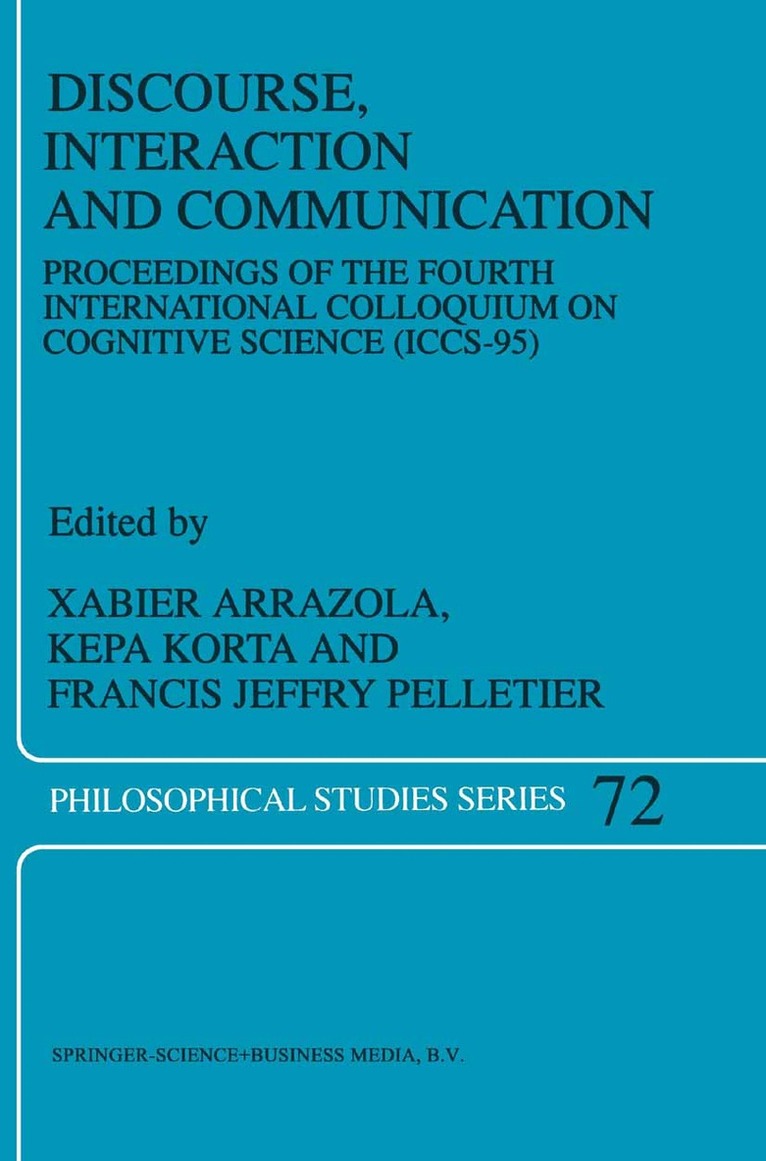
Discourse, Interaction and Communication
Proceedings of the Fourth International Colloquium on Cognitive Science (ICCS-95)
Häftad, Engelska, 2010
1 064 kr
Skickas inom 10-15 vardagar
The papers in this volume represent leading-edge work by well-known scholars on the topics mentioned in the title: discourse, interaction, and communication. They report work done from widely divergent points on the theoretical spectrum of cognitive science, and from different disciplinary starting points (philosophy, logic, linguistics, artificial intelligence). Not only do these works faithfully represent the main topics and the wide range of differing positions presented at the Fourth International Colloquium on Cognitive Science (ICCS-95), but despite their differences (or perhaps because of these differences) they also display many clear directions for future research in these three central areas of cognitive science. This book is essential reading for all researchers in cognitive science.