Francisco E. Gonzalez - Böcker
Visar alla böcker från författaren Francisco E. Gonzalez. Handla med fri frakt och snabb leverans.
5 produkter
5 produkter
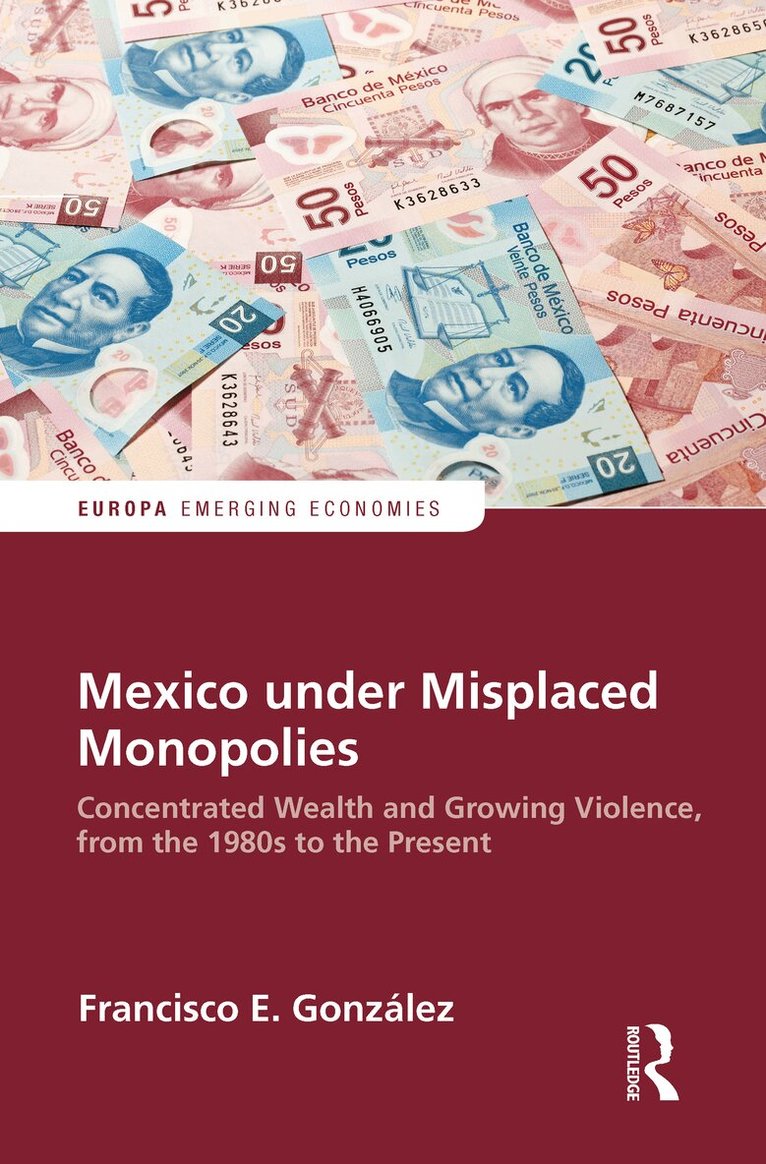
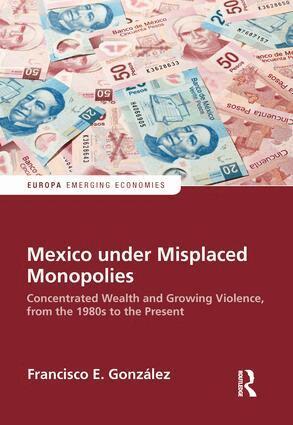
Mexico under Misplaced Monopolies
Concentrated Wealth and Growing Violence, from the 1980s to the Present
Häftad, Engelska, 2020
564 kr
Skickas inom 10-15 vardagar
Mexicans and those who follow Mexican affairs were optimistic in 2000 when the country experienced its first alternation in government (from the Partido Revolucionario Institucional –PRI--to the Partido Acción Nacional--PAN) in more than 70 years. Moreover, the Mexican economy had been restructured in a more open, market-led direction in the course of the 1980s and 1990s. The outcomes of these dual transitions were expected to create a new type of politics that were representative and accountable to citizens, and an economy that would grow rapidly, as it was forced to modernize by facing international competition.Some two decades later, views about Mexico are much less sanguine, and for many the country continues to follow a bipolar politico-economic trajectory characterized by periods of enthusiasm and mania which are followed by crisis and depression. This book presents a new analytical framework and reviews in detail Mexico’s political and economic history since the 1980s. The explanation offered is based on the idea of ‘misplaced monopolies’--i.e. an open political regime but a weak, fragmented state, and an internationally open economy, but highly concentrated economic sectors and activity in the domestic sphere. Accordingly, sown in the course of the crisis-ridden 1980s and 1990s, misplaced monopolies grew roots and became core features of Mexico’s political economy in the 2000s and 2010s. The end result has been great concentration of wealth in a small number of hands, and the dramatic growth in brutal violence in many parts of the country. From this perspective, unless ‘misplaced monopolies’ are reversed, conditions will remain prone to crisis, polarization, and conflict in Mexico. This volume concludes by extrapolating the framework and placing Mexico in comparative perspective, alongside internationally important countries such as Brazil, China, India, and Russia.This is a highly original investigation that will interest people who follow Mexican politics and its economy. The analytical framework will be of use to analysts, scholars, and students of comparative political economy, democratization studies, market reforms, and security and conflict studies.
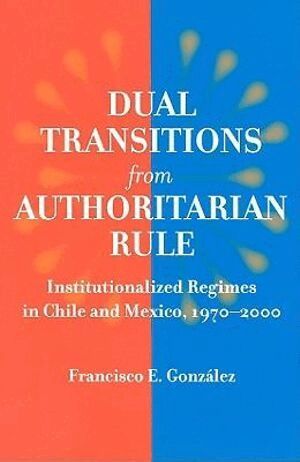
Dual Transitions from Authoritarian Rule
Institutionalized Regimes in Chile and Mexico, 1970–2000
Inbunden, Engelska, 2008
633 kr
Tillfälligt slut
Latin America's region-wide 1982 economic collapse had a drastic effect on governments throughout Central and South America, leading many to the verge of failure and pushing several of the most stridently authoritarian-Argentina, Bolivia, Brazil, and Uruguay-over the brink. Surprisingly though, Chile's repressive military dictatorship and Mexico's hegemonic civilian regime endured amid the economic chaos that rocked the region. Dual Transitions from Authoritarian Rule explains why the regimes in these two nations survived the financial upheaval of the early 1980s and how each progressed toward a more open, democratic, market-driven system in later years. Using an in-depth comparative analysis of Chile and Mexico, Francisco Gonzalez explains that the two governments-though quite different ideologically-possessed a common type of institutionalized authoritarian rule that not only served to maintain the political status quo but, paradoxically, also aided proponents of political and economic liberalization.Featuring a discussion of parallel phenomena in Brazil, Hungary, Taiwan, and South Korea, Dual Transitions from Authoritarian Rule presents a cogent challenge to the received wisdom that sociopolitical and economic change within authoritarian nations must be approached separately. This book will interest scholars of Latin American politics, democratization studies, market reform, and comparative politics and international relations.
Dual Transitions from Authoritarian Rule
Institutionalized Regimes in Chile and Mexico, 1970–2000
Häftad, Engelska, 2008
355 kr
Skickas inom 7-10 vardagar
Latin America's region-wide 1982 economic collapse had a drastic effect on governments throughout Central and South America, leading many to the verge of failure and pushing several of the most stridently authoritarian-Argentina, Bolivia, Brazil, and Uruguay-over the brink. Surprisingly though, Chile's repressive military dictatorship and Mexico's hegemonic civilian regime endured amid the economic chaos that rocked the region. Dual Transitions from Authoritarian Rule explains why the regimes in these two nations survived the financial upheaval of the early 1980s and how each progressed toward a more open, democratic, market-driven system in later years. Using an in-depth comparative analysis of Chile and Mexico, Francisco Gonzalez explains that the two governments-though quite different ideologically-possessed a common type of institutionalized authoritarian rule that not only served to maintain the political status quo but, paradoxically, also aided proponents of political and economic liberalization.Featuring a discussion of parallel phenomena in Brazil, Hungary, Taiwan, and South Korea, Dual Transitions from Authoritarian Rule presents a cogent challenge to the received wisdom that sociopolitical and economic change within authoritarian nations must be approached separately. This book will interest scholars of Latin American politics, democratization studies, market reform, and comparative politics and international relations.
484 kr
Tillfälligt slut
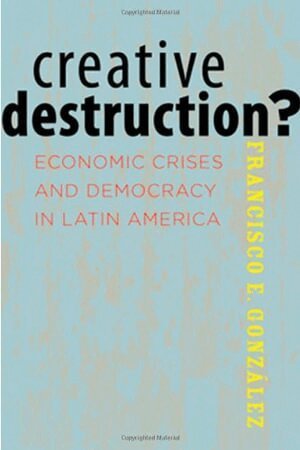
Throughout the twentieth century, financial shocks toppled democratic and authoritarian regimes across Latin America. But things began to change in the 1980s. This volume explains why this was the case in Argentina, Chile, and Uruguay. Taking a comparative historical approach, Francisco E. Gonzalez looks at how the Great Depression, Latin America's 1980s debt crisis, and the emerging markets' meltdowns of the late 1990s and early 2000s affected the governments of these three Southern Cone states. He finds that democratic or not, each nation's governing regime gained stability in the 1980s from a combination of changes in the structure and functioning of national and international institutions, material interests, political ideologies, and economic paradigms and policies. Underlying these changes was a growing ease in the exchange of ideas. As the world's balance of power transitioned from trilateral to bipolar to unipolar, international institutions such as the World Bank and the International Monetary Fund increased crisis interventions that backstopped economic freefalls and strengthened incumbents.Urban-based populations with relatively high per capita income grew and exercised their preference for the stability and prosperity they found as a class under democratic rule. These and other factors combined to substantially increase the cost of military takeovers, leading to fewer coups and an atmosphere friendlier toward domestic and foreign capital investment. Gonzalez argues that this confluence created a pro-democracy bias - which was present even in Augusto Pinochet's Chile - that not only aided the states' ability to manage economic and political crises but also lessened the political, social, and monetary barriers to maintaining or even establishing democratic governance. With a concluding chapter on the impact of the Great Recession in other Latin American states, Eastern Europe, and East Asia, "Creative Destruction?" lends insight into the survival of democratic and authoritarian regimes during times of extreme financial instability. Scholars and students of Latin America, political economy, and democratization studies will find Gonzalez's arguments engaging and the framework he built for this study especially useful in their own work.
Mexico under Misplaced Monopolies
Concentrated Wealth and Growing Violence, from the 1980s to the Present
Inbunden, Engelska, 2018
1 909 kr
Skickas inom 10-15 vardagar
Mexicans and those who follow Mexican affairs were optimistic in 2000 when the country experienced its first alternation in government (from the Partido Revolucionario Institucional –PRI--to the Partido Acción Nacional--PAN) in more than 70 years. Moreover, the Mexican economy had been restructured in a more open, market-led direction in the course of the 1980s and 1990s. The outcomes of these dual transitions were expected to create a new type of politics that were representative and accountable to citizens, and an economy that would grow rapidly, as it was forced to modernize by facing international competition.Some two decades later, views about Mexico are much less sanguine, and for many the country continues to follow a bipolar politico-economic trajectory characterized by periods of enthusiasm and mania which are followed by crisis and depression. This book presents a new analytical framework and reviews in detail Mexico’s political and economic history since the 1980s. The explanation offered is based on the idea of ‘misplaced monopolies’--i.e. an open political regime but a weak, fragmented state, and an internationally open economy, but highly concentrated economic sectors and activity in the domestic sphere. Accordingly, sown in the course of the crisis-ridden 1980s and 1990s, misplaced monopolies grew roots and became core features of Mexico’s political economy in the 2000s and 2010s. The end result has been great concentration of wealth in a small number of hands, and the dramatic growth in brutal violence in many parts of the country. From this perspective, unless ‘misplaced monopolies’ are reversed, conditions will remain prone to crisis, polarization, and conflict in Mexico. This volume concludes by extrapolating the framework and placing Mexico in comparative perspective, alongside internationally important countries such as Brazil, China, India, and Russia.This is a highly original investigation that will interest people who follow Mexican politics and its economy. The analytical framework will be of use to analysts, scholars, and students of comparative political economy, democratization studies, market reforms, and security and conflict studies.