Francois Ferre - Böcker
Visar alla böcker från författaren Francois Ferre. Handla med fri frakt och snabb leverans.
3 produkter
3 produkter
750 kr
Skickas inom 10-15 vardagar
Edited by the inventor of polymerase chain reaction (PCR) and the 1993 Nobel Prize winner in Chemistry, Kary Mullis, as well as two experts in the field, this handbook provides up-to-date methodological protocols from the world's leading laboratories, in addition to new techniques and enhanced applications not yet available in book form. Nearly 40 chapters inform the novice and experienced PCR user on how to optimize their results. In the chapters on applications, researchers provide not only protocols, but also descriptions of how PCR has revolutionized their particular field. Future enhancements of PCR, as well as new potential uses, are discussed. Readers can learn how PCR has changed the face of diagnostic testing, cancer research, genetics, forensics, plant biology, DNA sequencing and gene therapy. Special sections include the latest on QPCR, non-isotopic detection, genetic analysis, and PCR and the world of business, which includes a behind-the-scenes look at the legal battles between biotech giants Cetus and DuPont. It also provides insights into the origins of PCR and the history of nucleic acid research.
2 110 kr
Skickas inom 10-15 vardagar
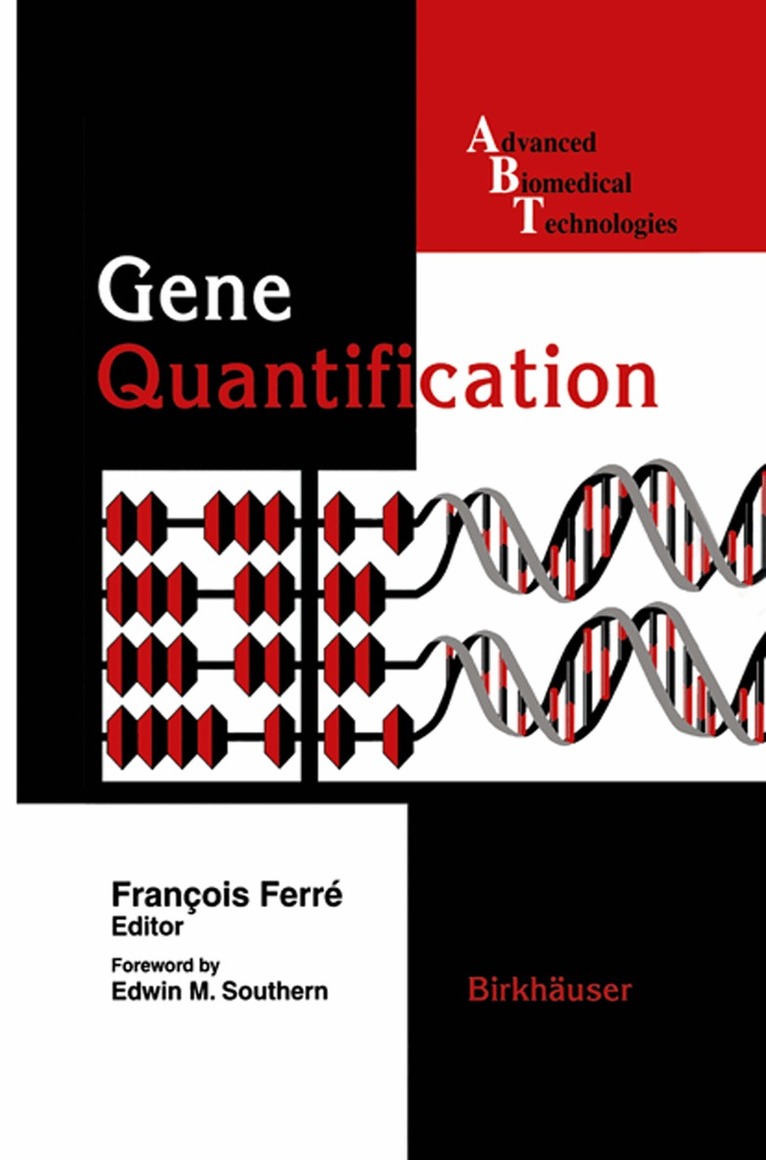
Geneticists and molecular biologists have been interested in quantifying genes and their products for many years and for various reasons (Bishop, 1974). Early molecular methods were based on molecular hybridization, and were devised shortly after Marmur and Doty (1961) first showed that denaturation of the double helix could be reversed - that the process of molecular reassociation was exquisitely sequence dependent. Gillespie and Spiegelman (1965) developed a way of using the method to titrate the number of copies of a probe within a target sequence in which the target sequence was fixed to a membrane support prior to hybridization with the probe - typically a RNA. Thus, this was a precursor to many of the methods still in use, and indeed under development, today. Early examples of the application of these methods included the measurement of the copy numbers in gene families such as the ribosomal genes and the immunoglo bulin family. Amplification of genes in tumors and in response to drug treatment was discovered by this method. In the same period, methods were invented for estimating gene num bers based on the kinetics of the reassociation process - the so-called Cot analysis. This method, which exploits the dependence of the rate of reassociation on the concentration of the two strands, revealed the presence of repeated sequences in the DNA of higher eukaryotes (Britten and Kohne, 1968). An adaptation to RNA, Rot analysis (Melli and Bishop, 1969), was used to measure the abundance of RNAs in a mixed population.
2 173 kr
Skickas inom 10-15 vardagar
Geneticists and molecular biologists have been interested in quantifying genes and their products for many years and for various reasons (Bishop, 1974). Early molecular methods were based on molecular hybridization, and were devised shortly after Marmur and Doty (1961) first showed that denaturation of the double helix could be reversed - that the process of molecular reassociation was exquisitely sequence dependent. Gillespie and Spiegelman (1965) developed a way of using the method to titrate the number of copies of a probe within a target sequence in which the target sequence was fixed to a membrane support prior to hybridization with the probe - typically a RNA. Thus, this was a precursor to many of the methods still in use, and indeed under development, today. Early examples of the application of these methods included the measurement of the copy numbers in gene families such as the ribosomal genes and the immunoglo bulin family. Amplification of genes in tumors and in response to drug treatment was discovered by this method. In the same period, methods were invented for estimating gene num bers based on the kinetics of the reassociation process - the so-called Cot analysis. This method, which exploits the dependence of the rate of reassociation on the concentration of the two strands, revealed the presence of repeated sequences in the DNA of higher eukaryotes (Britten and Kohne, 1968). An adaptation to RNA, Rot analysis (Melli and Bishop, 1969), was used to measure the abundance of RNAs in a mixed population.