François Savatier – författare
Visar alla böcker från författaren . Handla med fri frakt och snabb leverans.
6 produkter
6 produkter
Häftad, Engelska, 2019
166 kr
Skickas inom 5-8 vardagar
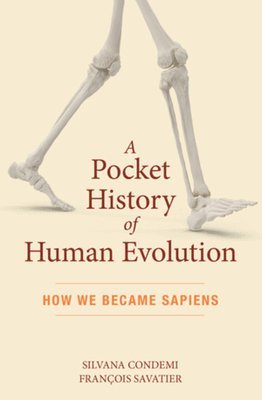
Prehistory has never been more exciting: New discoveries are overturning long-held theories left and right. Stone tools in Australia date back 65,000 years—a time when, we once thought, the first Sapiens had barely left Africa. DNA sequencing has unearthed a new hominid group—the Denisovans—and confirmed that crossbreeding with them (and Neanderthals) made Homo sapiens who we are today.A Pocket History of Human Evolution brings us up-to-date on the exploits of all our ancient relatives. Paleoanthropologist Silvana Condemi and science journalist François Savatier consider what accelerated our evolution: Was it tools, our “large” brains, language, empathy, or something else entirely? And why are we the sole survivors among many early bipedal humans? Their conclusions reveal the various ways ancient humans live on today—from gossip as modern “grooming” to our gendered division of labor—and what the future might hold for our strange and unique species.
Inbunden, Tyska, 2020
220 kr
Skickas inom 3-6 vardagar
Del 6579 - Beck Paperback
Denisova
Inbunden, Tyska, 2025
267 kr
Skickas inom 3-6 vardagar
E-bok
Spanska, 202170 kr
Läs direkt efter köp
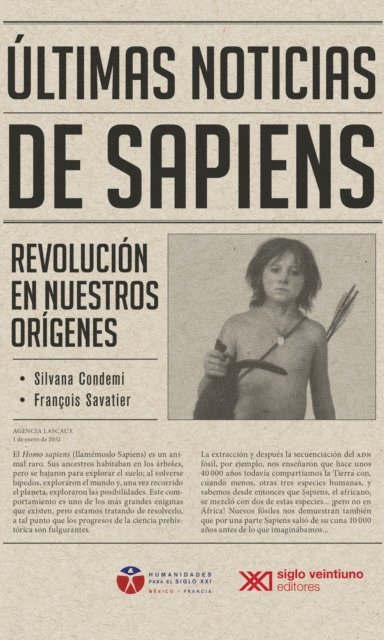
Homo sapiens es decididamente una especie extraña. Se pensaba que apareció en un lugar de África hace 200000 años, pero, sorpresa, se detecta su presencia mucho antes y por todo el continente. Se creía que salió de su cuna hace 80000 años, hasta que se descubrieron en China fósiles mucho más antiguos. Peor aún -o mejor aún, según se quiera-la genética ha mostrado que ¡hasta hace poco compartimos este planenta con otras especies humanas que después desaparecieron y con las cuales nos enrazamos!Esto habla de la urgencia de hacer un recuento de nuestros ancestros y de escuchar las últimas novedades de Sapiens. De los austrolopitecos al neolítico los autores nos cuentan la fascinante saga de un extraño primate transformado para siempre por la evolución y por nuestro bien preciado: la cultura.
Inbunden, Engelska, 2025
294 kr
Skickas
In December 2010, scientists discovered a fragment of a finger bone in the remote, isolated Denisova Cave in Siberia. To their surprise, the bone contained neither Homo sapiens nor Neanderthal DNA. Rather, the fast-advancing science of paleogenetics revealed that the DNA came from a previously unknown species of hominids—the Denisovans (as they almost immediately came to be called)—who shared a common ancestor with both Neanderthals and Homo sapiens.This first and subsequent Denisovan fossil discoveries required paleoanthropologists, including world-leading researcher and author Silvana Condemi, to reconsider their understanding of our ancestors and their successive prehistoric migrations out of Africa and into and throughout Eurasia tens of thousands of years ago.Leading us through the excavation of Denisova Cave, the sequencing of the Denisovan genome, and recent fossil research, Condemi and her coauthor, science journalist François Savatier, explore how the Denisovans migrated throughout Asia and with whom they interacted along the way, as well as the comparisons and divergences between the evolutionary processes of Denisovans and our other ancestor cousins, Neanderthals. They help us to understand and appreciate how today’s inhabitants of East Asia—from Siberia to the Philippines—carry up to 5 percent of Denisovan DNA, and they revise the epic story of our ancient human ancestors’ immense journeys as they peopled our planet.

Häftad, Engelska, 2026
184 kr
Skickas inom 5-8 vardagar
In December 2010, scientists discovered a fragment of a finger bone in the remote, Denisova Cave in Siberia. To their surprise, the bone contained neither Homo sapiens nor Neanderthal DNA. Rather, the fast-advancing science of paleogenetics revealed that the DNA came from a previously unknown species of hominids—the Denisovans—who shared a common ancestor with both Neanderthals and Homo sapiens.This and subsequent Denisovan fossil discoveries required paleoanthropologists, including Silvana Condemi, to reconsider their understanding of our ancestors and their successive prehistoric migrations out of Africa and into and throughout Eurasia tens of thousands of years ago.Leading us through the excavation of Denisova Cave, the sequencing of the Denisovan genome and recent fossil research, Condemi and her co-author, François Savatier, explore how the Denisovans migrated throughout Asia and with whom they interacted along the way, as well as the comparisons and divergences between the evolutionary processes of Denisovans and our other ancestor cousins, Neanderthals. They help us to understand and appreciate how today’s inhabitants of East Asia—from Siberia to the Philippines—carry up to 5 percent of Denisovan DNA, and they revise the epic story of our ancient human ancestors’ journeys as they peopled our planet.