Francoise Detienne – författare
Visar alla böcker från författaren Francoise Detienne. Handla med fri frakt och snabb leverans.
7 produkter
7 produkter
E-bok
PDF, Engelska, 2012734 kr
Läs direkt efter köp
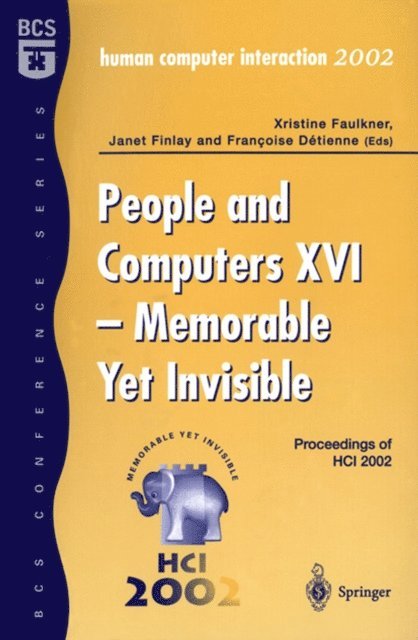
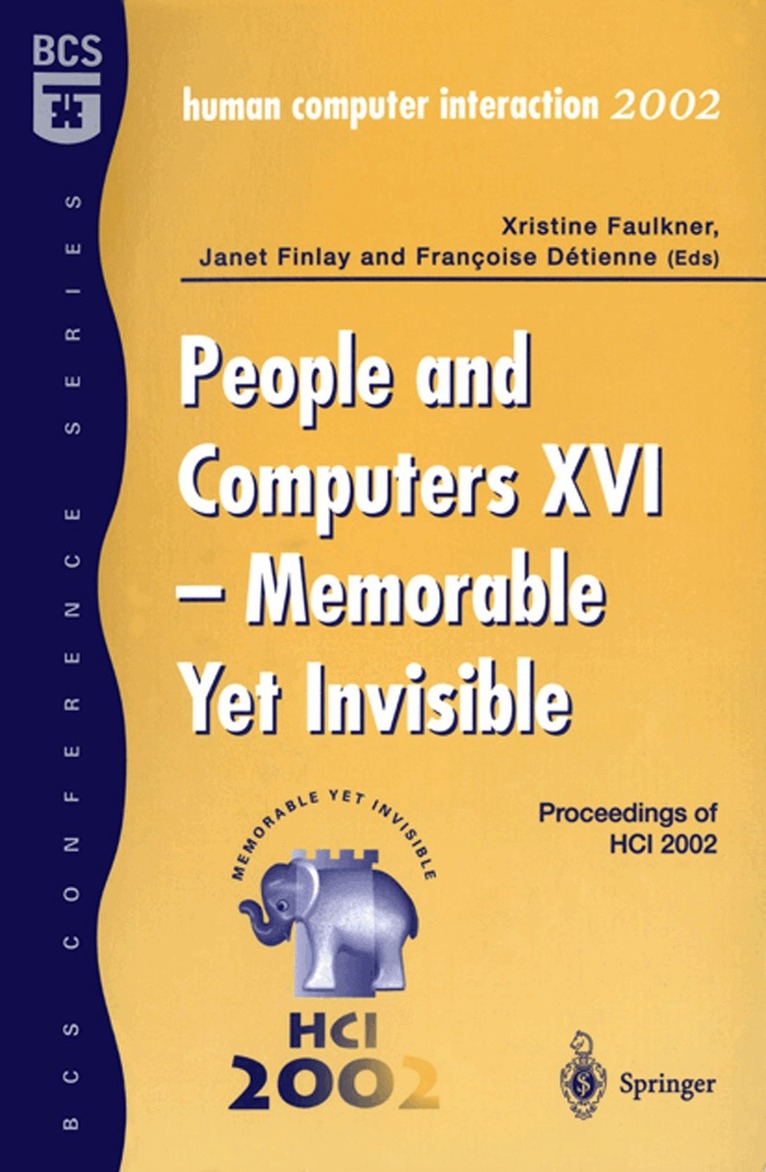
For the last 20 years the dominant form of user interface has been the Graphical User Interface (GUl) with direct manipulation. As software gets more complicated and more and more inexperienced users come into contact with computers, enticed by the World Wide Web and smaller mobile devices, new interface metaphors are required. The increasing complexity of software has introduced more options to the user. This seemingly increased control actually decreases control as the number of options and features available to them overwhelms the users and ''information overload'' can occur (Lachman, 1997). Conversational anthropomorphic interfaces provide a possible alternative to the direct manipulation metaphor. The aim of this paper is to investigate users reactions and assumptions when interacting with anthropomorphic agents. Here we consider how the level of anthropomorphism exhibited by the character and the level of interaction affects these assumptions. We compared characters of different levels of anthropomorphic abstraction, from a very abstract character to a realistic yet not human character. As more software is released for general use with anthropomorphic interfaces there seems to be no consensus of what the characters should look like and what look is more suited for different applications. Some software and research opts for realistic looking characters (for example, Haptek Inc., see http://www.haptek.com). others opt for cartoon characters (Microsoft, 1999) others opt for floating heads (Dohi & Ishizuka, 1997; Takama & Ishizuka, 1998; Koda, 1996; Koda & Maes, 1996a; Koda & Maes, 1996b).
E-bok
PDF, Engelska, 2012708 kr
Läs direkt efter köp
Software Design - Cognitive Aspects covers a variety of areas including software analysis, design, coding and maintenance. It details the history of the research that has been conducted since the 1970s in this fast-developing field before defining a computer program from a computing and cognitive psychology viewpoint. Detailed treatment is given to the two essential sides of programming; software production and software understanding and throughout the book parallels are drawn between studies on processing texts written in natural language and processing computer programs.This book will be of particular interest to researchers, practitioners and graduate students in Computer Science, Cognitive Psychology, and Cognitive Ergonomics.
Häftad, Engelska, 2001
533 kr
Skickas inom 10-15 vardagar
Software Design - Cognitive Aspects covers a variety of areas including software analysis, design, coding and maintenance. It details the history of the research that has been conducted since the 1970s in this fast-developing field before defining a computer program from a computing and cognitive psychology viewpoint. Detailed treatment is given to the two essential sides of programming; software production and software understanding and throughout the book parallels are drawn between studies on processing texts written in natural language and processing computer programs.This book will be of particular interest to researchers, practitioners and graduate students in Computer Science, Cognitive Psychology, and Cognitive Ergonomics.
Häftad, Engelska, 2002
565 kr
Skickas inom 10-15 vardagar
For the last 20 years the dominant form of user interface has been the Graphical User Interface (GUl) with direct manipulation. As software gets more complicated and more and more inexperienced users come into contact with computers, enticed by the World Wide Web and smaller mobile devices, new interface metaphors are required. The increasing complexity of software has introduced more options to the user. This seemingly increased control actually decreases control as the number of options and features available to them overwhelms the users and 'information overload' can occur (Lachman, 1997). Conversational anthropomorphic interfaces provide a possible alternative to the direct manipulation metaphor. The aim of this paper is to investigate users reactions and assumptions when interacting with anthropomorphic agents. Here we consider how the level of anthropomorphism exhibited by the character and the level of interaction affects these assumptions. We compared characters of different levels of anthropomorphic abstraction, from a very abstract character to a realistic yet not human character. As more software is released for general use with anthropomorphic interfaces there seems to be no consensus of what the characters should look like and what look is more suited for different applications. Some software and research opts for realistic looking characters (for example, Haptek Inc., see http://www.haptek.com). others opt for cartoon characters (Microsoft, 1999) others opt for floating heads (Dohi & Ishizuka, 1997; Takama & Ishizuka, 1998; Koda, 1996; Koda & Maes, 1996a; Koda & Maes, 1996b).
Inbunden, Engelska, 1994
2 239 kr
Skickas inom 10-15 vardagar
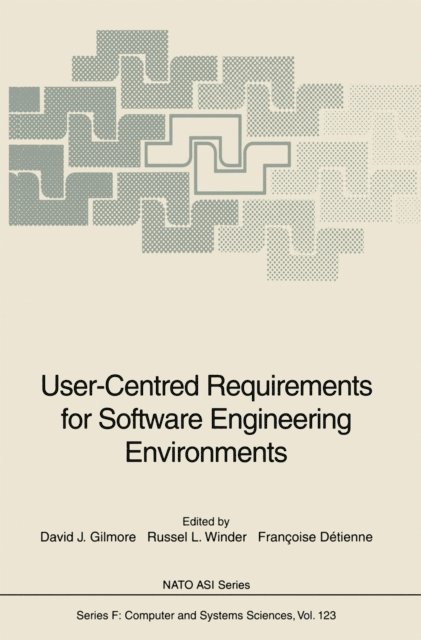
This volume is based on a NATO Advanced Research Workshop on User-Centred Requirements for Software Engineering Environments held in Bonas, France, in September 1991. The workshop was organized in two halves, one dominated by discussion of usability problems in software engineering and the other by discussion of existing solutions to these problems. The papers in the volume are grouped under four themes: - Design activities and representations for design - Code representation and manipulation - Technological solutions - The impact of design methods and new programming paradigms.
Häftad, Engelska, 2010
2 243 kr
Skickas inom 10-15 vardagar
The idea for this workshop originated when I came across and read Martin Zelkowitz's book on Requirements for Software Engineering Environments (the proceedings of a small workshop held at the University of Maryland in 1986). Although stimulated by the book I was also disappointed in that it didn't adequately address two important questions - "Whose requirements are these?" and "Will the environment which meets all these requirements be usable by software engineers?". And thus was the decision made to organise this workshop which would explicitly address these two questions. As time went by setting things up, it became clear that our workshop would happen more than five years after the Maryland workshop and thus, at the same time as addressing the two questions above, this workshop would attempt to update the Zelkowitz approach. Hence the workshop acquired two halves, one dominated by discussion of what we already know about usability problems in software engineering and the other by discussion of existing solutions (technical and otherwise) to these problems. This scheme also provided a good format for bringing together those in the HeI community concerned with the human factors of software engineering and those building tools to solve acknowledged, but rarely understood problems.
E-bok
PDF, Engelska, 20132 925 kr
Läs direkt efter köp
The idea for this workshop originated when I came across and read Martin Zelkowitz''s book on Requirements for Software Engineering Environments (the proceedings of a small workshop held at the University of Maryland in 1986). Although stimulated by the book I was also disappointed in that it didn''t adequately address two important questions - "Whose requirements are these?" and "Will the environment which meets all these requirements be usable by software engineers?". And thus was the decision made to organise this workshop which would explicitly address these two questions. As time went by setting things up, it became clear that our workshop would happen more than five years after the Maryland workshop and thus, at the same time as addressing the two questions above, this workshop would attempt to update the Zelkowitz approach. Hence the workshop acquired two halves, one dominated by discussion of what we already know about usability problems in software engineering and the other by discussion of existing solutions (technical and otherwise) to these problems. This scheme also provided a good format for bringing together those in the HeI community concerned with the human factors of software engineering and those building tools to solve acknowledged, but rarely understood problems.