• Fri frakt över 249 kr
  • •
  • Snabba leveranser
  • •
  • Billiga böcker
Kundservice

Du är på sajten för privatpersoner.

Företag, bibliotek eller offentlig verksamhet?

Du handlar på classic.bokus.com, där alla dina funktioner finns intakta.
Till classic.bokus.com
Bokus logotyp. Gå till startsidan.
  • Erbjudanden
  • Nyheter
  • Student
  • Topplistor
  • Barn & ungdom
  • Bokus Play
  • E-böcker
  • Pocketböcker
  • Spel & pussel

10% rabatt på allt med kod: NYSTART10 →

Sidfot

Mina sidor

    Hjälp

    • Kundservice
    • Vanliga frågor och svar
    • Frakt och leverans
    • Retur vid ångerrätt
    • Reklamera vara
    • Betalning
    • Köpvillkor
    • Allmänna villkor
    • Information om webbplatsens tillgänglighet

    Om Bokus

    • Om oss
    • Pressrum
    • För studenter
    • För företag
    • För bibliotek och offentlig verksamhet
    • För leverantörer
    • Hållbarhet

    Populärt

    • Aktuella erbjudanden
    • Presentkort
    • Studentlitteratur
    • Nya böcker
    • Topplistor
    • Signerade böcker
    • Engelska böcker

    Inspiration

    • Boktips
    • BookTok
    • Populära bokserier
    • Barnbokskaraktärer
    • Populära författare
    Logotyp för Bokus
    Följ oss på Facebook (extern länk)Följ oss på Instagram (extern länk)Följ oss på YouTube (extern länk)Följ oss på TikTok (extern länk)
    bokus @ CookiesAnpassa cookiesIntegritetspolicyKöpvillkor
    Till Citymail hemsida (extern länk)Till Budbee hemsida (extern länk)Till Postnord hemsida (extern länk)Till Schenker hemsida (extern länk)Till Early Bird hemsida (extern länk)Till Walleys hemsida (extern länk)
    1. Data och IT
    2. Människa – datorinteraktion

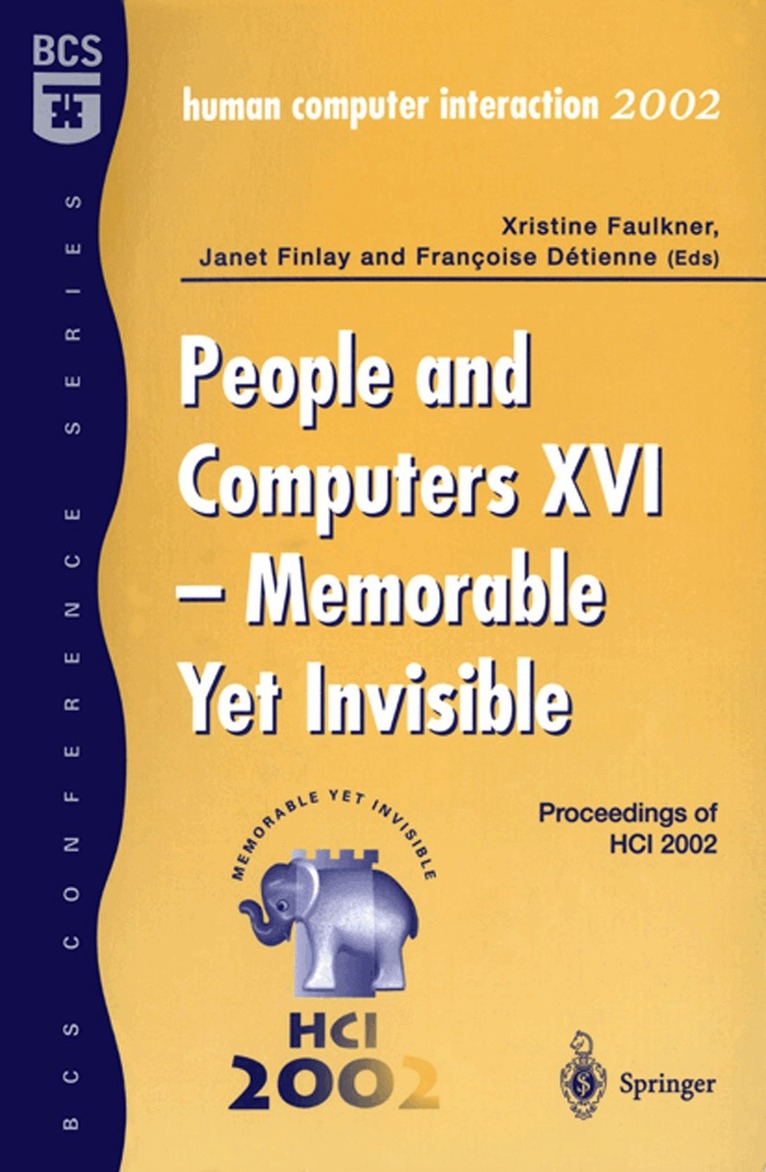
    People and Computers XVI - Memorable Yet Invisible

    Proceedings of HCI 2002

    AvXristine Faulkner,Janet Finlay

    Häftad, Engelska, 2002

    563 kr

    Beställningsvara. Skickas inom 10-15 vardagar. Fri frakt över 249 kr.

    Beskrivning

    For the last 20 years the dominant form of user interface has been the Graphical User Interface (GUl) with direct manipulation. As software gets more complicated and more and more inexperienced users come into contact with computers, enticed by the World Wide Web and smaller mobile devices, new interface metaphors are required. The increasing complexity of software has introduced more options to the user. This seemingly increased control actually decreases control as the number of options and features available to them overwhelms the users and 'information overload' can occur (Lachman, 1997). Conversational anthropomorphic interfaces provide a possible alternative to the direct manipulation metaphor. The aim of this paper is to investigate users reactions and assumptions when interacting with anthropomorphic agents. Here we consider how the level of anthropomorphism exhibited by the character and the level of interaction affects these assumptions. We compared characters of different levels of anthropomorphic abstraction, from a very abstract character to a realistic yet not human character. As more software is released for general use with anthropomorphic interfaces there seems to be no consensus of what the characters should look like and what look is more suited for different applications. Some software and research opts for realistic looking characters (for example, Haptek Inc., see http://www.haptek.com). others opt for cartoon characters (Microsoft, 1999) others opt for floating heads (Dohi & Ishizuka, 1997; Takama & Ishizuka, 1998; Koda, 1996; Koda & Maes, 1996a; Koda & Maes, 1996b).

    Produktinformation

    • Utgivningsdatum:2002-08-01
    • Mått:155 x 235 x 24 mm
    • Vikt:663 g
    • Format:Häftad
    • Språk:Engelska
    • Antal sidor:422
    • Förlag:Springer London Ltd
    • ISBN:9781852336592

    Utforska kategorier

    • Människa – datorinteraktion inom Data och IT
    • Artificiell intelligens inom Data och IT

    Innehållsförteckning

    • Keynotes.- Fun, Communication and Dependability: Extending the Concept of Usability.- Anthropomorphism.- Invisible but Audible: Enhancing Information Awareness through Anthropomorphic Speech.- User Perception of Anthropomorphic Characters with Varying Levels of Interaction.- CSCW.- A Tool for Performing and Analysing Experiments on Graphical Communication.- A Comparison of Text Messaging and Email Support for Digital Communities: A Case Study.- An Affordance-based Framework for CVE Evaluation.- Extending Low-cost Remote Evaluation with Synchronous Communication.- Impedance Matching: When You Need to Know What.- Multiple Viewpoints on Computer Supported Team Work: A Case Study on Ambulance Dispatch.- Design Process.- Pattern Languages in Participatory Design.- Provoking Innovation: Acting-out in Contextual Scenarios.- Haptic Interfaces.- Guidelines for the Design of Haptic Widgets.- Multi-session VR Medical Training: The HOPS Simulator.- Memorable Systems.- An Investigation of Memory for Daily Computing Events.- How People Recognise Previously Seen Web Pages from Titles, URLs and Thumbnails.- MATI: A System for Accessing Travel Itinerary Information using Mobile Phones.- User Interface Design as Systems Design.- Usability.- A Comparison of Think-aloud, Questionnaires and Interviews for Testing Usability with Children.- An Eye Movement Analysis of Web Page Usability.- Auditory Emotional Feedback Facilitates Human-Computer Interaction.- Navigation in the Software Development Information Space.- Selecting the ‘Invisible’ User Interface Development Tool.- VE and Games.- Non-Verbal Communication Forms in Multi-player Game Session.- Support Robots for Playing Games: The Role of Player-Actor Relationship.- Author Index.- Keyword Index.