Françoise Montambeault - Böcker
Visar alla böcker från författaren Françoise Montambeault. Handla med fri frakt och snabb leverans.
5 produkter
5 produkter
448 kr
Kommande
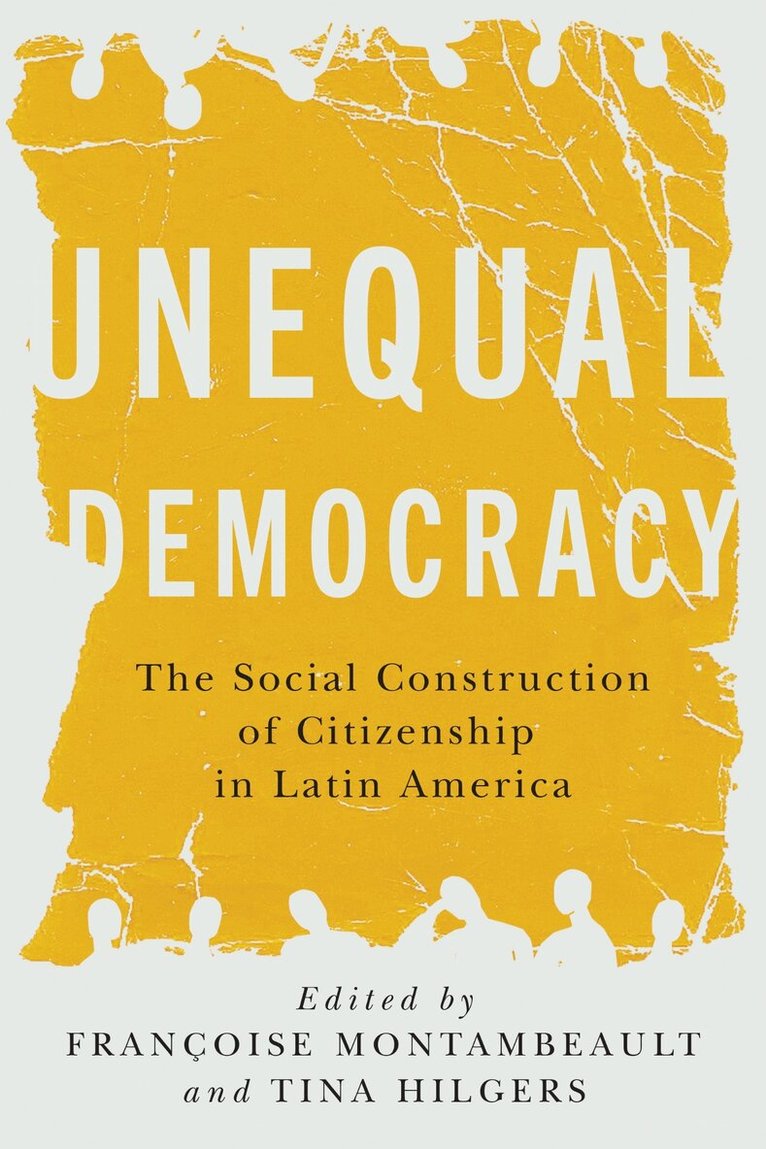
Across the world populist leaders are mobilizing citizens increasingly frustrated with political institutions and market outcomes, while analysts struggle to explain where liberal democracy has gone wrong. Unequal Democracy traces the roots of this dissatisfaction, arguing that persistent inequality and polarization constrain citizenship, weaken participation, and undermine democratic governance. Drawing on lessons from Latin America, long central to scholarship on democratic formation and breakdown, the volume uses these insights to make sense of the contemporary crisis.Inspired by Philip Oxhorn’s work on civil society and citizenship, the book presents case studies from Argentina and Chile, Mexico, Paraguay and Guatemala, Peru, the United States, Egypt and Syria, and South Africa. Contributors explore how social movements engage political parties; how marginalized groups gain access to social policy; how media and immigration shape political inclusion; and how states manage inequality, including through policing. Collectively, they identify the failure to extend citizenship beyond formal political rights to civil and social rights, necessary for equal participation.Reaffirming that neopluralism deepens inequality, fuels polarization, and weakens democracy, this thought-provoking work foregrounds the heterogeneity of civil society and contends that democratic progress is more likely to emerge through institutional adaptation than sweeping collective mobilization.
Legacies of the Left Turn in Latin America
The Promise of Inclusive Citizenship
Inbunden, Engelska, 2020
665 kr
Skickas inom 10-15 vardagar
Legacies of the Left Turn in Latin America: The Promise of Inclusive Citizenship contains original essays by a diverse group of leading and emerging scholars from North America, Europe, and Latin America. The book speaks to wide-ranging debates on democracy, the left, and citizenship in Latin America. What were the effects of a decade and a half of left and center-left governments? The central purpose of this book is to evaluate both the positive and negative effects of the Left turn on state-society relations and inclusion.Promises of social inclusion and the expansion of citizenship rights were paramount to the center-left discourses upon the factions' arrival to power in the late 1990s and early 2000s. This book is a first step in understanding to what extent these initial promises were or were not fulfilled, and why. In analyzing these issues, the authors demonstrate that these years yield both signs of progress in some areas and the deepening of historical problems in others. The contributors to this book reveal variation among and within countries, and across policy and issue areas such as democratic institution reforms, human rights, minorities' rights, environmental questions, and violence. This focus on issues rather than countries distinguishes the book from other recent volumes on the left in Latin America, and the book will speak to a broad and multi-dimensional audience, both inside and outside the academic world.Contributors: Manuel Balán, Françoise Montambeault, Philip Oxhorn, Maxwell A. Cameron, Kenneth M. Roberts, Nathalia Sandoval-Rojas, Daniel M. Brinks, Benjamin Goldfrank, Roberta Rice, Elizabeth Jelin, Celina Van Dembroucke, Nora Nagels, Merike Blofield, Jordi Díez, Eve Bratman, Gabriel Kessler, Olivier Dabène, Jared Abbott, Steve Levitsky
616 kr
Skickas inom 10-15 vardagar
Since the 1960s, participatory discourses and techniques have been at the core of decision making processes in a variety of sectors around the world – a phenomenon often referred to as the participatory turn. Over the years, this participatory turn has given birth to a large array of heterogeneous participatory practices developed by a wide variety of organizations and groups, as well as by governments. Among the best-known practices of citizen participation are participatory budgeting, citizen councils, public consultations, etc. However, these experiences are sometimes far from the original 1960s’ radical conception of participatory democracy, which had a transformative dimension and aimed to overcome unequal relationships between the state and society and emancipate and empower citizens in their daily lives. This book addresses four sets of questions: what do participatory practices mean today?; what does it mean to participate for participants, from the perspective of citizenship building?; how the processes created by the participatory turn have affected the way political representation functions?; and does the participatory turn also mean changing relationships and dynamics among civil servants, political representatives, and citizens? Overall, the contributions in this book illustrate and grasp the complexity of the so-called participatory turn. It shows that the participatory turn now includes several participatory democracy projects, which have different effects on the overall system depending on the principles that they advocate. This book was originally published as a special issue of the Journal of Civil Society.
Politics of Local Participatory Democracy in Latin America
Institutions, Actors, and Interactions
Inbunden, Engelska, 2015
794 kr
Skickas inom 7-10 vardagar
Participatory democracy innovations aimed at bringing citizens back into local governance processes are now at the core of the international democratic development agenda. Municipalities around the world have adopted local participatory mechanisms of various types in the last two decades, including participatory budgeting, the flagship Brazilian program, and participatory planning, as it is the case in several Mexican municipalities. Yet, institutionalized participatory mechanisms have had mixed results in practice at the municipal level. So why and how does success vary? This book sets out to answer that question.Defining democratic success as a transformation of state-society relationships, the author goes beyond the clientelism/democracy dichotomy and reveals that four types of state-society relationships can be observed in practice: clientelism, disempowering co-option, fragmented inclusion, and democratic cooperation. Using this typology, and drawing on the comparative case study of four cities in Mexico and Brazil, the book demonstrates that the level of democratic success is best explained by an approach that accounts for institutional design, structural conditions of mobilization, and the configurations, strategies, behaviors, and perceptions of both state and societal actors.Thus, institutional change alone does not guarantee democratic success: the way these institutional changes are enacted by both political and social actors is even more important as it conditions the potential for an autonomous civil society to emerge and actively engage with the local state in the social construction of an inclusive citizenship.
2 103 kr
Skickas inom 10-15 vardagar
Since the 1960s, participatory discourses and techniques have been at the core of decision making processes in a variety of sectors around the world – a phenomenon often referred to as the participatory turn. Over the years, this participatory turn has given birth to a large array of heterogeneous participatory practices developed by a wide variety of organizations and groups, as well as by governments. Among the best-known practices of citizen participation are participatory budgeting, citizen councils, public consultations, etc. However, these experiences are sometimes far from the original 1960s’ radical conception of participatory democracy, which had a transformative dimension and aimed to overcome unequal relationships between the state and society and emancipate and empower citizens in their daily lives. This book addresses four sets of questions: what do participatory practices mean today?; what does it mean to participate for participants, from the perspective of citizenship building?; how the processes created by the participatory turn have affected the way political representation functions?; and does the participatory turn also mean changing relationships and dynamics among civil servants, political representatives, and citizens? Overall, the contributions in this book illustrate and grasp the complexity of the so-called participatory turn. It shows that the participatory turn now includes several participatory democracy projects, which have different effects on the overall system depending on the principles that they advocate. This book was originally published as a special issue of the Journal of Civil Society.