Tina Hilgers - Böcker
Visar alla böcker från författaren Tina Hilgers. Handla med fri frakt och snabb leverans.
3 produkter
3 produkter
448 kr
Kommande
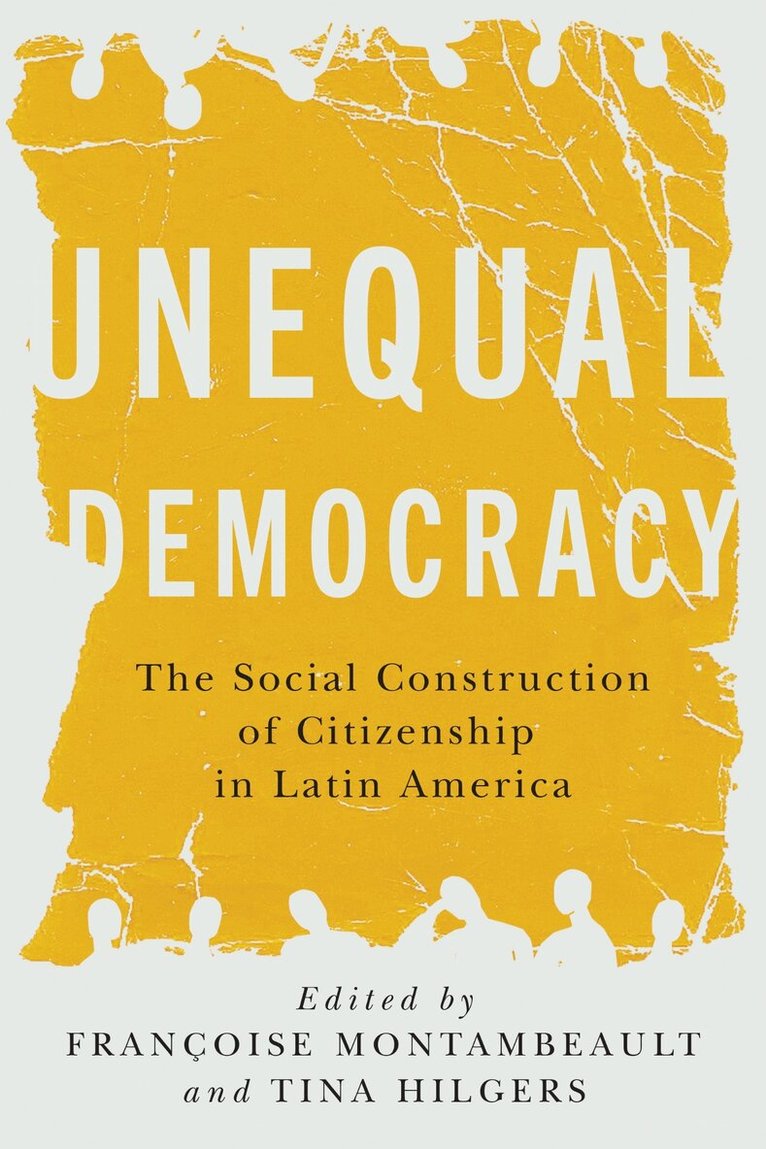
Across the world populist leaders are mobilizing citizens increasingly frustrated with political institutions and market outcomes, while analysts struggle to explain where liberal democracy has gone wrong. Unequal Democracy traces the roots of this dissatisfaction, arguing that persistent inequality and polarization constrain citizenship, weaken participation, and undermine democratic governance. Drawing on lessons from Latin America, long central to scholarship on democratic formation and breakdown, the volume uses these insights to make sense of the contemporary crisis.Inspired by Philip Oxhorn’s work on civil society and citizenship, the book presents case studies from Argentina and Chile, Mexico, Paraguay and Guatemala, Peru, the United States, Egypt and Syria, and South Africa. Contributors explore how social movements engage political parties; how marginalized groups gain access to social policy; how media and immigration shape political inclusion; and how states manage inequality, including through policing. Collectively, they identify the failure to extend citizenship beyond formal political rights to civil and social rights, necessary for equal participation.Reaffirming that neopluralism deepens inequality, fuels polarization, and weakens democracy, this thought-provoking work foregrounds the heterogeneity of civil society and contends that democratic progress is more likely to emerge through institutional adaptation than sweeping collective mobilization.
Violence in Latin America and the Caribbean
Subnational Structures, Institutions, and Clientelistic Networks
Inbunden, Engelska, 2017
1 271 kr
Skickas inom 7-10 vardagar
Violence in Latin America and the Caribbean is no longer perpetrated primarily by states against their citizens, but by a variety of state and non-state actors struggling to control resources, territories, and populations. This book examines violence at the subnational level to illuminate how practices of violence are embedded within subnational configurations of space and clientelistic networks. In societies shaped by centuries of violence and exclusion, inequality and marginalization prevail at the same time that democratization and neoliberalism have decentralized power to regional and local levels, where democratic and authoritarian practices coexist. Within subnational arenas, unique configurations - of historical legacies, economic structures, identities, institutions, actors, and clientelistic networks - result in particular patterns of violence and vulnerability that are often strikingly different from what is portrayed by aggregate national-level statistics. The chapters of this book examine critical cases from across the region, drawing on new primary data collected in the field to analyze how a range of political actors and institutions shape people's lives and to connect structural and physical forms of violence.
Violence in Latin America and the Caribbean
Subnational Structures, Institutions, and Clientelistic Networks
Häftad, Engelska, 2019
414 kr
Skickas inom 7-10 vardagar
Violence in Latin America and the Caribbean is no longer perpetrated primarily by states against their citizens, but by a variety of state and non-state actors struggling to control resources, territories, and populations. This book examines violence at the subnational level to illuminate how practices of violence are embedded within subnational configurations of space and clientelistic networks. In societies shaped by centuries of violence and exclusion, inequality and marginalization prevail at the same time that democratization and neoliberalism have decentralized power to regional and local levels, where democratic and authoritarian practices coexist. Within subnational arenas, unique configurations - of historical legacies, economic structures, identities, institutions, actors, and clientelistic networks - result in particular patterns of violence and vulnerability that are often strikingly different from what is portrayed by aggregate national-level statistics. The chapters of this book examine critical cases from across the region, drawing on new primary data collected in the field to analyze how a range of political actors and institutions shape people's lives and to connect structural and physical forms of violence.